
Listen to this Post
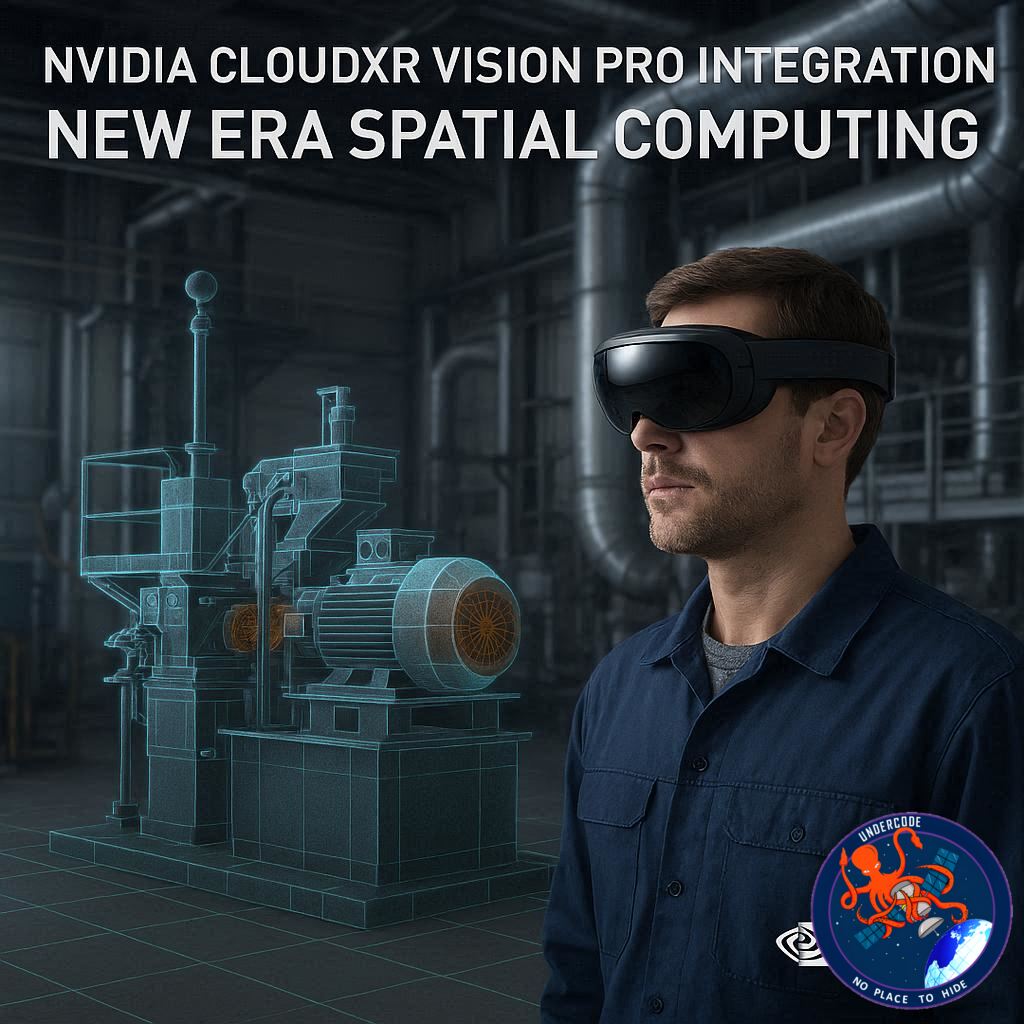
Introduction: The Convergence of Cloud Graphics and Spatial Computing
The race toward immersive computing has entered a new phase as two major technology ecosystems move closer together. The integration of NVIDIA’s CloudXR streaming technology with Apple Vision Pro signals a major step forward for spatial computing, unlocking workflows that once required massive local hardware setups. Announced during the annual NVIDIA GTC conference in San Jose, the collaboration introduces a powerful combination of cloud-rendered graphics and next-generation mixed-reality hardware.
With CloudXR 6.0 now natively supported by visionOS, Apple Vision Pro can stream extremely high-fidelity 3D environments from powerful RTX systems located on local workstations or remote cloud infrastructure. This development enables industries such as automotive design, healthcare, manufacturing, and simulation gaming to interact with complex digital environments at unprecedented realism. Instead of simplifying datasets or reducing visual quality to fit mobile hardware limitations, professionals can now experience full-scale models with cinematic graphics directly through a lightweight headset.
The implications extend far beyond entertainment. Companies can now build digital twins of factories, simulate pharmaceutical labs before construction, or collaborate globally on vehicle design reviews without the need for expensive on-site visualization infrastructure. The integration effectively merges spatial computing hardware with enterprise-grade cloud graphics processing, redefining what immersive computing can achieve in professional environments.
Spatial Computing Workflows Now Streamed From the Cloud
Spatial computing relies on blending digital objects with the physical world in real time, creating environments where users can interact naturally with complex virtual data. The integration of NVIDIA CloudXR with Apple Vision Pro provides the technical foundation to support this workflow at scale.
CloudXR allows heavy graphics workloads to run on powerful GPU systems equipped with NVIDIA RTX technology while streaming the resulting visuals to the headset with minimal latency. This eliminates the need for headsets to perform all rendering locally. Instead, users receive high-resolution frames streamed from RTX-powered machines located in data centers, offices, or cloud environments.
The result is a seamless experience that delivers photorealistic graphics, responsive interactions, and large-scale 3D models without compromising device mobility.
Foveated Streaming Enhances Performance and Privacy
A major innovation introduced in this integration is dynamic foveated streaming. This technique focuses the highest rendering resolution on the area where the user is looking, while reducing resolution in peripheral regions. The approach significantly improves performance and bandwidth efficiency.
visionOS now supports this feature directly, enabling CloudXR to deliver 4K-level immersive visuals while maintaining smooth responsiveness. At the same time, Apple maintains strict privacy protection by ensuring that gaze data is not exposed to applications. The system only transmits approximate focus information necessary for rendering optimization.
This balance between performance and privacy represents an important step in making immersive technologies suitable for enterprise and professional environments.
Enterprise Applications Expand Across Multiple Industries
Several major technology and industrial partners are already building applications using this new integration. Software providers such as Autodesk, Synopsys, Trifork, and Innoactive are delivering immersive tools optimized for Vision Pro through CloudXR.
These tools allow enterprises to explore massive datasets, digital twins, and real-time simulations without reducing detail or simplifying geometry.
Large companies including Roche, Foxconn, and Switch are already experimenting with these capabilities. Their use cases range from simulating pharmaceutical laboratory layouts to exploring factory environments and monitoring large-scale data center infrastructure.
Automotive Design Reviews Enter a New Dimension
One of the most transformative applications lies in automotive design. Engineers and designers traditionally rely on expensive visualization labs or physical prototypes to review new vehicle models.
With tools like Autodesk VRED streamed through CloudXR, companies can visualize full-scale vehicle models inside Apple Vision Pro with RTX-powered ray tracing. Designers can examine materials, surfaces, lighting, and proportions at a 1:1 scale while collaborating with colleagues located anywhere in the world.
Automotive companies including BMW Group, Kia, Rivian, and Volvo Group are already integrating these tools into their design processes.
The ability to explore high-fidelity models without physical prototypes dramatically accelerates product development timelines.
Industrial Digital Twins and Factory Planning
Manufacturing companies are also leveraging spatial computing to simulate facilities before construction begins.
For example, Foxconn is using CloudXR-powered spatial computing to walk through virtual factory floors before building them. Engineers can inspect layouts, identify bottlenecks, and optimize workflow design inside a virtual environment.
Meanwhile, data-center provider Switch is demonstrating a digital twin of its AI factories using NVIDIA’s simulation ecosystem. Operators can navigate entire data center infrastructures in immersive environments, analyzing cooling systems, server placements, and power distribution.
This approach enables organizations to identify design flaws long before construction or deployment begins.
Simulation Enthusiasts Gain Ultra-Realistic Experiences
Although enterprise use cases dominate the discussion, the integration also benefits simulation enthusiasts and gaming communities.
High-fidelity simulation titles such as iRacing and X‑Plane can now stream RTX-powered graphics directly to Apple Vision Pro. This setup transforms the headset into a high-end simulation cockpit capable of delivering uncompromised 4K visuals.
For racing or aviation enthusiasts, the experience closely replicates professional training simulators, with immersive environments rendered remotely on powerful GPUs.
Developer Ecosystem Expands With Native Support
CloudXR 6.0 is now available as a native streaming framework for Swift developers. This allows engineers to build and stream XR applications directly within Xcode.
Because Swift supports multiple Apple platforms including iOS, iPadOS, and visionOS, developers can create immersive spatial applications that scale across the entire Apple ecosystem.
This move dramatically lowers the barrier for building advanced XR experiences and expands the developer community capable of creating enterprise-grade immersive applications.
What Undercode Say:
The integration between NVIDIA CloudXR and Apple Vision Pro represents something larger than a simple feature upgrade. It reflects a deeper transformation in how computing power is delivered to immersive devices.
For years, XR hardware struggled with a fundamental limitation: local processing power. Headsets were forced to balance battery life, heat generation, and graphics capability. That limitation prevented many industries from adopting XR for real work. Designers had to compress assets, engineers had to simplify simulations, and enterprises had to invest in expensive on-site visualization clusters.
CloudXR fundamentally changes that equation.
By moving the rendering workload to RTX-powered systems, the headset becomes more like a window into a remote supercomputer. This architecture mirrors the evolution of cloud gaming and remote workstations, but applied to spatial computing.
The real strategic shift here lies in industrial adoption.
When companies like BMW, Foxconn, or Roche invest in immersive visualization pipelines, they are not simply experimenting with VR headsets. They are redesigning how products are conceived, tested, and validated.
Digital twins represent one of the most powerful examples. Instead of building expensive physical prototypes or infrastructure mockups, companies can simulate entire environments in real time. Factories, laboratories, vehicles, and even data centers can exist as interactive digital systems before the first physical component is built.
This approach dramatically reduces costs and development cycles.
Another key factor is collaboration.
Traditional design reviews often require teams to travel to centralized facilities equipped with specialized visualization hardware. With spatial streaming, engineers in different countries can explore the same virtual object simultaneously, each wearing a headset connected to the same cloud-rendered environment.
This turns immersive design into a distributed workflow rather than a location-dependent event.
Apple’s involvement also carries strategic significance.
The Vision Pro has positioned itself as a premium spatial computing platform rather than a gaming headset. Integrating enterprise-grade streaming from NVIDIA reinforces that positioning and strengthens Apple’s push toward professional and industrial users.
Meanwhile, NVIDIA continues expanding beyond GPUs into infrastructure platforms for AI, simulation, and digital twins.
The partnership effectively combines Apple’s interface and hardware design with NVIDIA’s graphics and simulation ecosystem. Together they create a pipeline where massive datasets can be visualized instantly through spatial interfaces.
Looking ahead, this architecture may eventually evolve into a standard computing model. Instead of local devices running heavy software, users could access powerful remote computing environments through lightweight spatial interfaces.
If that vision becomes reality, spatial computing may become the next major platform after smartphones and laptops.
Fact Checker Results
✅ NVIDIA officially announced CloudXR integration with Apple Vision Pro during the NVIDIA GTC.
✅ CloudXR allows RTX-powered workstations or cloud systems to stream high-fidelity XR content to devices like Vision Pro.
❌ Apple Vision Pro itself does not perform all heavy rendering locally when using CloudXR, the workload is streamed from external RTX systems.
Prediction
🔮 Spatial computing platforms will increasingly rely on cloud rendering rather than local processing.
🔮 Industrial sectors such as automotive design, factory planning, and healthcare simulation will adopt XR workflows faster than consumer markets.
🔮 Partnerships between companies like Apple and NVIDIA may define the next generation of remote visualization and digital-twin infrastructure.
▶️ Related Video (74% Match):
🕵️📝✔️Let’s dive deep and fact‑check.
References:
Reported By: blogs.nvidia.com
Extra Source Hub (Possible Sources for article):
https://www.facebook.com
Wikipedia
OpenAi & Undercode AI
Image Source:
Unsplash
Undercode AI DI v2
Bing
🔐JOIN OUR CYBER WORLD [ CVE News • HackMonitor • UndercodeNews ]
📢 Follow UndercodeNews & Stay Tuned:
𝕏 formerly Twitter 🐦 | @ Threads | 🔗 Linkedin | 🦋BlueSky | 🐘Mastodon


