
Listen to this Post
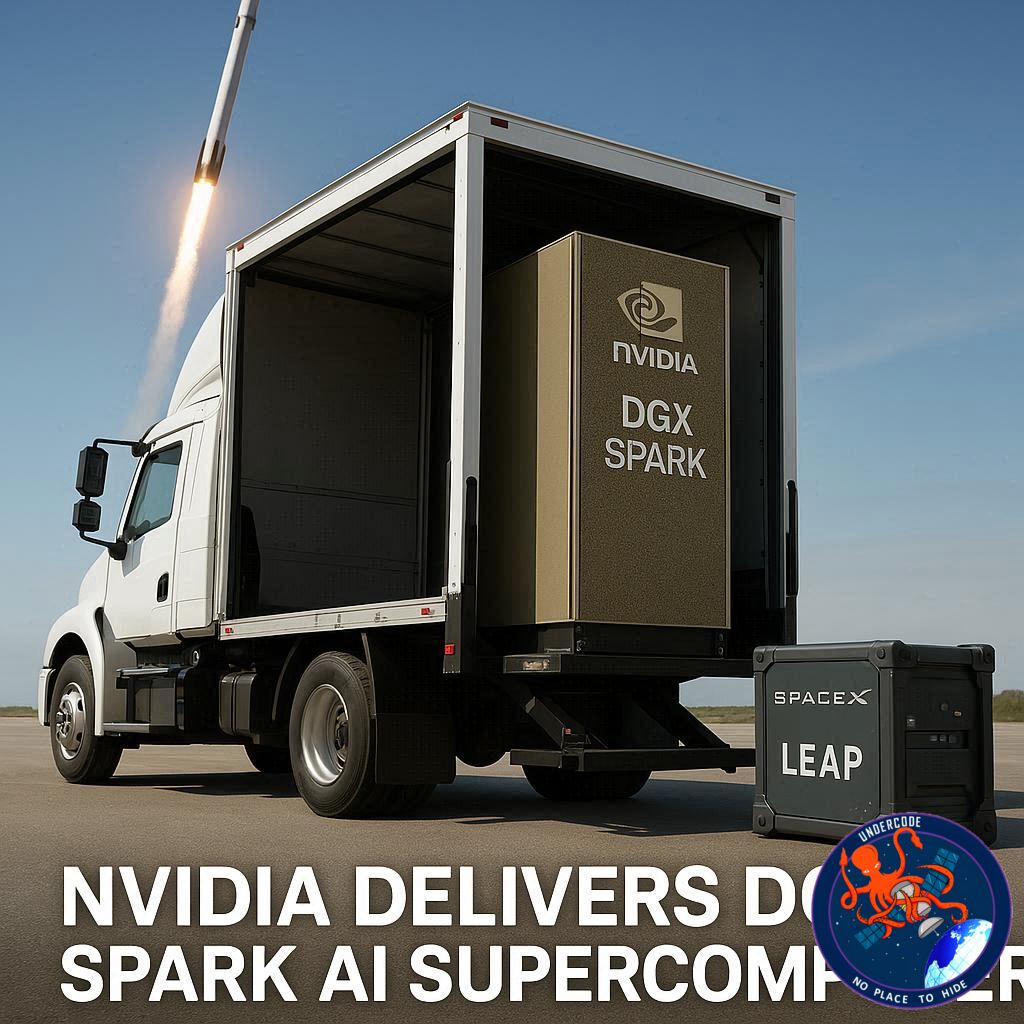
In a striking convergence of technology giants, Nvidia’s founder and CEO Jensen Huang personally delivered the company’s latest DGX Spark AI supercomputer to Elon Musk at SpaceX’s Starbase facility in Texas. This extraordinary meeting, set against the backdrop of SpaceX’s 11th Starship rocket test, symbolizes the bridging of cutting-edge AI computing with revolutionary space exploration. Huang described the moment as “delivering the smallest supercomputer next to the biggest rocket,” highlighting both the scale and ambition of this collaboration.
A Historic Moment at Starbase
Jensen Huang arrived at SpaceX’s Starbase, surrounded by engineers and staff, and met Elon Musk in the facility’s cafeteria. During their exchange, Huang recounted Nvidia’s early collaboration with OpenAI and explained how the new DGX Spark system advances that mission further. The discussion underscored the growing importance of high-performance AI computing in pushing the boundaries of research, creativity, and technological exploration.
The timing of the visit, just before the 11th Starship test flight, added symbolic weight. It was a literal intersection of AI and space innovation: a portable AI supercomputer standing beside the colossal engineering marvel of the Starship rocket. This convergence emphasizes how AI is increasingly becoming a critical tool in industries once considered purely mechanical or aerospace-driven.
What is the Nvidia DGX Spark
The DGX Spark is a compact but extraordinarily powerful AI supercomputer. Despite its small size of approximately 1.2 kilograms, it delivers up to 1 petaflop of performance, making it a formidable tool for developers, researchers, and creators who need computing capabilities that surpass traditional data centers.
Key features of DGX Spark include:
Nvidia GB10 Grace Blackwell Superchip for accelerated AI processing
128GB unified memory for smooth model training and inference
Nvidia ConnectX networking and NVLink-C2C for rapid data transfer
NVMe storage and HDMI output for direct visualization
It also comes preloaded with Nvidia’s comprehensive AI software stack, including frameworks, libraries, pretrained models, and NIM microservices. This allows users to build advanced AI applications locally, from chatbots to vision agents and creative tools.
To expand its reach, Nvidia partnered with global hardware leaders like Acer, ASUS, Dell Technologies, HP, Lenovo, GIGABYTE, and MSI, enabling the creation of AI-ready workstations from standard desktops. Early adopters range from academic institutions such as NYU Global Frontier Lab and Arizona State University to creative hubs like Refik Anadol’s studio and AI startups including Ollama and Zipline.
The DGX Spark will be available globally starting October 15 through Nvidia’s official website and partner channels, marking a major milestone in accessible, high-performance AI computing.
What Undercode Say:
The Nvidia DGX Spark represents more than just a technological product—it embodies a shift in how AI power is distributed and applied. Traditionally, supercomputing required centralized, highly specialized infrastructure. DGX Spark, however, is designed to decentralize that power, allowing individual labs, startups, and creative professionals to access AI capabilities previously reserved for large institutions.
Delivering the DGX Spark to SpaceX is also deeply symbolic. Space exploration generates enormous amounts of data—from rocket telemetry to simulations of orbital mechanics. With AI systems like DGX Spark, organizations like SpaceX can process and analyze these datasets more efficiently, potentially accelerating innovations in spacecraft design, navigation, and mission planning.
Moreover, the portability of DGX Spark is a game-changer. Weighing just over a kilogram yet offering one petaflop of computational power, it challenges conventional assumptions about the size and scale required for serious AI work. This could democratize AI in fields ranging from research and education to creative arts, where high-end computing has previously been inaccessible.
The collaboration also underscores the growing intersection of AI and industry leaders. Nvidia’s early involvement with OpenAI set the stage for such partnerships, but delivering DGX Spark to Elon Musk signals a bold move: supercomputing is no longer confined to labs—it is moving into dynamic, high-stakes environments where innovation occurs at speed and scale.
DGX Spark’s preloaded software stack enhances this impact, enabling immediate application of AI models without extensive setup. This lowers barriers to entry for AI experimentation, fostering rapid prototyping in both academic and commercial contexts. The partnerships with global hardware manufacturers further indicate a strategic approach to making AI ubiquitous—transforming ordinary desktops into powerful AI workstations.
From an economic perspective, the DGX Spark also represents a new model for AI adoption. Rather than investing in massive centralized data centers, organizations can deploy smaller, highly efficient systems locally, saving on operational costs while increasing computational flexibility.
Culturally, this move also resonates with the broader narrative of human ingenuity. Placing a supercomputer next to a rocket symbolizes a union of intellect and ambition, computation and exploration, and technology and imagination. It hints at a future where AI not only supports but accelerates humanity’s reach beyond Earth.
Fact Checker Results
✅ DGX Spark is a compact AI supercomputer delivering up to 1 petaflop of performance.
✅ Nvidia delivered DGX Spark to SpaceX’s Starbase ahead of the 11th Starship rocket test.
❌ There is no evidence that DGX Spark is limited to SpaceX; it is available globally starting October 15.
Prediction
🚀 Nvidia’s DGX Spark will accelerate the adoption of AI in aerospace, research, and creative industries, turning compact supercomputers into indispensable tools.
📊 As more organizations integrate portable AI systems, the traditional centralization of AI power will shift toward decentralized, accessible computing models.
💡 We can expect future collaborations between AI companies and high-tech innovators like SpaceX to drive breakthroughs that merge physical and digital frontiers in ways previously unimaginable.
🕵️📝✔️Let’s dive deep and fact‑check.
References:
Reported By: timesofindia.indiatimes.com
Extra Source Hub (Possible Sources for article):
https://www.twitter.com
Wikipedia
OpenAi & Undercode AI
Image Source:
Unsplash
Undercode AI DI v2
Bing
🔐JOIN OUR CYBER WORLD [ CVE News • HackMonitor • UndercodeNews ]
📢 Follow UndercodeNews & Stay Tuned:
𝕏 formerly Twitter 🐦 | @ Threads | 🔗 Linkedin | 🦋BlueSky | 🐘Mastodon


