Listen to this Post
🎯 Introduction
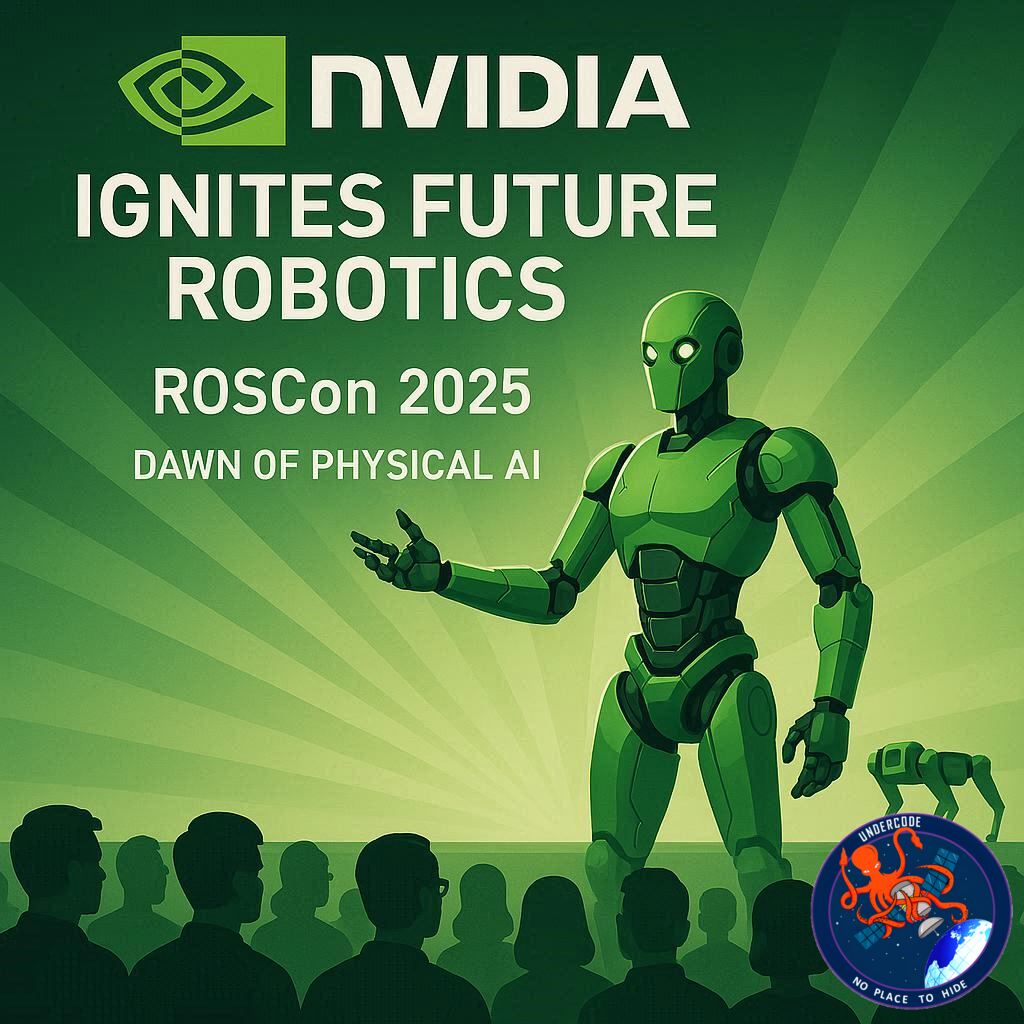
In a world racing toward autonomy, intelligence, and precision, robotics has become the frontier of innovation. This year, all eyes turned to Singapore as the global robotics community gathered for ROSCon 2025, the annual conference celebrating the open-source Robot Operating System (ROS). Known as the heart of modern robotics, ROS is where developers, researchers, and companies converge to shape the future of intelligent machines. And leading the charge once again is NVIDIA, unveiling a new wave of open-source tools, accelerated AI models, and collaborations designed to redefine what robots can see, think, and do.
Global Robotics Revolution Unfolds at ROSCon 2025
The ROSCon 2025 conference in Singapore marked a turning point in robotics evolution. Bringing together the global developer community behind Robot Operating System (ROS) — the world’s most widely used open-source framework for robotics — the event became a showcase for technological breakthroughs and powerful collaborations.
NVIDIA made some of the most talked-about announcements, revealing deep partnerships with the Open Source Robotics Alliance (OSRA) and several key players across the robotics ecosystem. One of the highlights was NVIDIA’s support for OSRA’s Physical AI Special Interest Group, a new initiative targeting real-time control, accelerated AI processing, and advanced tools for autonomous behavior. This collaboration underscores a growing movement toward standardizing robotics performance under open, high-speed frameworks like ROS 2.
At the technical core of NVIDIA’s contribution lies a major upgrade: GPU-aware abstractions integrated directly into ROS 2. This enhancement allows ROS to intelligently manage computing workloads across CPUs, integrated GPUs, and discrete GPUs, ensuring consistent high-speed performance across diverse platforms. The move effectively future-proofs the ROS ecosystem, aligning it with the rapid evolution of hardware acceleration technologies.
NVIDIA also introduced Greenwave Monitor, an open-source diagnostic tool designed to help developers quickly detect and fix performance bottlenecks in robotic systems. By enabling smoother debugging and optimization, Greenwave Monitor is set to significantly reduce development time for robotics teams worldwide.
Expanding its ecosystem further, NVIDIA announced the release of Isaac ROS 4.0, a suite of GPU-accelerated libraries and AI models compatible with ROS. This new version, available on the NVIDIA Jetson Thor platform, empowers developers to deploy physical AI and robotics applications at scale, using CUDA-accelerated workflows for tasks like manipulation, perception, and mobility.
Industry Leaders Embrace NVIDIA’s Open-Source Vision
The ripple effect of NVIDIA’s innovations is already visible across the robotics industry.
AgileX Robotics uses Jetson modules to enhance AI-driven autonomy and vision for its mobile robots, while leveraging Isaac Sim on Omniverse for high-fidelity simulation.
Canonical introduced a fully open observability stack for ROS 2 devices on Ubuntu, integrated with NVIDIA Jetson AGX Thor for seamless edge computing.
Ekumen Labs implemented Isaac Sim into their workflows, using it to generate photorealistic synthetic data and simulate real-world systems.
Intrinsic, Google’s robotics company, is embedding Isaac foundation models and Omniverse tools into its Flowstate platform, enabling real-time digital twins and advanced robot-grasping capabilities.
KABAM Robotics’ Matrix robot combines Jetson Orin and Triton Inference Server on ROS 2 Jazzy for intelligent security and facility management.
Open Navigation, led by Steve Macenski, showcased the use of NVIDIA SWAGGER and Isaac Sim during a keynote focused on next-gen route navigation for autonomous mobile robots.
Robotec.ai and NVIDIA are collaborating to create a new ROS simulation standard, making cross-simulator testing and automation more robust.
ROBOTIS leverages Jetson and Isaac Sim for validation of its AI Worker, powered by the Isaac GR00T N1.5 model, designed for scalable edge AI.
Stereolabs introduced full Jetson Thor compatibility for its ZED cameras, enabling low-latency, real-time spatial AI for robotics vision.
From hardware to simulation, NVIDIA’s strategy is clear — to arm developers with open, interoperable, and AI-accelerated tools that transform robotic imagination into physical reality.
What Undercode Say:
The 2025 ROSCon in Singapore was more than just another conference. It was a clear declaration that open-source robotics is evolving into the era of Physical AI — where machine perception, cognition, and control converge in real time. NVIDIA’s role in this transformation is pivotal.
By embedding GPU-awareness directly into ROS 2, NVIDIA is not just optimizing performance; it’s reshaping the architecture of how robots think and act. This is a profound shift. Instead of treating hardware acceleration as an optional add-on, NVIDIA is making it native — meaning every robot built on ROS 2 can automatically adapt to the computational resources available. That’s how AI stops being software and becomes a living, breathing capability inside the machine.
The introduction of Greenwave Monitor reflects another layer of intelligence — the meta-awareness of performance. In robotics, milliseconds matter. A small latency in sensor data or a missed frame in vision can cause catastrophic errors in the real world. By giving developers the tools to monitor and optimize in real time, NVIDIA is ensuring reliability at the edge, where robots operate without human oversight.
Then there’s Isaac ROS 4.0, the most strategic element of all. This release effectively merges the AI and robotics development pipelines. With CUDA acceleration and pre-trained models accessible directly from the Jetson Thor platform, developers no longer need to reinvent perception or control algorithms. They can build on NVIDIA’s foundation and focus on innovation, not infrastructure.
When you analyze the industry partnerships, a pattern emerges: simulation and interoperability are becoming the cornerstones of robotics R&D. Platforms like Isaac Sim and Omniverse are now the digital proving grounds for robots before they ever touch the real world. Companies such as Ekumen Labs and Intrinsic demonstrate how powerful this digital twin approach can be — not just for safety testing but for generating synthetic data that fuels AI learning itself.
In short, ROSCon 2025 represents a critical inflection point. The robotics ecosystem is maturing, moving from fragmented systems to a unified, GPU-accelerated, open-source future. NVIDIA’s leadership here is not about dominating the space, but about enabling collaboration at scale. That’s how true open innovation grows.
The rise of Physical AI means robots are no longer limited to repetitive automation. They’re becoming adaptive, sensory-driven entities capable of responding dynamically to their environment. The open-source community, powered by NVIDIA’s contributions, is turning the dream of general-purpose robotics into a tangible, global movement.
🔍 Fact Checker Results
✅ ROSCon 2025 was officially held in Singapore and featured NVIDIA’s major announcements.
✅ NVIDIA introduced GPU-aware abstractions, Greenwave Monitor, and Isaac ROS 4.0 at the event.
✅ Multiple robotics companies — including AgileX, Intrinsic, and Canonical — confirmed collaborations using NVIDIA’s AI and simulation tools.
📊 Prediction
🤖 Expect a surge in AI-native robotic startups building on ROS 2 and Isaac ecosystems.
🌍 Within two years, simulation-first development will dominate robotics R&D pipelines.
⚙️ By 2027, Physical AI will transition from a conference buzzword to a core industrial standard, defining the next generation of intelligent machines.
🕵️📝✔️Let’s dive deep and fact‑check.
References:
Reported By: RxRTTPnyghtml
Extra Source Hub (Possible Sources for article):
https://www.linkedin.com
Wikipedia
OpenAi & Undercode AI
Image Source:
Unsplash
Undercode AI DI v2
Bing
🔐JOIN OUR CYBER WORLD [ CVE News • HackMonitor • UndercodeNews ]
📢 Follow UndercodeNews & Stay Tuned:
𝕏 formerly Twitter 🐦 | @ Threads | 🔗 Linkedin | 🦋BlueSky | 🐘Mastodon