
Listen to this Post
Introduction
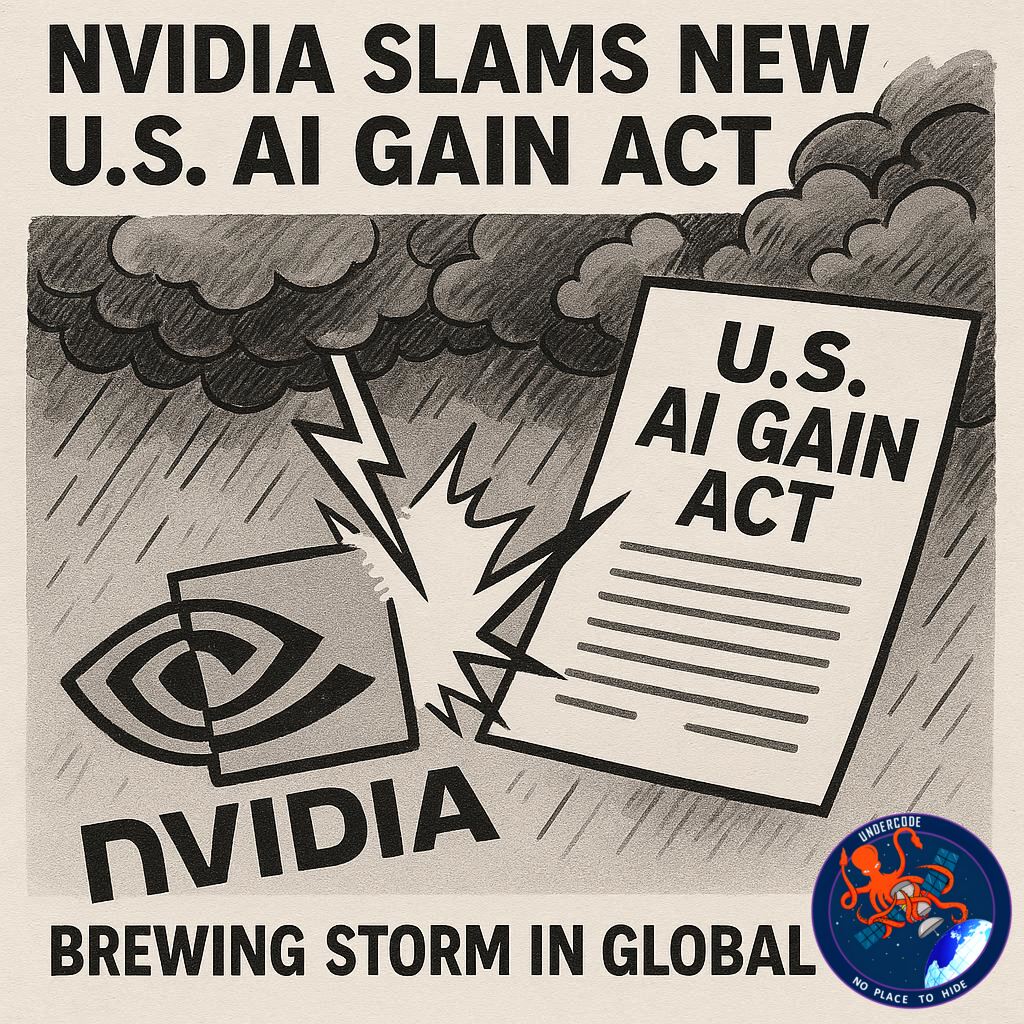
The battle over artificial intelligence isn’t just about algorithms and innovation—it’s increasingly a tug-of-war over hardware, regulation, and global power. Nvidia, the leading supplier of advanced processors that power today’s AI boom, is furious over a new U.S. legislative proposal known as the AI GAIN Act. Officially titled the Guaranteeing Access and Innovation for National Artificial Intelligence Act, this legislation is wrapped into the National Defense Authorization Act and aims to prioritize U.S. domestic demand for high-performance chips over foreign orders.
While the law is pitched as a national security safeguard, Nvidia argues it could choke competition, stifle technological progress, and destabilize the global AI ecosystem. With echoes of the AI Diffusion Rule from the Biden era, the bill represents yet another attempt to balance economic growth against fears of adversarial nations exploiting AI for military gains. But critics say Washington may be solving the wrong problem at the wrong time.
the Original
The AI GAIN Act, introduced as part of the National Defense Authorization Act, has triggered sharp backlash from Nvidia. The company argues that the legislation could mirror the negative effects of the AI Diffusion Rule, which previously restricted access to high-performance chips worldwide.
Under the proposed law, U.S. chipmakers would be required to prioritize domestic customers before shipping advanced processors abroad. This means exports of powerful AI chips could be delayed or even denied if U.S. companies are still waiting for them.
A spokesperson for Nvidia told Reuters that the company already prioritizes American customers, rejecting the idea that foreign markets come first. Nvidia warned that the bill addresses a “problem that does not exist” and risks crippling global industries reliant on mainstream chips. Despite its global dominance, Nvidia stressed that the U.S. remains its largest market and will continue to be so.
The AI GAIN Act also introduces specific export licensing requirements. Any chip exceeding a processing threshold of 4,800 must receive government approval before being sold internationally. The policy emphasizes denying licenses for the most advanced AI processors, reinforcing a national security stance against China and other potential rivals.
This approach resembles the AI Diffusion Rule under former President Joe Biden, which categorized nations based on computing power allowances. However, the GAIN Act sets even stricter technical benchmarks, especially regarding memory bandwidth.
Adding complexity, President Donald Trump reportedly reached a deal last month with Nvidia, permitting exports of previously restricted AI chips to China in exchange for a share of the company’s sales. This contradictory move raises questions about how strictly new restrictions might be enforced if the bill becomes law.
What Undercode Say:
The AI GAIN Act is more than just a trade policy—it’s a reflection of the U.S. government’s deep anxiety about AI supremacy and national security. On paper, restricting exports of ultra-advanced processors makes sense. America doesn’t want its rivals to gain an edge in military or intelligence capabilities by tapping into cutting-edge hardware. But the execution here feels shortsighted.
First, Nvidia’s frustration is justified. This company isn’t just a chipmaker; it’s the backbone of the global AI industry. By curbing its international sales, the U.S. risks damaging its own tech leadership. If foreign companies can’t reliably access Nvidia products, they may shift toward alternative suppliers—most notably in Taiwan, South Korea, or even China itself. Ironically, a law meant to weaken China could accelerate Chinese investment in homegrown chip technologies, narrowing Nvidia’s lead.
Second, the policy assumes that prioritizing domestic orders solves a problem. Nvidia has already clarified that American clients are always first in line. The bill’s restrictions may end up punishing foreign industries that are not military-related, like healthcare, automotive, or education—all of which rely on AI hardware. In a globalized economy, limiting innovation abroad often circles back to hurt U.S. companies, investors, and researchers.
Third, the U.S. seems caught in a cycle of reactionary policymaking. The AI Diffusion Rule, and now the GAIN Act, represent attempts to tighten control over AI chip distribution. But tech evolves faster than legislation. By the time rules are enforced, the chip performance thresholds set in the law may already be outdated. The 4,800 performance limit could look laughably low in a few years, forcing new revisions and further instability in the market.
Meanwhile, Trump’s reported side-deal with Nvidia adds a layer of inconsistency. If one hand of the government restricts exports while another hand strikes backroom deals, the message to both allies and rivals is confusion. This undermines trust in U.S. policymaking and creates unnecessary uncertainty in the chip supply chain.
The stakes couldn’t be higher. AI isn’t just about chatbots or recommendation systems—it’s powering defense systems, financial markets, biotech breakthroughs, and climate simulations. Chips are the oil of the 21st century. If Washington mishandles this balance, the U.S. risks losing both allies and influence in the AI race. Nvidia’s warning should not be dismissed as corporate self-interest. It’s a signal that over-regulation could fracture the very ecosystem America is trying to protect.
In the end, the GAIN Act raises a fundamental question: Should America prioritize short-term control over long-term dominance? Restricting access may provide immediate national security comfort, but it could also push the rest of the world to find alternatives, reducing U.S. leverage in the future. The world needs Nvidia—and Nvidia needs the world.
🔍 Fact Checker Results
✅ Nvidia confirmed it does not prioritize foreign customers over U.S. ones.
✅ The AI GAIN Act proposes a 4,800 processing power threshold for export restrictions.
❌ No evidence supports the claim that foreign customers currently outpace U.S. buyers in Nvidia’s supply chain.
📊 Prediction
If the AI GAIN Act passes in its current form, Nvidia’s global market share will likely decline within five years as foreign competitors ramp up domestic chip production. China, in particular, could accelerate investments in self-sufficiency, while U.S. allies like Europe may turn toward alternative suppliers. Long-term, instead of reinforcing America’s dominance in AI hardware, the bill could dilute it—ironically strengthening the very rivals it seeks to contain.
🕵️📝✔️Let’s dive deep and fact‑check.
References:
Reported By: timesofindia.indiatimes.com
Extra Source Hub:
https://www.twitter.com
Wikipedia
OpenAi & Undercode AI
Image Source:
Unsplash
Undercode AI DI v2
🔐JOIN OUR CYBER WORLD [ CVE News • HackMonitor • UndercodeNews ]
📢 Follow UndercodeNews & Stay Tuned:
𝕏 formerly Twitter 🐦 | @ Threads | 🔗 Linkedin | 🦋BlueSky | 🐘Mastodon


