
Listen to this Post
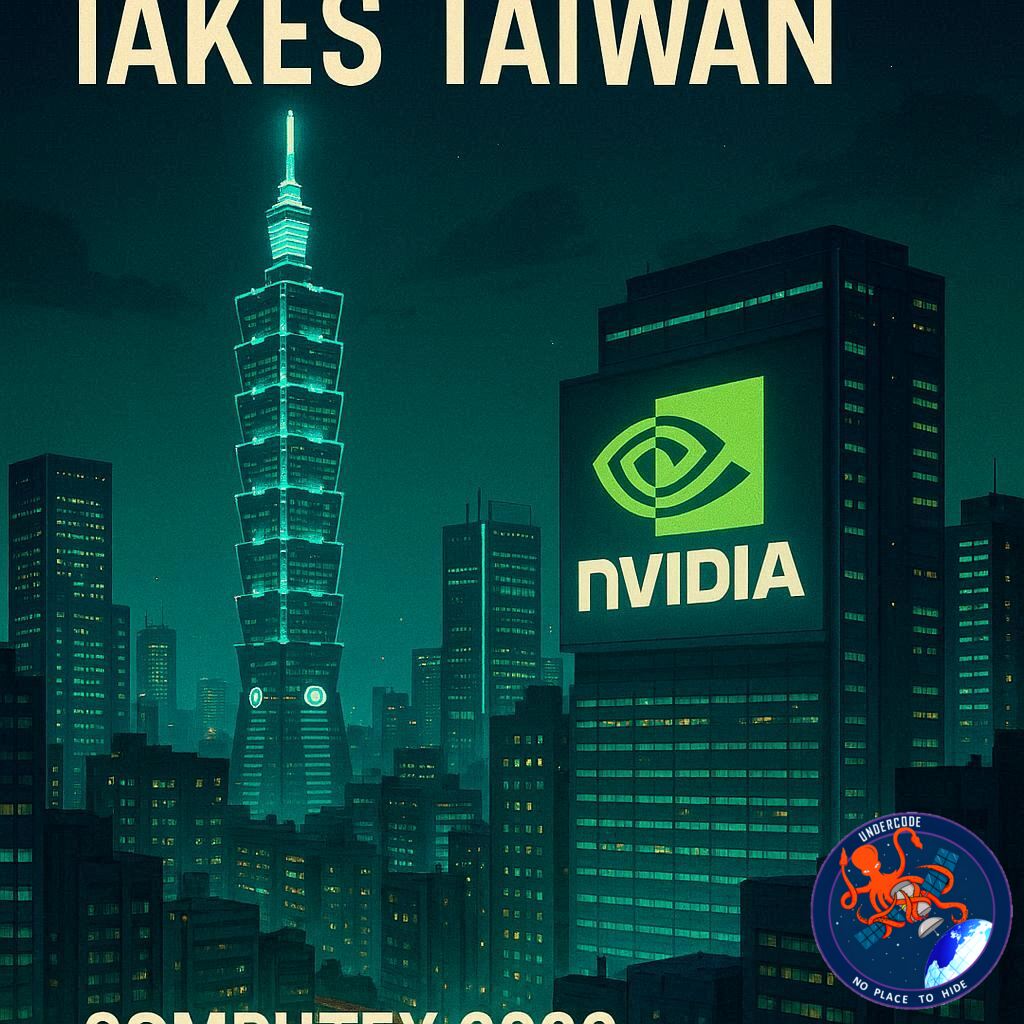
A New Era of Artificial Intelligence Begins in Taipei
The global AI race is accelerating faster than ever, and Taiwan is now standing directly at the center of it. As the world prepares for NVIDIA GTC Taipei at COMPUTEX 2026, the atmosphere around artificial intelligence, robotics, autonomous vehicles, and accelerated computing has reached a completely different level. Developers, engineers, researchers, and major tech companies are all gathering in Taipei to witness what could become one of the most influential AI events of the decade.
At the heart of the event is NVIDIA founder and CEO Jensen Huang, whose keynote presentations have increasingly become global technology moments rather than ordinary corporate announcements. Scheduled at the Taipei Music Center, Huang’s speech is expected to reveal major advancements in AI infrastructure, physical AI, AI factories, robotics, and autonomous systems that may define the next generation of computing.
This year’s COMPUTEX already delivered a strong signal about where the industry is heading. NVIDIA dominated the COMPUTEX 2026 Best Choice Awards, collecting multiple honors for technologies related to AI supercomputing, robotics, and autonomous driving. The company’s growing influence is no longer limited to graphics processors. NVIDIA is now attempting to build the entire AI ecosystem, from data center infrastructure to intelligent machines operating in the physical world.
NVIDIA Turns AI Infrastructure Into a New Industrial Powerhouse
One of the biggest highlights of the event was the NVIDIA Vera Rubin NVL72 AI supercomputer system. The platform received both a Golden Award and the Sustainable Tech Special Award at COMPUTEX, signaling not only raw performance leadership but also a growing focus on energy-efficient AI deployment.
The Vera Rubin NVL72 system combines 36 NVIDIA Vera CPUs with 72 Rubin GPUs through the sixth-generation NVLink Switch architecture. The design is aimed at solving one of the largest challenges in AI today: scaling massive models without destroying efficiency and energy budgets.
NVIDIA claims the platform delivers up to ten times higher inference performance per watt while also reducing token generation costs dramatically. In the age of trillion-parameter AI models, these numbers matter more than marketing slogans. Every efficiency gain translates directly into lower operational costs and faster AI deployment for enterprises.
The architecture also introduces advanced networking and data movement technologies, including ConnectX-9 SuperNICs, Spectrum-X Ethernet Photonics switches, and BlueField-4 DPUs. These technologies work together to optimize communication between AI systems, storage, and security operations inside massive data centers.
AI Factories Are Becoming the New Digital Economy
One of the most important concepts repeatedly emphasized during NVIDIA’s announcements is the idea of “AI factories.” Instead of traditional data centers merely storing and processing information, AI factories are designed to generate intelligence itself.
This shift may sound subtle, but it changes everything.
AI factories are being engineered to continuously train, refine, and deploy reasoning models capable of handling long-context understanding, agentic AI tasks, and autonomous decision-making systems. NVIDIA is positioning Vera Rubin NVL72 as the backbone for these future AI production environments.
The company also introduced significant sustainability improvements in the system design. The modular tray system dramatically cuts installation complexity, reducing assembly time from hours to minutes. Its fanless and hose-free architecture is another attempt to simplify maintenance and reduce infrastructure failures.
Perhaps the most interesting aspect is the fully liquid-cooled design operating at 45 degrees Celsius. Cooling is becoming one of the largest hidden costs in AI expansion, and NVIDIA clearly understands that efficiency will determine which companies survive the next phase of the AI boom.
Jetson Thor Pushes Robotics Into the Generative AI Era
Another major winner at COMPUTEX 2026 was NVIDIA Jetson Thor, which received a Golden Award for edge AI and robotics innovation.
Jetson Thor represents NVIDIA’s aggressive push into physical AI, meaning AI systems that interact directly with the real world rather than existing only in cloud environments. Powered by the Blackwell GPU architecture, the compact module delivers enormous AI computing power while maintaining energy efficiency suitable for robots, industrial machines, and autonomous devices.
According to NVIDIA, Jetson Thor delivers up to 2,070 FP4 teraflops of AI performance, far surpassing the previous Jetson Orin generation. The platform is designed specifically for generative AI workloads running locally on robots and smart machines.
This is an important shift because future AI systems will not only answer questions or generate text. They will move, navigate, manipulate objects, and operate independently in factories, hospitals, warehouses, and city infrastructure.
Jetson Thor is already being integrated into hundreds of real-world applications, ranging from industrial automation systems to medical devices and autonomous robotics platforms.
NVIDIA Alpamayo Targets the Hardest Autonomous Driving Problems
NVIDIA also secured another COMPUTEX award through Alpamayo, its open platform focused on autonomous vehicle development.
Unlike older autonomous driving systems that rely heavily on repetitive training patterns, Alpamayo focuses on “long-tail” scenarios. These are the rare and unpredictable situations that often confuse self-driving systems.
Examples include pedestrians making unclear hand gestures, conflicting traffic signals, emergency vehicles blocking roads, or unusual urban driving conditions. These edge cases are some of the biggest reasons fully autonomous driving remains difficult even after years of investment.
Alpamayo introduces chain-of-thought reasoning models specifically designed for autonomous vehicle research. The platform includes vision-language-action AI systems, open-source simulation tools, and massive driving datasets collected across different geographic and environmental conditions.
This approach reflects a broader trend in AI development: reasoning is becoming more important than simple pattern recognition.
Modern AI systems are no longer judged only by how much data they consume. Increasingly, the focus is shifting toward whether these systems can interpret ambiguity, understand context, and make safe decisions under uncertainty.
What Undercode Say:
NVIDIA Is Quietly Building the Operating System of the AI Age
Many people still think NVIDIA is simply a graphics card company that benefited from the AI trend. That view is now outdated.
What is happening at COMPUTEX 2026 shows that NVIDIA is evolving into something much larger. The company is attempting to control nearly every layer of the future AI stack: chips, networking, data center infrastructure, robotics hardware, simulation systems, AI frameworks, and autonomous reasoning platforms.
This strategy resembles what happened during previous industrial revolutions. The companies that dominated were not always the ones building the final products consumers saw. Instead, the winners controlled the infrastructure underneath everything else.
NVIDIA appears determined to become that foundational infrastructure provider for artificial intelligence.
The Vera Rubin NVL72 announcement is particularly significant because it highlights a growing reality inside the AI industry: scaling is becoming brutally expensive. Training and operating frontier AI models require massive amounts of energy, cooling, networking bandwidth, and computational efficiency.
Most companies simply cannot build these systems alone.
This creates a huge opportunity for NVIDIA because businesses increasingly need integrated AI infrastructure solutions instead of standalone chips. NVIDIA is no longer selling components. It is selling entire AI ecosystems.
Another major observation is how aggressively NVIDIA is targeting “physical AI.” For years, AI discussions focused mostly on chatbots and software assistants. That phase may already be transitioning toward something bigger.
Physical AI means robots, autonomous systems, industrial automation, smart factories, AI-powered logistics, and intelligent infrastructure. Jetson Thor clearly demonstrates NVIDIA’s ambition to dominate this emerging category.
The timing is important.
Many industries face labor shortages, rising operational costs, and increasing pressure for automation. Physical AI could become one of the largest economic transformations since industrial robotics first appeared decades ago.
Meanwhile, Alpamayo reveals another important industry transition: AI reasoning is replacing brute-force scaling as the next competitive battleground.
The first wave of AI success came from training increasingly larger models. But size alone is no longer enough. AI systems now need contextual reasoning, long-term planning, and the ability to handle uncertainty.
Autonomous vehicles represent one of the hardest possible environments for AI because real-world driving contains endless unpredictable variables. If NVIDIA can solve reasoning for autonomous systems, the same breakthroughs may later expand into robotics, manufacturing, healthcare, and military logistics.
Another interesting detail is Taiwan’s growing strategic importance.
Taiwan is no longer just a semiconductor manufacturing hub. It is becoming one of the most important geopolitical centers of the global AI economy. Events like COMPUTEX are now functioning as global technology summits where the future direction of computing is effectively negotiated.
Jensen Huang’s public image also deserves attention. He has evolved into one of the defining faces of the AI revolution. Unlike many corporate executives, Huang communicates technology with unusually high clarity and vision, making NVIDIA announcements feel closer to industry-defining moments rather than ordinary product launches.
Still, challenges remain.
AI infrastructure expansion raises enormous concerns regarding electricity demand, water usage, hardware concentration, and market monopolization. NVIDIA’s dominance also creates dependency risks for companies building on its ecosystem.
Competition from companies like AMD, Intel, Google, and custom AI chip startups is intensifying rapidly. Governments are also beginning to scrutinize AI concentration more closely.
Despite those concerns, NVIDIA currently appears several steps ahead of most rivals in terms of ecosystem integration and AI deployment strategy.
The biggest takeaway from COMPUTEX 2026 is simple: AI is no longer experimental technology.
It is becoming industrial infrastructure.
And NVIDIA wants to own the factory.
Fact Checker Results
✅ NVIDIA did win multiple COMPUTEX 2026 Best Choice Awards for AI, robotics, and autonomous vehicle technologies.
✅ Vera Rubin NVL72, Jetson Thor, and Alpamayo were officially highlighted as major NVIDIA innovations at the event.
⚠️ Performance claims such as “10x higher inference performance” and “35x higher throughput” are based on NVIDIA’s internal benchmarks and real-world deployment results may vary.
Prediction
🔮 AI factories will become one of the fastest-growing sectors in enterprise technology over the next five years.
🔮 Physical AI platforms like Jetson Thor could push robotics into mainstream commercial adoption much faster than analysts currently expect.
🔮 NVIDIA’s growing control over AI infrastructure may eventually trigger stronger global competition and regulatory pressure from both governments and rival tech giants.
▶️ Related Video (76% Match):
🕵️📝Let’s dive deep and fact‑check.
References:
Reported By: blogs.nvidia.com
Extra Source Hub (Possible Sources for article):
https://www.twitter.com
Wikipedia
OpenAi & Undercode AI
Image Source:
Unsplash
Undercode AI DI v2
Bing
🔐JOIN OUR CYBER WORLD [ CVE News • HackMonitor • UndercodeNews ]
📢 Follow UndercodeNews & Stay Tuned:
𝕏 formerly Twitter 🐦 | @ Threads | 🔗 Linkedin | 🦋BlueSky | 🐘Mastodon | 📺Youtube


