
Listen to this Post
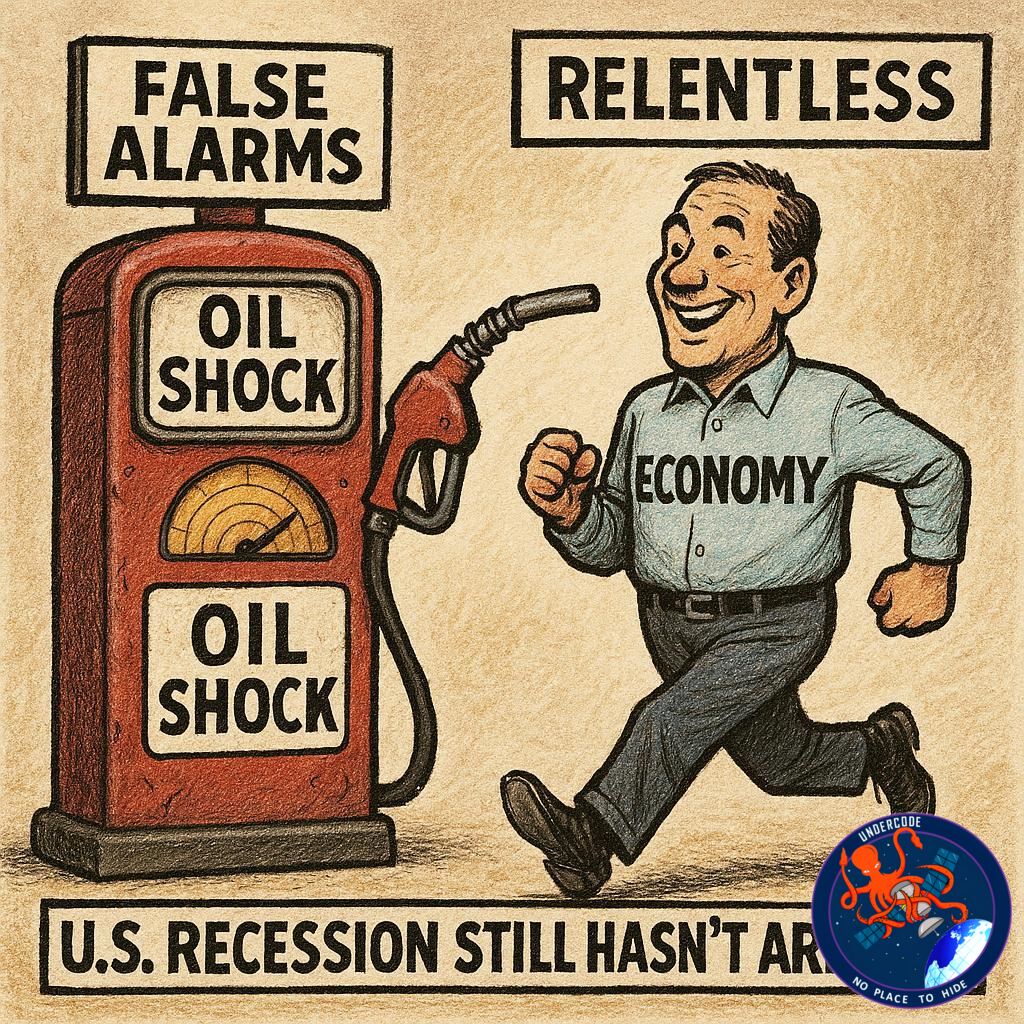
Introduction: A Crisis That Keeps Getting Delayed
For years, the narrative surrounding the U.S. economy has felt like a broken record: recession is coming. Analysts, economists, and financial institutions have repeatedly warned that a downturn is imminent, pointing to rising inflation, geopolitical tensions, and volatile energy prices. Yet, despite these persistent alarms, the economy has continued to defy expectations. Now, with oil prices surging again and uncertainty mounting, the question resurfaces with renewed urgency—is this finally the moment when the long-predicted recession becomes reality?
A Pattern of Warnings That Rarely Materialized
The concern surrounding a potential recession is not new. Back in 2022, when oil prices exceeded $100 per barrel and gasoline averaged nearly $5 per gallon, many experts believed a downturn was inevitable. However, the recession never came—not in 2022, nor in the years that followed.
This pattern extends even further back. Analysts have repeatedly misjudged the timing of economic slowdowns, often reacting to signals that historically preceded recessions but failed to deliver one in recent years. The persistence of these warnings highlights a central issue: predicting recessions is far more complex than relying on traditional indicators.
Eight Years of Economic False Alarms
Since 2018, recession predictions have become almost annual events. Each year brought its own set of triggers and concerns:
In 2018, warning signs like an inverted yield curve suggested the economy was nearing its peak. By 2019, trade tensions fueled fears across global markets, with many corporate leaders bracing for a downturn.
The year 2020 did see a recession, but it was an anomaly—triggered not by economic imbalances but by the global shutdown during the pandemic. This brief yet severe contraction was unlike traditional recessions and quickly reversed due to massive stimulus measures.
In 2021, inflation fears dominated discussions as supply chains struggled and trillions of dollars flowed into the economy. By 2022, rising energy costs linked to geopolitical conflict and aggressive interest rate hikes seemed to guarantee a recession, with some models predicting a near certainty.
Yet 2023 and 2024 continued the trend of missed predictions. Despite surveys showing widespread expectations of a downturn, the economy remained resilient. Even in 2025, when policy changes and market volatility intensified concerns, a full-scale recession still did not materialize.
Now in 2026, the narrative remains strikingly similar: rising oil prices and economic uncertainty once again threaten to push the economy over the edge.
Oil Prices: A Historically Reliable Warning Signal
One factor that continues to alarm economists is the sharp rise in oil prices. Historically, energy shocks have preceded most U.S. recessions, acting as a catalyst for broader economic slowdowns. Higher energy costs increase production expenses, reduce consumer purchasing power, and create ripple effects across industries.
With oil prices climbing again, the fear is that this could finally be the tipping point. However, history also shows that while oil shocks are significant, they do not guarantee a recession on their own.
The Role of Policy Uncertainty
Economic policy has also contributed to the growing unease. Trade tensions, tariffs, and shifting immigration policies have created an unpredictable environment for businesses. Companies often delay investments and hiring decisions when faced with uncertainty, which can slow economic growth.
Financial markets have begun reflecting these concerns, showing signs of caution as investors weigh the risks of a potential downturn.
Why the Economy Keeps Avoiding Recession
Despite repeated warnings, the U.S. economy has demonstrated remarkable resilience. Economists have proposed several explanations for this phenomenon.
The Rolling Recession Effect
Instead of a single, widespread downturn, the economy has experienced what some call a “rolling recession.” Different sectors have contracted at different times, but these declines have been offset by growth in other areas.
For example, the tech sector faced significant challenges in 2022, while manufacturing thrived. Later, manufacturing slowed while industries like semiconductors expanded. More recently, artificial intelligence has driven substantial growth, compensating for weaknesses in other sectors.
This staggered pattern has prevented the kind of synchronized decline typically associated with a recession.
The K-Shaped Economy
Another explanation lies in the uneven distribution of economic strength. Wealthier individuals have continued to spend despite rising costs, supported by investments and asset ownership. Meanwhile, lower-income households have faced greater financial strain.
This imbalance creates a “K-shaped” recovery, where one segment of the population thrives while another struggles. The spending power of higher-income groups has been enough to sustain overall economic growth.
Front-Loading Behavior
Businesses and consumers have also adapted to policy uncertainty by adjusting their behavior. When tariffs or economic restrictions are anticipated, companies often accelerate purchases and stockpile goods. This “front-loading” boosts short-term economic activity, helping to offset potential slowdowns.
Interestingly, when anticipated policies are delayed or softened, spending often continues, further supporting the economy.
Is 2026 Different?
While previous predictions have proven overly pessimistic, there are reasons to take current concerns seriously. The combination of rising oil prices, geopolitical tensions, and policy uncertainty presents a complex set of challenges.
Some economists estimate the probability of a recession at around 40%, noting that the risk could increase significantly if global conflicts escalate or energy prices continue to climb.
At the same time, there is a growing awareness among analysts of the dangers of over-predicting downturns. Being wrong repeatedly has made many economists more cautious in their forecasts.
What Undercode Says:
A Narrative Driven by Fear Cycles
The repeated prediction of recessions reflects more than just economic data—it reveals a cycle of fear embedded within financial systems. Markets and analysts are highly sensitive to signals like inflation spikes, yield curve inversions, and geopolitical instability. However, these signals are no longer as deterministic as they once were, largely due to structural changes in the global economy.
Structural Resilience Is Underestimated
The modern U.S. economy is far more diversified and technologically advanced than in previous decades. Growth in sectors like artificial intelligence, digital services, and renewable energy has created buffers that did not exist in earlier economic cycles. This diversification reduces the likelihood of a synchronized collapse across industries.
Policy Tools Have Become More Aggressive
Governments and central banks now respond more quickly and aggressively to economic threats. Stimulus measures, interest rate adjustments, and fiscal interventions have been deployed at unprecedented scales in recent years. These tools have effectively delayed or softened downturns, though they may also introduce long-term risks.
Consumer Behavior Has Shifted
Consumers have adapted to economic uncertainty by becoming more strategic in their spending. Higher-income households, in particular, have maintained strong consumption patterns, acting as a stabilizing force. This behavioral shift challenges traditional recession models that assume uniform consumer reactions.
The Illusion of Imminence
The constant anticipation of a recession creates a paradox: when everyone expects a downturn, they adjust their behavior in ways that may prevent it. Businesses become cautious, consumers save more, and policymakers intervene earlier—all of which can delay the very recession being predicted.
Oil Shocks Are No Longer Absolute Triggers
While oil prices remain influential, their impact has diminished compared to previous decades. The U.S. has increased its energy independence, and alternative energy sources have reduced reliance on traditional oil markets. As a result, oil shocks alone may not carry the same recessionary force they once did.
The Danger of Overfitting Historical Patterns
Many recession predictions rely heavily on historical patterns, but the current economic landscape is fundamentally different. Applying old models to new conditions can lead to repeated forecasting errors, as seen over the past eight years.
Financial Markets as Amplifiers
Markets do not just reflect economic conditions—they amplify them. Fear-driven reactions can create volatility that appears to signal deeper issues than actually exist. This feedback loop contributes to the persistent sense that a recession is always just around the corner.
Fact Checker Results:
Accuracy of Historical Claims
✅ The article correctly notes that most recession predictions since 2018 did not materialize as expected.
Interpretation of Oil Price Impact
✅ It is true that oil shocks have preceded many recessions, though not all lead directly to downturns.
Reliability of Economic Forecasting
❌ The assumption that traditional indicators alone can predict recessions is misleading, as recent years have shown inconsistencies.
Prediction:
Short-Term Outlook
📊 The U.S. economy is likely to experience continued volatility, but a full-scale recession may still be avoided in the immediate future due to structural resilience and adaptive policy measures.
Medium-Term Risk Factors
📊 Persistent high energy prices and geopolitical instability could gradually weaken economic momentum, increasing recession probability over time.
Long-Term Economic Shift
📊 The pattern of “almost recessions” may continue, signaling a new era where downturns are less abrupt but more prolonged and uneven across sectors.
🕵️📝✔️Let’s dive deep and fact‑check.
References:
Reported By: edition.cnn.com
Extra Source Hub (Possible Sources for article):
https://www.facebook.com
Wikipedia
OpenAi & Undercode AI
Image Source:
Unsplash
Undercode AI DI v2
Bing
🔐JOIN OUR CYBER WORLD [ CVE News • HackMonitor • UndercodeNews ]
📢 Follow UndercodeNews & Stay Tuned:
𝕏 formerly Twitter 🐦 | @ Threads | 🔗 Linkedin | 🦋BlueSky | 🐘Mastodon


