
Listen to this Post
Introduction
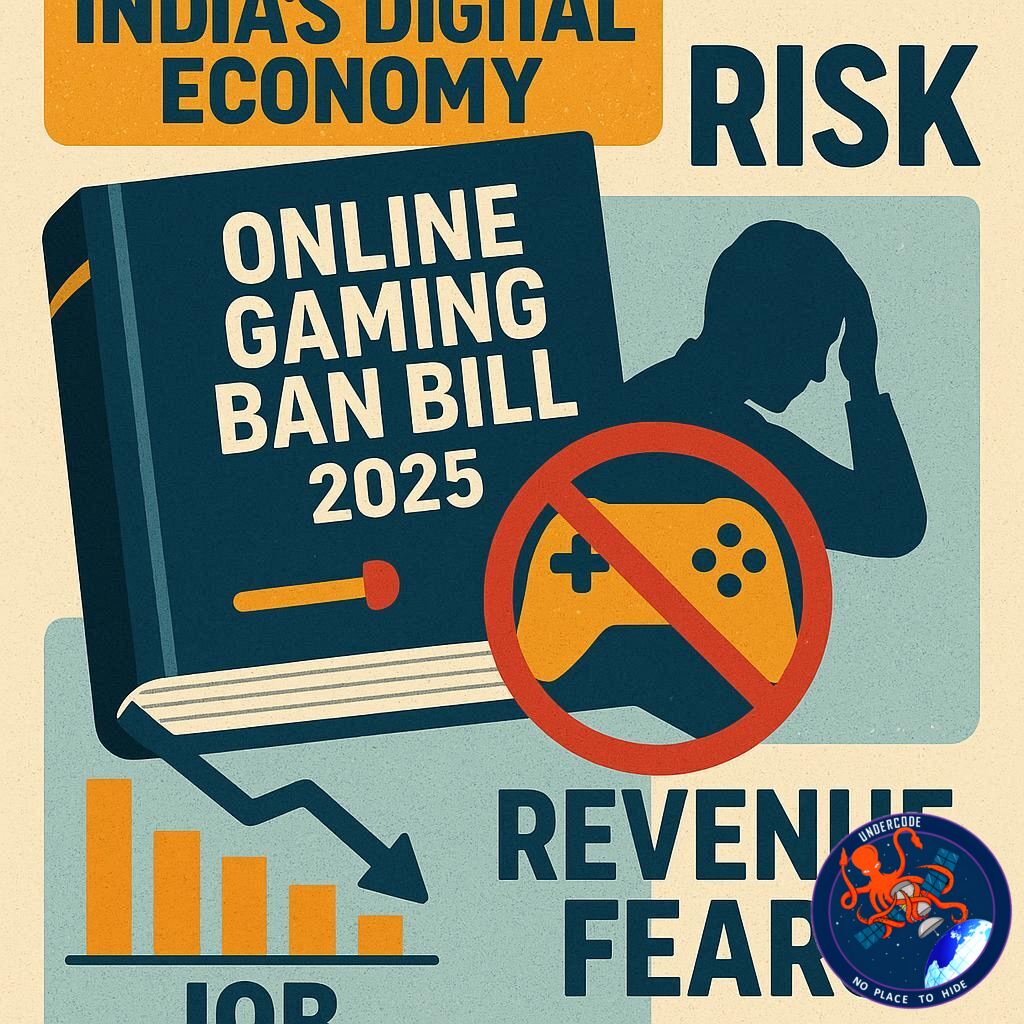
India’s booming online gaming industry is facing a storm after the Cabinet cleared the Online Gaming Ban Bill 2025, a legislation aimed at tightening rules on digital gambling and betting. While the government argues the Bill will curb fraud, addiction, and unlawful betting, industry bodies are warning of a potential economic catastrophe. From massive job losses to an exodus of gamers toward illegal operators, the controversy has sparked heated debate in business circles, legal corridors, and among millions of players who form India’s fast-growing digital economy.
Online Gaming Ban Bill – What’s at Stake
The Online Gaming Ban Bill 2025 has shaken the foundations of India’s digital entertainment sector. Industry leaders are raising alarms that the Bill, in its current form, could devastate an ecosystem valued at over ₹2 lakh crore.
In a joint letter to Union Home Minister Amit Shah, three major industry federations — the All India Gaming Federation (AIGF), the E-Gaming Federation (EGF), and the Federation of Indian Fantasy Sports (FIFS) — urged urgent intervention. They warned that the law, rather than protecting players, may push them into the clutches of offshore betting sites and illegal gambling networks that operate without consumer safeguards or tax contributions.
The proposed Bill threatens around 4 lakh companies and 2 lakh jobs, alongside ₹25,000 crore worth of investments. More significantly, the industry contributes close to ₹20,000 crore annually in GST revenues, which could shrink if players move to unregulated platforms.
The federations emphasized that online skill gaming has proven to be a legitimate economic engine. With revenues topping ₹31,000 crore and a 20% CAGR growth rate, the sector has been earmarked as a major pillar of the government’s \$1 trillion digital economy ambition. By 2028, revenues were expected to double, driven by India’s rapidly expanding gamer base that has already crossed 50 crore players in 2024, up from 36 crore in 2020.
The Bill aims to introduce penalties for gambling through digital apps, establish a legal framework, and designate the Ministry of Electronics and Information Technology as the central regulator. However, the uniform application of laws remains a challenge, as different states already have conflicting gaming regulations.
Adding to the burden, the government had already imposed a 28% GST on online gaming activities since October 2023. Industry insiders claim this tax regime was already squeezing operators, and the proposed ban would be a “final nail in the coffin.”
What Undercode Say:
The debate over the Online Gaming Ban Bill highlights a deeper clash between regulation and innovation. On one hand, the government’s intent to safeguard citizens from gambling addiction, fraud, and black-market activities is valid. Yet, the unintended economic fallout cannot be ignored. The Indian online gaming sector has transformed into a massive employment generator and foreign investment magnet. Curtailing it abruptly risks sending shockwaves across the startup ecosystem.
A major point of contention lies in the definition of “skill gaming” versus “gambling”. Globally, skill-based gaming such as fantasy sports, e-sports, and online chess is treated differently from pure gambling activities like poker or betting on chance. If the Bill blurs these lines, genuine skill-gaming firms could face the same restrictions as illegal betting platforms, crippling innovation.
The warning from industry bodies about players shifting toward illegal matka and offshore betting operators is not an exaggeration. History shows that prohibition without viable legal alternatives often fuels underground economies. If millions of Indian gamers find their favorite platforms unavailable, the lure of black-market operators — who neither pay taxes nor protect users — will only grow stronger.
The financial implications are staggering. Losing ₹20,000 crore in annual GST collections at a time when the government is pushing for fiscal consolidation is a serious risk. Beyond revenue, the estimated 2 lakh jobs at stake represent skilled employment in tech, design, marketing, and e-sports management. This workforce cannot easily be absorbed by other industries, meaning unemployment rates may rise.
Another overlooked factor is India’s global competitiveness in the gaming sector. Countries like the United States, Singapore, and South Korea are actively promoting e-sports and digital gaming as growth engines. If India clamps down, global investors may divert billions of dollars toward these markets, leaving Indian startups starved of capital.
There is also the sociocultural dimension. Online gaming is not just about economics; it has become a form of social interaction, creativity, and entertainment for over half a billion Indians. A ban could alienate this massive consumer base, sparking public backlash, especially among the youth demographic.
At the same time, the Bill does highlight valid concerns. Gambling addiction, fraudulent platforms, and inconsistent state regulations do require stronger oversight. But rather than blanket restrictions, a balanced framework of regulation, licensing, and taxation could safeguard consumers while allowing the industry to flourish. Countries that adopted regulatory models — such as the UK with its Gambling Commission — have seen success in controlling illegal betting while maintaining a thriving digital economy.
Ultimately, the Online Gaming Ban Bill 2025 is a test of India’s ability to strike the right balance between regulation and growth. A misstep could derail one of the country’s fastest-growing digital sectors, while smart policymaking could transform India into a global gaming hub.
🔍 Fact Checker Results
✅ The Bill has been approved by the Cabinet and awaits introduction in the Lok Sabha.
✅ Industry federations have officially warned of job and revenue losses.
❌ The Bill does not impose a blanket nationwide ban yet; it proposes regulation and penalties.
📊 Prediction
If the Bill passes in its current form, India’s online gaming industry could see widespread consolidation, with only the largest players surviving under heavy compliance burdens. Smaller startups may shut down, leading to job losses. However, if the government revises the Bill to distinguish skill gaming from gambling and introduces a licensing framework, the sector could emerge stronger, attract more foreign investments, and cement India as a leader in digital entertainment by 2030.
🕵️📝✔️Let’s dive deep and fact‑check.
References:
Reported By: zeenews.india.com
Extra Source Hub:
https://www.reddit.com/r/AskReddit
Wikipedia
OpenAi & Undercode AI
Image Source:
Unsplash
Undercode AI DI v2
🔐JOIN OUR CYBER WORLD [ CVE News • HackMonitor • UndercodeNews ]
📢 Follow UndercodeNews & Stay Tuned:
𝕏 formerly Twitter 🐦 | @ Threads | 🔗 Linkedin | 🦋BlueSky | 🐘Mastodon


