
Listen to this Post
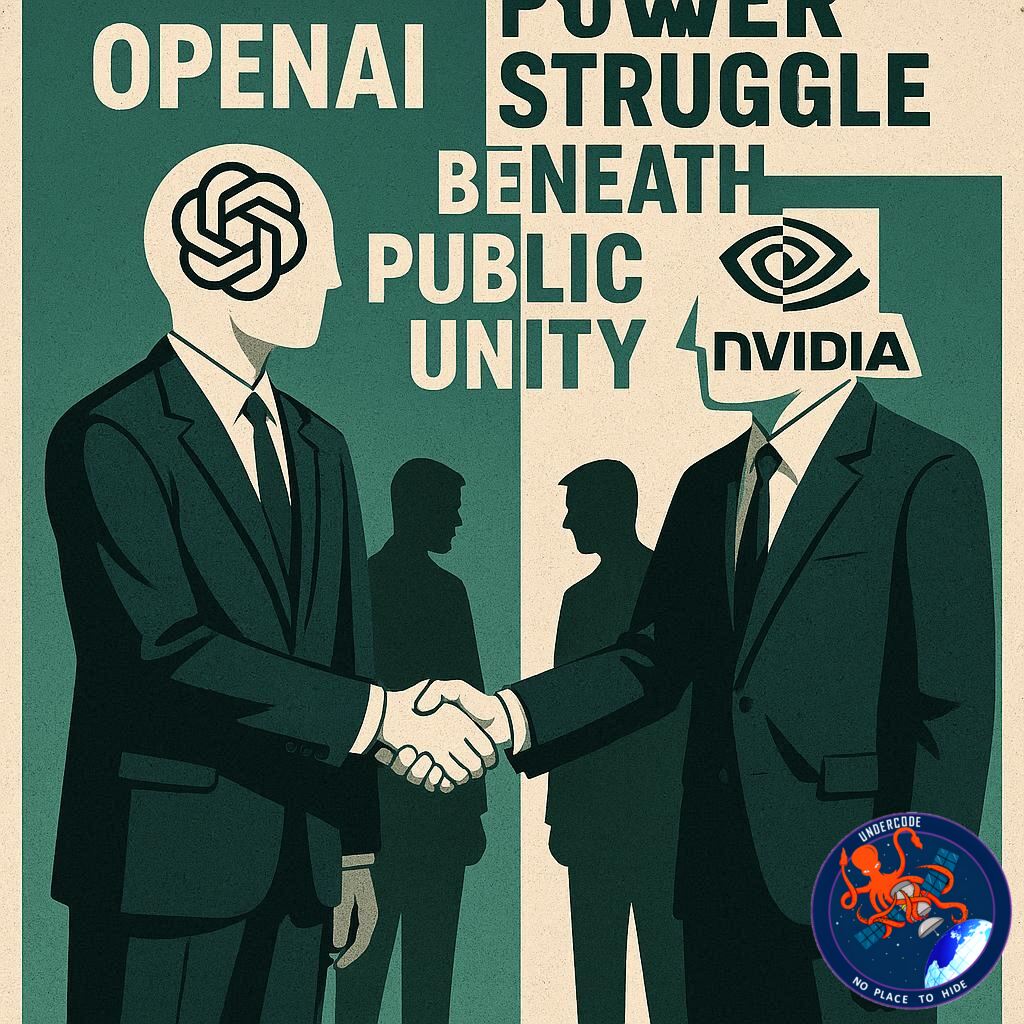
Introduction: When Strategic Partners Start Rethinking the Future
At the surface, OpenAI and Nvidia continue to present a picture of mutual admiration and long term alignment. Public statements from Sam Altman and Jensen Huang reinforce the idea that their partnership remains strong, even historic. Yet beneath the polished messaging, a different narrative is emerging. Multiple reports suggest that OpenAI is actively reassessing its dependence on Nvidia’s hardware, particularly as artificial intelligence enters a new phase centered on inference rather than training. This shift, subtle but consequential, may redefine one of the most important relationships in the modern AI industry.
the Original Report: Signals of Strain Inside a Strategic Alliance
Recent reporting reveals that OpenAI has grown dissatisfied with certain aspects of Nvidia’s latest AI chips, especially their performance in handling inference workloads tied to ChatGPT. According to sources cited by Reuters, OpenAI believes Nvidia’s hardware does not deliver responses fast enough for specific tasks such as software development and AI to software communication. Seven out of eight sources reportedly confirmed these concerns, indicating that OpenAI has been searching for alternative chip solutions since last year.
The company’s goal is not to replace Nvidia entirely, but to secure hardware capable of covering roughly 10 percent of its future inference computing needs. This represents a strategic recalibration rather than a sudden rupture. Analysts interpret this move as part of a broader industry shift toward inference optimization, the stage where trained AI models generate real time answers for users.
Nvidia’s GPUs have historically excelled at training massive models like ChatGPT, but inference presents different demands. Speed, memory proximity, and efficiency at scale are now becoming decisive. OpenAI has reportedly explored chips that integrate large amounts of SRAM directly onto silicon, a design that can significantly accelerate chatbot responses for millions of concurrent users.
In pursuit of these alternatives, OpenAI has engaged with competitors such as AMD, a move that reportedly caused discomfort within Nvidia. This search for inference focused hardware comes at a delicate moment, as both companies are also entangled in investment negotiations.
In September, Nvidia announced plans to invest up to $100 billion in OpenAI, a deal framed as the largest computing project in history. However, despite expectations of a swift closure, talks have dragged on for months. New reports suggest Nvidia may now reduce its planned investment by half, with Jensen Huang privately emphasizing that the original figure was nonbinding.
Additional tension surfaced through reports that Huang has criticized OpenAI’s business discipline and voiced concerns about competitive pressure from Google and Anthropic. Despite this, both CEOs have publicly dismissed claims of a rift. Nvidia maintains that it offers the best performance per dollar for inference, while Sam Altman continues to praise Nvidia’s chips as the best in the world and reaffirms OpenAI’s intention to remain a major customer.
What Undercode Say: The Inference Era Is Rewriting Power Dynamics
The real story here is not about personal friction or corporate drama. It is about a structural transition in artificial intelligence. Training was the gold rush of the last AI cycle. Inference is the infrastructure war of the next one.
OpenAI’s dissatisfaction signals a deeper realization that dominance in training hardware does not automatically translate into dominance in inference. Inference workloads are relentless, cost sensitive, latency obsessed, and unforgiving at scale. When millions of users expect near instant responses, even marginal delays become strategic liabilities.
Nvidia’s architecture was built to win the training race, and it did so spectacularly. But inference rewards different trade offs. Memory locality, specialized silicon, and energy efficiency matter more than brute force parallelism. OpenAI’s interest in SRAM heavy designs reflects an industry wide recognition that inference speed is now a competitive moat.
The reported target of covering only 10 percent of inference needs is telling. OpenAI is not staging a rebellion. It is hedging. This is classic platform risk management, ensuring that no single supplier controls the economic destiny of a global AI service.
The investment saga adds another layer of complexity. A $100 billion figure, even if symbolic, framed Nvidia not just as a supplier but as a strategic patron. Walking that number back quietly changes the balance of power. It suggests caution on Nvidia’s side and perhaps unease about OpenAI’s spending velocity and competitive exposure.
Jensen Huang’s reported criticism of OpenAI’s discipline should not be dismissed as mere gossip. It reflects a broader concern among infrastructure providers that application layer AI companies burn capital faster than they generate defensible margins. From Nvidia’s perspective, Google and Anthropic are not just competitors to OpenAI, they are alternative demand centers that may offer more predictable returns.
Public denials from both CEOs are expected. Markets dislike uncertainty, and partnerships of this scale cannot afford visible fractures. Yet actions matter more than tweets. OpenAI’s outreach to AMD, its focus on inference specific chips, and the prolonged investment negotiations all point to a recalibration in progress.
This does not mean Nvidia is losing. It means Nvidia is being tested. The inference era will not be won by reputation alone, but by adaptability. If Nvidia evolves its hardware stack fast enough, it can retain its central role. If not, the AI ecosystem will fragment into specialized silicon niches, each optimized for a different layer of intelligence.
In that sense, OpenAI is not undermining Nvidia. It is forcing the entire industry to confront the next bottleneck. And in technology, bottlenecks are where power shifts quietly, long before headlines catch up.
Fact Checker Results
✅ Multiple sources confirm OpenAI is exploring inference chip alternatives.
✅ Nvidia’s proposed $100 billion investment was described as nonbinding.
❌ No public evidence proves a formal breakdown in the OpenAI Nvidia partnership.
Prediction: Where This Quiet Shift Leads Next
📊 Nvidia will accelerate inference optimized chip development to defend its ecosystem.
📊 OpenAI will diversify hardware suppliers without fully abandoning Nvidia.
📊 The next AI arms race will be fought on latency, cost efficiency, and inference scale, not training size alone.
🕵️📝✔️Let’s dive deep and fact‑check.
References:
Reported By: timesofindia.indiatimes.com
Extra Source Hub (Possible Sources for article):
https://www.linkedin.com
Wikipedia
OpenAi & Undercode AI
Image Source:
Unsplash
Undercode AI DI v2
Bing
🔐JOIN OUR CYBER WORLD [ CVE News • HackMonitor • UndercodeNews ]
📢 Follow UndercodeNews & Stay Tuned:
𝕏 formerly Twitter 🐦 | @ Threads | 🔗 Linkedin | 🦋BlueSky | 🐘Mastodon


