
Listen to this Post
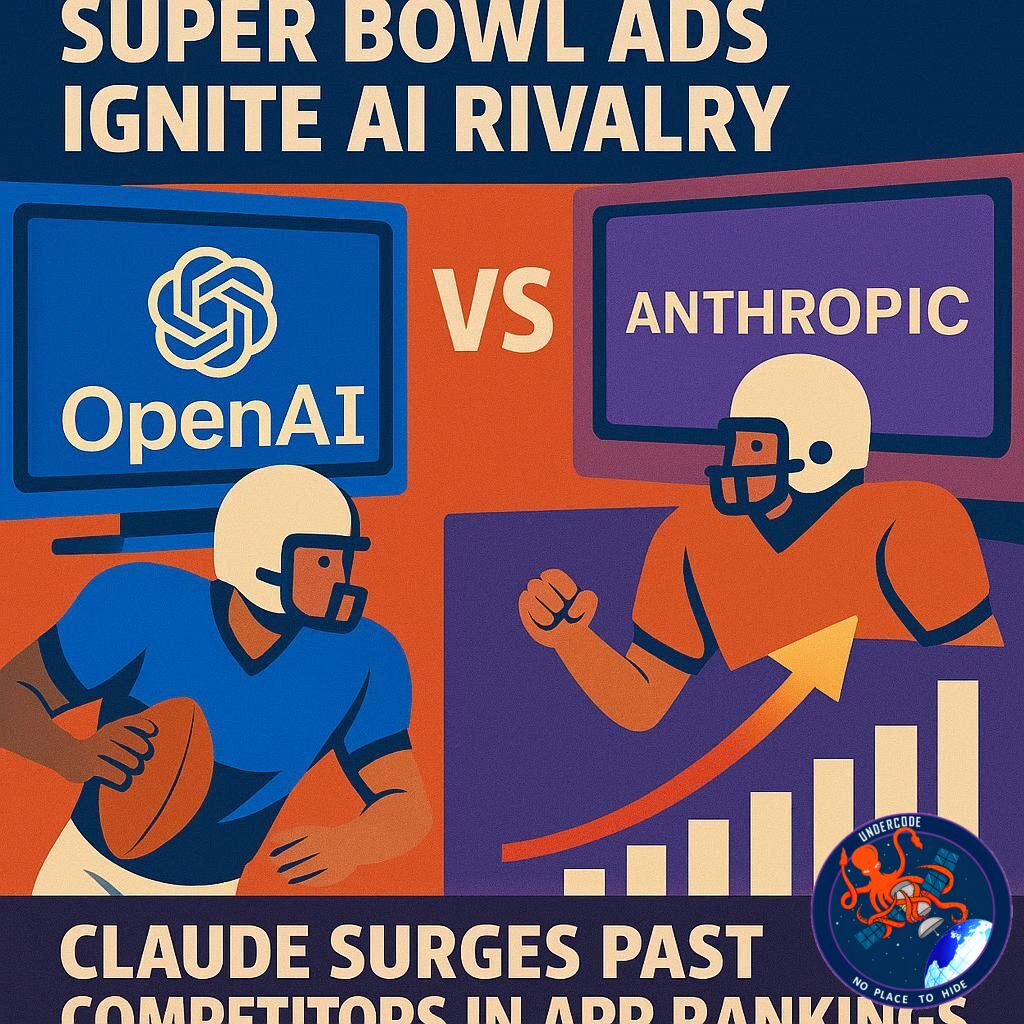
The artificial intelligence war is no longer confined to research labs and product launches. It has entered prime time television. During one of the most watched sporting events in the United States, the Super Bowl, Anthropic took direct aim at its biggest rival, OpenAI. The result was not just social media noise or executive frustration. It translated into measurable growth, sharper competition, and a public clash between two fundamentally different visions for the future of AI.
With 125 million viewers watching, Anthropic’s 30-second commercial did something bold. It mocked OpenAI’s reported plan to introduce advertisements into ChatGPT. The punchline was simple and provocative: “Ads are coming to AI. But not to Claude.” The message was clear. Claude would remain clean, premium, and ad-free. ChatGPT, by implication, would not.
Super Bowl Spotlight Turns AI Rivalry into Prime-Time Drama
Artificial intelligence companies dominated the advertising conversation during the championship game, signaling that AI is no longer a niche industry. It is a mass-market product category. Anthropic’s decision to spend millions of dollars on a Super Bowl slot was strategic. This was not just about brand awareness. It was about positioning Claude as the ethical and premium alternative to ChatGPT in front of an audience larger than most countries.
The ad campaign centered on a critique of OpenAI’s potential advertising model. By framing ads in AI as intrusive and undesirable, Anthropic sought to plant doubt in the minds of everyday users. The timing was precise. As AI tools become embedded in daily life, questions about monetization and trust are becoming central to user loyalty.
Claude Sees Immediate Traffic and User Growth Surge
The gamble appears to have paid off. Data analyzed by BNP Paribas showed that visits to Anthropic’s website jumped 6.5 percent following the Super Bowl advertisement. In the competitive world of AI platforms, even single-digit percentage increases can translate into millions of interactions.
More impressively, Claude entered the top 10 free apps on the Apple App Store after the game. That ranking placed it ahead of major competitors including OpenAI’s ChatGPT, Google’s Gemini, and Meta’s AI offerings. In a market saturated with powerful brands and deep pockets, that leap in visibility marked a significant milestone for Anthropic.
Daily active users for Claude reportedly rose 11 percent after the game. By comparison, ChatGPT saw a 2.7 percent increase and Gemini gained 1.4 percent. The numbers suggest that while OpenAI remains dominant overall, the Super Bowl campaign delivered a sharper short-term impact for Claude.
Scale Still Favors ChatGPT Despite Momentum Shift
Despite the growth surge, it is important to contextualize the numbers. Claude’s user base remains significantly smaller than that of ChatGPT and Gemini. OpenAI’s platform continues to serve hundreds of millions globally, with free and paid tiers that give it enormous scale advantages.
Sam Altman, CEO of OpenAI, underscored this difference when responding publicly to the advertisement. He pointed out that more Texans use ChatGPT for free than the total number of people using Claude across the United States. The message was clear. OpenAI operates at a different magnitude.
Scale matters in AI. More users generate more feedback loops, more data insights, and more ecosystem partnerships. Even if Anthropic achieved a short-term spike, OpenAI’s broader infrastructure and distribution network remain formidable.
Sam Altman Responds: “Deceptive” and “Clearly Dishonest”
Sam Altman did not remain silent. In a lengthy post on X, he described Anthropic’s ads as “deceptive” and “clearly dishonest.” Interestingly, he admitted that the ads were funny. Yet his core criticism centered on misrepresentation.
Altman argued that OpenAI would not deploy ads in the intrusive way depicted. He emphasized that paid tiers such as ChatGPT Plus and Pro do not show advertisements, and that OpenAI remains committed to providing broad free access to AI tools. For Altman, the issue was not humor. It was integrity.
He went further, suggesting that Anthropic was engaging in “doublespeak” by criticizing hypothetical deceptive ads with what he viewed as a deceptive ad of its own. For him, the Super Bowl was not the appropriate stage for what he perceived as distortion.
Competing Philosophies: Access vs Control
Beyond the ad dispute, Altman’s response revealed a deeper philosophical divide. He accused Anthropic of wanting to control how companies and individuals use AI. According to him, Anthropic blocks certain companies from using its coding tools and seeks to define restrictive rules around AI deployment.
Altman framed OpenAI’s mission differently. He emphasized democratization, broad access, and lowering prices over time. He positioned OpenAI as a platform builder, empowering creators rather than restricting them. The launch of Codex, with 500,000 downloads since its debut earlier that week, was cited as evidence that builders are gravitating toward OpenAI’s ecosystem.
This ideological contrast is shaping the narrative. Anthropic highlights safety, premium positioning, and curated use cases. OpenAI emphasizes scale, openness, and global accessibility.
AI Advertising Signals Market Maturity
The presence of multiple AI brands advertising during the Super Bowl signals something larger. The AI market is entering a new maturity phase. What was once a research breakthrough has become a consumer battleground. With 125 million viewers watching, companies are no longer speaking only to developers. They are speaking to families, students, entrepreneurs, and small businesses.
The competitive intensity reflects a market that shows no signs of slowing. AI assistants are evolving from novelty tools into productivity infrastructure. As competition increases, messaging strategies will become sharper, and brand positioning will matter as much as model performance.
What Undercode Say:
The Super Bowl clash between OpenAI and Anthropic is not about humor or even traffic spikes. It represents a strategic turning point in how AI companies define trust, monetization, and power.
Anthropic’s campaign was a calculated reputational strike. By associating ads with potential user exploitation, it positioned itself as a guardian of purity. In technology markets, perception often moves faster than product updates. If users begin to equate one platform with commercialization pressure and another with clean design, brand loyalty can shift subtly but decisively.
However, scale economics cannot be ignored. OpenAI’s broader user base creates a network effect that is difficult to replicate. A temporary 11 percent surge in daily active users is impressive, yet sustainability will depend on retention metrics rather than download spikes. Super Bowl ads can drive curiosity, but product stickiness determines long-term success.
Altman’s emphasis on democratization is also strategically important. By framing AI access as a public good rather than a premium commodity, OpenAI aligns itself with global expansion. Lower pricing over time can create defensible mass adoption, even if advertising models evolve. If OpenAI successfully balances free access with optional paid tiers, it could normalize ads in AI much like social platforms did a decade ago.
Anthropic’s premium narrative may resonate with privacy-conscious and enterprise customers. The absence of ads becomes a signal of focus and trust. Yet premium positioning narrows the total addressable market unless pricing adapts. If Claude remains associated with exclusivity, growth ceilings may appear sooner than expected.
The deeper conflict lies in governance philosophy. Altman’s comments about control versus democratic decision-making reveal anxiety about regulatory influence. As governments begin shaping AI policy frameworks, companies that present themselves as open ecosystems may gain political and developer goodwill.
Another dimension is developer loyalty. Codex’s 500,000 downloads suggest OpenAI’s builder ecosystem remains powerful. Developers often determine long-term platform dominance because they create tools, plugins, and integrations that embed AI into daily workflows. If OpenAI maintains momentum among builders, advertising controversies may fade in importance.
The psychological impact of public rivalry should not be underestimated either. By responding forcefully, Altman amplified Anthropic’s message. Public disputes between tech leaders can accelerate brand awareness for smaller competitors. In some cases, criticism acts as free marketing.
From a market strategy perspective, Anthropic’s move reflects asymmetric competition. When one player is dominant, the challenger must differentiate sharply. Humor, controversy, and moral framing become strategic levers. OpenAI, as the incumbent leader, must defend scale without appearing defensive.
Ultimately, the ad clash signals that AI is transitioning into a consumer loyalty war. Model benchmarks still matter, but narrative dominance is emerging as a parallel battlefield. The companies that define the moral story of AI may shape its adoption curve just as much as those that refine its algorithms.
Fact Checker Results
Claude’s website traffic increased by 6.5 percent after the Super Bowl ad, according to BNP Paribas analysis. ✅
Daily active users for Claude rose 11 percent post-game, compared to 2.7 percent for ChatGPT and 1.4 percent for Gemini. ✅
Claude’s total user base remains smaller than ChatGPT’s despite the surge. ✅
Prediction
AI advertising battles will intensify as monetization models evolve and regulatory scrutiny increases. 📈
OpenAI is likely to experiment cautiously with hybrid revenue streams while protecting its free user base. 🤖
Anthropic may double down on premium, ad-free positioning to attract enterprise and privacy-focused customers. 🚀
▶️ Related Video (74% Match):
🕵️📝✔️Let’s dive deep and fact‑check.
References:
Reported By: timesofindia.indiatimes.com
Extra Source Hub (Possible Sources for article):
https://www.reddit.com/r/AskReddit
Wikipedia
OpenAi & Undercode AI
Image Source:
Unsplash
Undercode AI DI v2
Bing
🔐JOIN OUR CYBER WORLD [ CVE News • HackMonitor • UndercodeNews ]
📢 Follow UndercodeNews & Stay Tuned:
𝕏 formerly Twitter 🐦 | @ Threads | 🔗 Linkedin | 🦋BlueSky | 🐘Mastodon


