
Listen to this Post
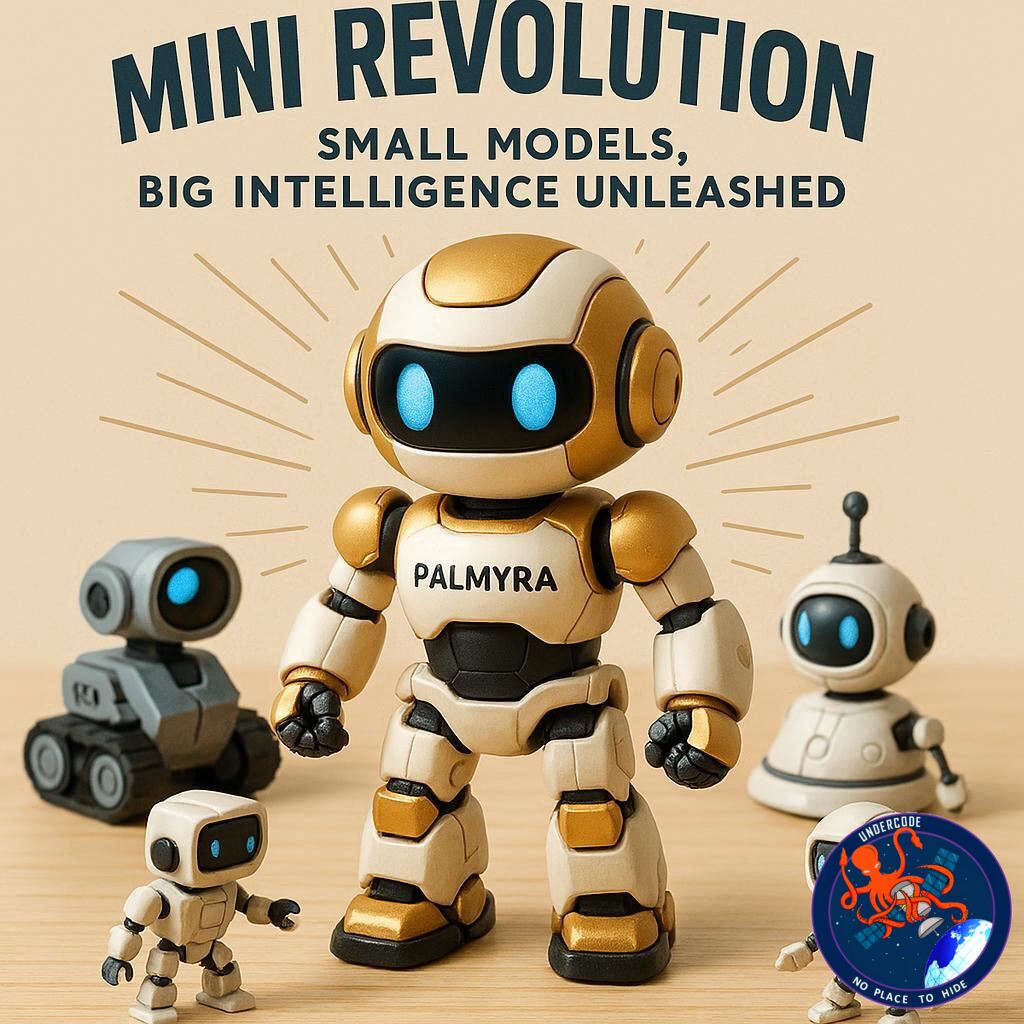
Introduction: A New Era of Lightweight AI
Artificial Intelligence has long been dominated by massive models requiring enormous computing power, but a new shift is taking place. The Palmyra-mini family, introduced by WRITER, is designed to prove that bigger doesn’t always mean better. With parameter sizes between 1.5B to 1.7B, these models strike a perfect balance between speed, reasoning power, and efficiency, making them highly accessible for both researchers and businesses.
This article explores the release, benchmarks, and implications of Palmyra-mini models. We’ll also analyze their potential, the trade-offs they bring, and what their future means for AI innovation.
Palmyra-Mini Models Explained
The Palmyra-mini family introduces three distinct open-source models, each with a unique specialization:
palmyra-mini: The core, lightweight non-reasoning base model.
palmyra-mini-thinking-a: A reasoning-focused variant optimized for logic and problem-solving.
palmyra-mini-thinking-b: A high-performance model specializing in mathematics and advanced reasoning.
The “thinking” variants use Chain of Thought (CoT) training, boosting their reasoning ability beyond typical lightweight models.
Benchmark Performance That Speaks Volumes
palmyra-mini (Base Model): Achieved 52.6% on Big Bench Hard (get-answer exact match). This proves it’s a reliable general-purpose generator.
palmyra-mini-thinking-a: Scored 82.87% on GSM8K, showing excellence in solving logical and reasoning-heavy challenges.
palmyra-mini-thinking-b: Delivered 92.5% on AMC23, outperforming peers in benchmarks such as AIME24, AIME25, GPQA, HMMT25, HLE, MMLU_PRO, MATH500, and LCB.
These results confirm that even small parameter models can rival larger AI systems when trained effectively.
Technical Notes Behind the Scenes
Architectural Backbone: All models are built on Qwen architecture, ensuring compatibility with frameworks like vLLM, SGLang, TRTLLM, and TGI.
Fine-Tuning Experimentation: For palmyra-mini-thinking-b, reinforcement learning fine-tuning improved single-shot accuracy but reduced sampling diversity. This reveals a critical trade-off between accuracy and creativity.
Quantization Support: GGUF and MLX quantizations make these models easy to deploy in different environments.
Why Palmyra-Mini Matters for the Future of AI
Traditionally, advanced reasoning required models with billions more parameters. Palmyra-mini challenges that by offering:
Efficiency: High performance without massive GPU clusters.
Accessibility: Open-source release democratizes AI research.
Scalability: Perfect fit for edge devices and low-resource settings.
This balance of speed, intelligence, and availability could redefine how businesses adopt AI.
What Undercode Say: 🧐
Palmyra-mini is more than just a new release—it represents a paradigm shift in how the AI community views small models. Here’s a deeper analysis:
1. Benchmark Disruption
The high scores prove that intelligent training strategies can outperform brute-force scaling. This is a direct challenge to the “bigger is better” philosophy that has dominated AI for years.
2. Chain of Thought Impact
The success of the “thinking” variants showcases the importance of structured reasoning in model training. Instead of memorizing answers, these models learn to think step-by-step, leading to superior results in logic-heavy tasks.
3. Trade-offs in Diversity vs. Accuracy
The reinforcement learning fine-tuning results highlight a delicate balance. While accuracy goes up, diversity takes a hit. This raises questions for developers: Should a model be precise but rigid, or creative but less reliable?
4. Democratizing Advanced AI
With models that run efficiently on consumer hardware, Palmyra-mini could enable startups, educators, and independent researchers to access cutting-edge reasoning capabilities without enterprise-level resources.
5. Business Applications
From customer support automation to mathematical problem-solving tools, Palmyra-mini opens new doors for industries that need fast, lightweight, and intelligent solutions.
6. Research Potential
The transparency around trade-offs, performance, and quantization support invites the AI community to experiment further. This could accelerate progress in model collapse research, inference optimization, and edge AI development.
In essence, Palmyra-mini is not just a technical achievement—it’s a strategic signal that the future of AI may not rely solely on scaling up, but also on optimizing smaller, smarter systems.
✅ Fact Checker Results
Palmyra-mini family does include three models (base, thinking-a, thinking-b).
Benchmarks like GSM8K and AMC23 confirm the reasoning capabilities.
Claims about trade-offs between accuracy and diversity are documented in WRITER’s release notes.
🔮 Prediction: What’s Next for Palmyra-Mini?
Looking ahead, we can expect Palmyra-mini to inspire a new generation of compact yet powerful AI systems. Future iterations may focus on increasing diversity without losing accuracy, making these models even more versatile. Businesses will likely adopt them in education, healthcare, and edge devices, where efficiency and reasoning power are crucial.
Palmyra-mini’s rise signals a future where smaller AI models dominate real-world applications, while massive AI giants remain reserved for specialized, high-power tasks.
🕵️📝✔️Let’s dive deep and fact‑check.
References:
Reported By: huggingface.co
Extra Source Hub:
https://www.reddit.com/r/AskReddit
Wikipedia
OpenAi & Undercode AI
Image Source:
Unsplash
Undercode AI DI v2
🔐JOIN OUR CYBER WORLD [ CVE News • HackMonitor • UndercodeNews ]
📢 Follow UndercodeNews & Stay Tuned:
𝕏 formerly Twitter 🐦 | @ Threads | 🔗 Linkedin | 🦋BlueSky | 🐘Mastodon


