
Listen to this Post
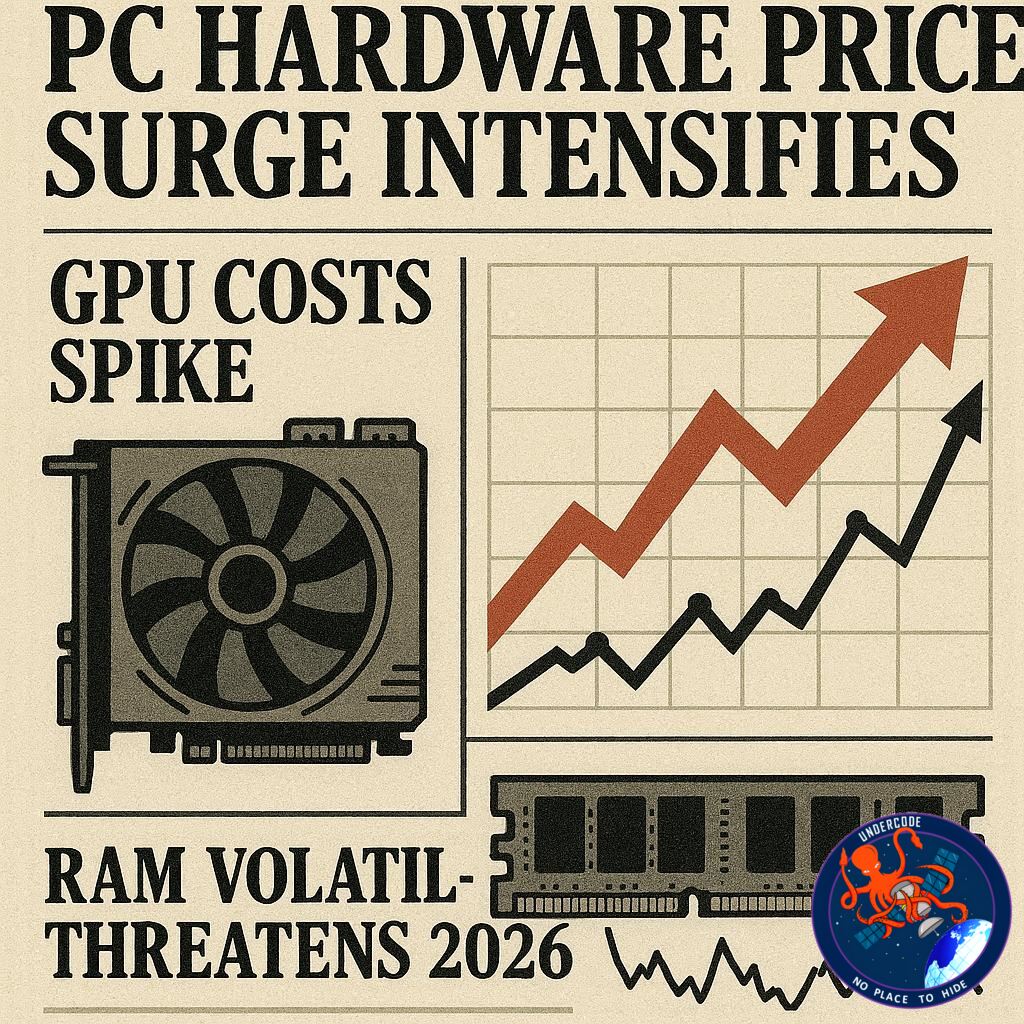
🎯 Introduction: A Market That Refuses to Settle
Just when consumers began hoping for stability in PC hardware pricing, the market delivers another shock. Graphics cards are suddenly climbing in price again, memory costs remain unpredictable, and manufacturers are quietly signaling that the worst may not be over. What once looked like a cooling trend is now revealing itself as a fragile pause, not a recovery. For gamers, creators, and everyday users planning upgrades, the landscape is becoming increasingly uncertain.
📊 Main Summary: Rising GPU Prices and Persistent Memory Uncertainty
The PC hardware market is experiencing another wave of price increases, affecting both graphics cards and memory-related components. A notable example comes from Asus, where several Radeon RX 9070 XT models have seen abrupt price hikes in the United States. These increases appeared almost overnight, without any formal announcement, raising concerns about broader market trends.
The Asus Prime RX 9070 XT OC model, previously priced at $799.99, has jumped to $939.99, reflecting a significant 17.5% increase. Meanwhile, a newer white edition of the same GPU has risen by around 7%, now costing $959.99. Even higher-end variants, such as the TUF overclocked version, have climbed to nearly $989.99, pushing them close to the $1,000 threshold. These sudden jumps suggest potential upstream cost pressures or strategic pricing adjustments.
Despite these increases, the overall GPU market is not entirely uniform. Some entry-level versions of the RX 9070 XT can still be found for just over $700, although this is notably higher than earlier in the year when prices hovered closer to $600. The concern now is whether other manufacturers will follow Asus in raising prices, potentially triggering a wider market shift.
At the same time, Framework, a company known for its modular laptops and desktops, has issued a warning regarding memory and storage costs. While certain areas of the memory market have shown signs of stabilization, Framework emphasizes that this is likely temporary. The company predicts continued volatility and rising costs throughout the remainder of 2026.
Framework has already implemented selective price increases. For instance, its prebuilt laptop configurations featuring 64GB of DDR5 RAM have become more expensive. On the desktop side, the company has absorbed some of the cost increases internally, except for high-capacity configurations such as the 128GB RAM model, which has seen a price bump.
Storage pricing is also under pressure. Framework reports that newly sourced SSDs come with substantially higher costs. As a result, products like the 4TB WD SN850X SSD are now more expensive, with expectations that other storage options will soon follow. The company even advises customers to purchase high-capacity storage now while older, lower-cost inventory is still available.
Although some price increases have been softened or delayed by manufacturers, the broader message is clear: the memory market remains unstable. Temporary stabilization may give the illusion of recovery, but underlying factors continue to drive uncertainty. Reduced consumer demand, caused by already high prices, has contributed to short-term balance, but this does not indicate a long-term solution.
In this environment, the GPU price hikes appear particularly concerning. Rapid and unannounced increases could signal the beginning of a new upward trend across the industry. Combined with ongoing memory and storage cost pressures, the overall outlook suggests that building or upgrading a PC may become even more expensive in the near future.
🧠 What Undercode Say: Market Signals Point to Structural Pressure, Not Temporary Noise
The recent developments are not random fluctuations; they reflect deeper structural issues within the global hardware supply chain. The sudden GPU price hikes from Asus are especially telling, not because of their scale alone, but because of their timing and execution. Overnight increases without explanation often indicate upstream cost shocks, such as rising component prices, tighter supply, or currency and logistics pressures that manufacturers prefer not to publicly detail.
More importantly, the warning from Framework should not be underestimated. When a company known for transparency openly advises consumers to buy now before costs rise further, it signals a level of confidence in continued inflationary pressure. This is not speculative commentary; it is operational insight coming directly from procurement realities.
The memory market has always been cyclical, but the current cycle appears distorted. Traditionally, falling demand would lead to price corrections and eventual stabilization. However, what we are seeing now is a scenario where demand destruction is not enough to offset supply-side constraints. Manufacturing costs, geopolitical tensions, and supply chain fragmentation are preventing prices from dropping meaningfully.
Another critical factor is the increasing baseline expectation for higher capacity hardware. Consumers are no longer satisfied with 16GB or even 32GB of RAM in high-performance systems. Similarly, storage demands have surged, with 2TB and 4TB SSDs becoming standard for many users. This shift amplifies the impact of price increases because buyers are now purchasing more expensive configurations by default.
The GPU market adds another layer of complexity. Even if some models remain relatively affordable, the psychological pricing barrier is shifting upward. Once $900 becomes normalized for mid-to-high-end GPUs, it resets consumer expectations and gives manufacturers room to push prices further. The gradual move from $600 to $700, and now toward $900, is not accidental; it is a recalibration of perceived value.
There is also a strategic element at play. Companies may be leveraging controlled scarcity and staggered price increases to maximize margins during uncertain times. By raising prices incrementally and observing consumer response, they can identify the threshold at which demand begins to collapse, then adjust accordingly.
Looking ahead, the combination of volatile memory pricing and rising GPU costs suggests that the PC hardware market is entering a prolonged period of instability. This is not a short-term spike but a transition phase where pricing models, supply chains, and consumer behavior are all being reshaped simultaneously.
For consumers, the implication is clear: waiting for prices to drop significantly may not yield the expected results. Instead, the market may continue oscillating with an upward bias, punctuated by brief and misleading periods of stability.
🔍 Fact Checker Results
✅ Asus RX 9070 XT models have experienced documented price increases in the US market
✅ Framework has publicly warned about continued memory and storage cost volatility through 2026
❌ The entire GPU market has not uniformly reached $900+, as lower-priced models still exist
📊 Prediction
📈 Hardware prices will continue rising in waves, not a straight line, creating short-lived buying opportunities
⚠️ RAM and SSD costs are likely to spike again in late 2026 as supply constraints tighten
🚀 GPU pricing may normalize at a higher baseline, with $800–$1,000 becoming standard for performance-tier cards
▶️ Related Video (80% Match):
🕵️📝✔️Let’s dive deep and fact‑check.
References:
Reported By: www.techradar.com
Extra Source Hub (Possible Sources for article):
https://www.reddit.com/r/AskReddit
Wikipedia
OpenAi & Undercode AI
Image Source:
Unsplash
Undercode AI DI v2
Bing
🔐JOIN OUR CYBER WORLD [ CVE News • HackMonitor • UndercodeNews ]
📢 Follow UndercodeNews & Stay Tuned:
𝕏 formerly Twitter 🐦 | @ Threads | 🔗 Linkedin | 🦋BlueSky | 🐘Mastodon


