
Listen to this Post
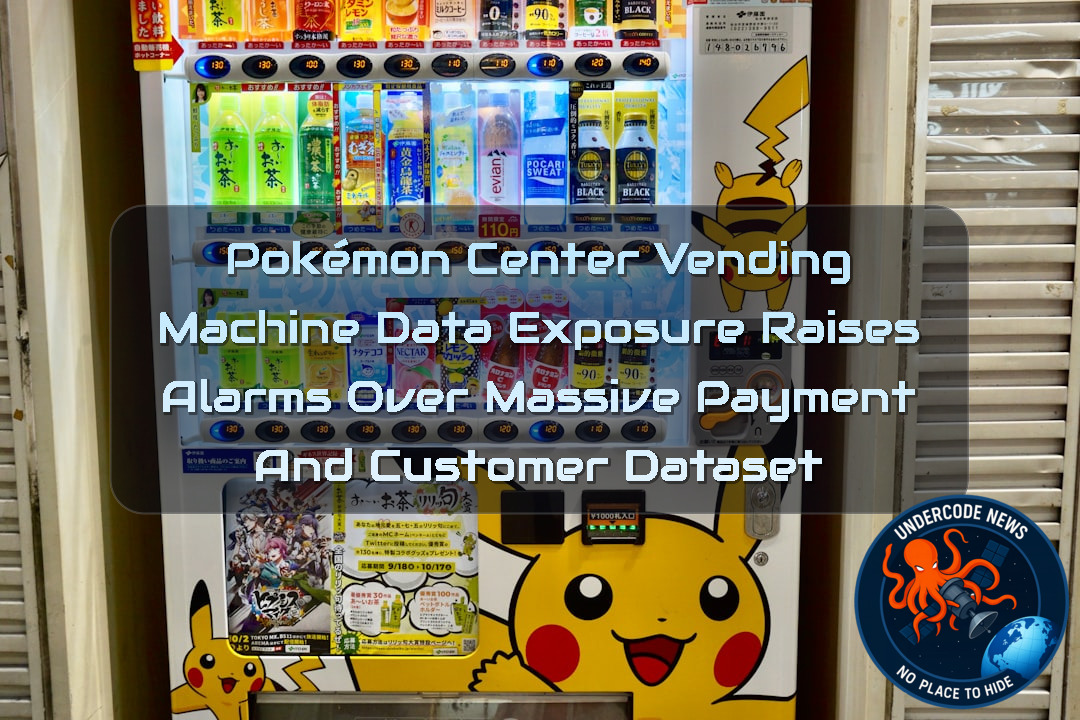 A Potential Data Exposure Behind Pokémon Center Vending Machines
A cybersecurity incident involving vending-machine infrastructure has raised fresh concerns about how seemingly simple retail systems can become gateways to highly sensitive customer and payment information. A threat actor has alleged that a misconfigured Firebase environment connected to a U.S.-based automated retail platform exposed a substantial database containing customer email addresses, payment-card hashes, transaction records, vending-machine information, source code, and backend credentials.
The reported scale is striking. According to the information published by Dark Web Intelligence, the allegedly exposed dataset contains more than 206,000 unique email addresses and approximately 70,500 payment-card hashes. Nearly 60,000 receipts are also said to be present, potentially revealing masked card numbers, transaction values, terminal identifiers, and authorization codes.
The dataset reportedly relates to 217 vending machines, including 66 Pokémon Center kiosks. That detail immediately makes the incident more visible because Pokémon Center has become a major retail channel for Pokémon merchandise, collectibles, and limited-edition products. However, the available information does not establish that Pokémon itself was breached.
That distinction matters.
What Is Reportedly Exposed
The alleged exposure appears to involve several categories of information rather than a single database table. The reported 206,092 unique email addresses represent the largest obvious customer-data component.
Email addresses may appear relatively harmless compared with passwords or financial information, but large collections of verified customer addresses can become valuable commodities for phishing, credential theft, spam campaigns, and targeted social engineering.
The threat actor also reportedly claims access to 70,546 payment-card hashes. A hash is not automatically equivalent to a readable credit-card number, and the security implications depend heavily on the hashing method, implementation, whether additional data was used, and whether the hashes can be exploited for verification or correlation.
The presence of hashes should therefore not be interpreted as meaning that tens of thousands of complete payment-card numbers were immediately exposed in plaintext.
Thousands of Receipts Add Another Layer of Risk
The alleged dataset reportedly contains 59,797 receipts.
These receipts are particularly interesting from a security perspective because they may connect multiple pieces of transactional information together. The reported fields include masked card numbers, transaction amounts, terminal IDs, and authorization codes.
Individually, some of these fields may have limited value. Together, however, they can provide a much richer picture of transactions and infrastructure.
Terminal identifiers can potentially reveal how individual machines are organized. Transaction amounts can establish purchasing patterns. Masked card numbers can provide correlation points. Authorization information may expose additional weaknesses depending on how it is generated and stored.
The risk is therefore not simply about one exposed field. It is about the relationship between multiple datasets.
217 Vending Machines Reportedly Connected
The reported infrastructure allegedly covers 217 vending machines.
Among them, 66 are said to be Pokémon Center kiosks.
That number suggests that the affected environment, if the dataset is authentic and accurately described, may have been designed to support a distributed retail operation rather than a single isolated vending machine.
A centralized backend can make management easier for operators. It can also create a much larger blast radius when authentication, database permissions, cloud configuration, or API security fails.
A single misconfigured backend can potentially expose information associated with hundreds of connected endpoints.
Pokémon Center Should Not Automatically Be Blamed for a Direct Breach
One of the most important details in the original report is also the easiest to overlook.
The presence of Pokémon Center vending machines in the reported dataset does not establish that Pokémon or The Pokémon Company was directly compromised.
The alleged affected platform reportedly serves multiple brands. That means the infrastructure could belong to an external automated-retail provider, technology vendor, payment intermediary, or another third-party operator supporting vending machines.
This distinction is critical when assessing responsibility.
A company can have customer-facing equipment involved in an incident without its own corporate network being breached. Third-party infrastructure, cloud services, contractors, payment processors, and retail technology providers can all create indirect security exposure.
Firebase Configuration Becomes a Major Question
The alleged incident centers around a misconfigured Firebase environment.
Firebase is widely used to build and operate applications and cloud-backed services. Like any cloud platform, however, security depends heavily on how developers configure authentication, database rules, storage permissions, API access, service accounts, and application secrets.
A secure cloud service can become dangerously exposed when development settings reach production or access-control rules are overly permissive.
The important question is not simply whether Firebase was involved.
The real question is what security controls were applied to the specific environment.
Source Code and API Credentials Raise the Stakes
The most concerning part of the allegation may be the reported exposure of source code and backend API credentials.
Customer information creates privacy and fraud concerns. Credentials can potentially create an entirely different category of risk.
If valid backend credentials were exposed, attackers might attempt to use them to access internal services, databases, APIs, administrative functions, or other connected infrastructure.
Source code can also reveal how the application communicates with its backend, how authentication works, what APIs exist, which endpoints are available, and where security assumptions were made.
However, an exposed credential does not automatically mean unrestricted system access. Permissions, expiration, network controls, service-account scopes, monitoring, and other defensive layers can significantly limit what a compromised credential can accomplish.
Why Vending Machines Are Becoming Cybersecurity Targets
Modern vending machines are no longer simply mechanical devices accepting coins.
Many connected vending systems function as small Internet-connected computers. They can communicate with cloud platforms, process electronic payments, transmit inventory information, receive configuration updates, and report operational statistics.
That transformation has created a new attack surface.
A vending machine may look harmless from the outside while being part of a sophisticated cloud-connected ecosystem behind the scenes.
The security chain can include the machine itself, payment hardware, local software, wireless connectivity, cloud APIs, databases, dashboards, third-party services, and administrator accounts.
A weakness anywhere in that chain can become significant.
The Retail Convenience Trap
Retail technology often prioritizes speed and convenience.
Operators want machines that can be deployed quickly, remotely managed, automatically updated, and monitored from centralized dashboards.
Those features are valuable operationally, but every additional connection can introduce another security dependency.
The result is a familiar cybersecurity paradox.
The more convenient a system becomes, the more carefully its trust boundaries must be designed.
Why Email Addresses Matter
The reported email dataset deserves attention even if no passwords were exposed.
Large email collections are highly useful to criminals because they can support targeted phishing campaigns.
An attacker could send messages pretending to represent Pokémon Center, a vending-machine operator, a payment provider, or another familiar retail brand.
The messages could claim that a transaction failed, a collectible order requires confirmation, a payment method needs verification, or an account has been suspended.
The victim does not necessarily need to have suffered a direct account compromise for the exposed information to become useful.
Payment Hashes Require Careful Interpretation
Payment-card hashes sound alarming, but cybersecurity analysis needs to distinguish hashes from plaintext card numbers.
A properly implemented cryptographic hash is designed to make reversing the original input computationally difficult.
However, the practical security value depends on implementation details.
Weak hashing algorithms, predictable inputs, inadequate salting, poor key management, or auxiliary information can change the risk dramatically.
Furthermore, payment information can be sensitive even when stored in a transformed format because it may enable correlation or validation attacks.
The reported card hashes should therefore be treated as potentially sensitive information rather than automatically described as stolen plaintext cards.
Receipts Can Become Intelligence
Transaction receipts can also reveal more than consumers might expect.
A receipt containing an amount, terminal ID, timestamp, masked payment identifier, and authorization information can create a transaction fingerprint.
When thousands of such records are aggregated, patterns can become visible.
An attacker may potentially learn which machines are active, how frequently they process transactions, which locations generate higher volumes, or how the backend identifies individual terminals.
Even when each individual receipt seems low-risk, aggregation changes the equation.
The Supply-Chain Dimension
The incident also illustrates why cybersecurity increasingly extends beyond an organization’s own servers.
Retail businesses routinely depend on technology vendors.
A vending machine can involve hardware manufacturers, software developers, payment processors, cloud providers, logistics companies, maintenance contractors, and retail brands.
The customer sees one machine.
Behind that machine may be an entire supply chain.
A vulnerability in one
A Third-Party Breach Can Still Become a Brand Crisis
Consumers rarely distinguish between the primary brand and its technology suppliers when something goes wrong.
If a Pokémon Center-branded vending machine is associated with an exposed database, customers are likely to remember Pokémon Center rather than the name of an unknown backend provider.
That creates a reputational problem even when the brand itself did not suffer a direct compromise.
This is why third-party risk management has become such an important component of modern cybersecurity programs.
What Security Teams Should Investigate
If the reported exposure is confirmed, the first priority should be containment.
Security teams should determine whether the Firebase project remains accessible, identify exposed collections and storage buckets, revoke potentially compromised credentials, rotate API keys, and review authentication configurations.
Logs should then be examined for unauthorized access.
The investigation should not stop after the database is closed.
Security teams need to determine whether attackers accessed, downloaded, modified, or deleted information before remediation.
Credentials Should Be Rotated Immediately
Any backend credential that may have been exposed should be treated as compromised.
Waiting for proof that someone used a credential can create unnecessary risk.
API keys, service-account credentials, database passwords, signing keys, tokens, and other secrets should be rotated according to the affected system’s architecture.
Old credentials should be revoked rather than merely replaced.
Firebase Rules Need Special Attention
Cloud database security rules should be reviewed line by line.
Teams should verify that anonymous users cannot read protected collections, write operations are restricted, administrative functionality requires strong authentication, and clients cannot access information belonging to other customers.
Testing should also include attempts to access resources without authentication and with deliberately manipulated identifiers.
A secure configuration should fail closed.
APIs Should Be Treated as an Attack Surface
Backend APIs should undergo a complete review.
Security teams should identify exposed endpoints, authentication requirements, authorization checks, rate limits, input validation, and error handling.
An API that correctly authenticates a user but fails to verify whether that user is authorized to access a particular record can still expose sensitive information.
This type of access-control failure is particularly dangerous in systems handling customer and payment records.
Logging Could Determine the True Scope
The difference between exposure and exploitation is often found in logs.
Investigators should examine authentication events, database reads, API requests, administrative actions, unusual geographic access, large data transfers, credential usage, and changes to security policies.
If historical logging is available, the organization may be able to determine when the environment became accessible and whether an attacker actually retrieved information.
Without sufficient logs, organizations may have to operate under uncertainty.
Customers Could Face Secondary Attacks
If customer emails were genuinely exposed, affected individuals could eventually encounter phishing messages.
These campaigns may not appear immediately.
Criminals often enrich stolen datasets with information from other breaches before launching targeted attacks.
The more information attackers possess, the more convincing their messages can become.
Consumers should therefore be cautious with unsolicited messages referencing vending-machine purchases, Pokémon products, payment problems, refunds, loyalty programs, or account verification.
The Incident Shows Why Cloud Misconfiguration Still Matters
Cloud security failures do not always require sophisticated zero-day exploits.
Sometimes the vulnerability is configuration.
An incorrectly configured database rule can defeat otherwise sophisticated infrastructure.
An exposed credential can bypass application-level controls.
An overly permissive API can make sensitive records accessible to unauthorized users.
The lesson is uncomfortable because the technology itself may be functioning exactly as designed.
The problem is that it was configured to trust too much.
What Undercode Say:
The Real Story Is Bigger Than Pokémon
The most important lesson is not whether Pokémon Center itself was breached.
The bigger issue is the security of the technology ecosystem supporting modern automated retail.
Convenience Creates Complexity
A vending machine connected to a cloud backend is effectively an IoT endpoint.
Every connected endpoint increases the number of systems that defenders must protect.
Centralization Creates Blast Radius
Centralized infrastructure makes management efficient.
It also means one compromised environment can potentially affect hundreds of machines.
The Dataset Is Potentially Valuable
More than 206,000 email addresses represent a significant phishing opportunity if authentic.
The reported payment hashes add another layer of sensitivity.
Receipts Create Correlation
Nearly 60,000 receipts could allow attackers to correlate transactions with machines and payment identifiers.
That makes the dataset more useful than a simple email list.
Source Code Can Reveal Architecture
Source code may show how the platform communicates with Firebase.
It may also reveal API endpoints, internal assumptions, and authentication workflows.
Credentials Are More Dangerous Than Code
Exposed code can be studied.
Valid credentials can potentially be used immediately.
That makes secret exposure a particularly urgent concern.
Third-Party Risk Is Central
The reported incident demonstrates why companies must assess technology providers as carefully as their own infrastructure.
Brand Exposure Does Not Equal Brand Breach
A Pokémon Center vending machine appearing in the dataset does not prove that Pokémon’s corporate systems were compromised.
The distinction should remain clear.
Cloud Security Requires Continuous Monitoring
A secure configuration today can become insecure tomorrow after a deployment or policy change.
Continuous configuration monitoring is therefore essential.
Security Rules Must Be Tested
Teams should not assume that cloud access rules are correct simply because they were written by experienced developers.
They should be tested like application code.
Secrets Should Never Live in Public Code
API credentials and backend secrets should be stored using appropriate secret-management systems.
Source repositories should be continuously scanned for accidental exposure.
Payment Data Requires Strict Controls
Payment-related information should be minimized, protected, and retained only when necessary.
The less sensitive information an organization stores, the less attractive it becomes as a target.
Receipts Need Protection Too
Receipts are often treated as ordinary business records.
Aggregated receipt databases can become highly sensitive intelligence repositories.
IoT Security Cannot Be Ignored
Connected vending machines belong to the wider IoT security problem.
Organizations should inventory every connected device and understand what each device can access.
Machine Identity Matters
Each vending machine should have a unique identity and narrowly scoped permissions.
Shared credentials across hundreds of machines can dramatically increase risk.
Least Privilege Is Essential
A vending machine should not have access to data it does not need.
Likewise, a customer-facing application should not possess administrative privileges.
Segmentation Limits Damage
Retail endpoints, payment systems, customer databases, and administrative services should be separated wherever practical.
Segmentation can prevent a single compromise from becoming a platform-wide disaster.
Monitoring Must Include Unusual Reads
Mass database queries should trigger alerts.
A normal vending-machine transaction should not generate behavior resembling bulk data extraction.
Incident Response Should Assume Credentials Can Leak
Organizations need a documented process for immediately rotating keys and revoking sessions.
Every hour of delay can increase potential exposure.
Third-Party Contracts Matter
Security requirements should be included in vendor agreements.
Companies should know who owns the data, who can access it, and who is responsible for incident notification.
Security Audits Should Follow the Data
Organizations often audit corporate systems while overlooking vendors.
The most sensitive information may actually reside outside the primary corporate network.
Data Minimization Reduces Impact
If the platform does not need to retain certain information, it should not retain it indefinitely.
Less stored data means less potential damage.
Encryption Is Not Enough
Encryption protects information in many scenarios, but it does not fix excessive database permissions.
Access control remains fundamental.
Authentication Alone Is Insufficient
A system can authenticate users correctly and still expose data if authorization is poorly implemented.
Authentication answers who you are.
Authorization determines what you can access.
APIs Need Authorization Testing
Every endpoint should be tested for unauthorized object access.
This is especially important for APIs handling transaction records.
Security Teams Should Hunt for Abuse
After an exposure, defenders should actively search for suspicious queries, downloads, credential use, and administrative activity.
Waiting for alerts alone may not reveal the full story.
Retail Technology Deserves Enterprise Security
A vending machine may be physically small.
Its backend infrastructure can still process sensitive customer and payment information.
The Attack Surface Is Invisible
Consumers see a screen, a payment terminal, and a product dispenser.
Security teams see APIs, credentials, cloud databases, network connections, and software dependencies.
The Weakest Link Can Be Remote
An attacker does not necessarily need to attack the vending machine itself.
Compromising the backend may be more valuable.
Public Exposure Can Spread Quickly
Once sensitive data appears in underground communities, copies may circulate beyond the original source.
Removing the original exposure does not guarantee that the information disappears.
Verification Remains Critical
The current report contains allegations that have not been independently verified.
Security analysis should distinguish confirmed facts from reported claims.
But Unverified Does Not Mean Unimportant
Even before verification, the reported indicators provide defenders with useful questions.
Organizations can investigate the relevant infrastructure and determine whether similar weaknesses exist.
The Most Important Question
The central question is not simply, “Was Pokémon breached?”
It is, “Which systems processed this information, who could access them, and were those access controls working as intended?”
The Broader Warning
Modern retail is becoming increasingly connected.
Security architecture must evolve at the same speed.
Deep Analysis
Check Exposed Secrets in Source Trees
Security teams can search repositories for accidentally committed secrets using tools such as:
git grep -nEi 'api[_-]?key|secret|token|password|firebase'
This should be performed against authorized internal repositories only.
Review Environment Configuration
Configuration files should be inspected for accidentally exposed credentials:
find . -type f ( -name ".env" -o -name ".json" -o -name ".yaml" -o -name ".yml" ) -print
Sensitive files should never be publicly accessible.
Search Git History
Removing a credential from the latest commit does not necessarily remove it from Git history:
git log --all --oneline --decorate
Organizations should also use dedicated secret-scanning systems to inspect historical commits.
Inspect Network Connections
Authorized defenders can review active connections from affected systems:
ss -tulpn
Unexpected listening services should be investigated.
Review Authentication Events
Linux administrators can inspect authentication-related logs:
journalctl --since "24 hours ago" | grep -Ei 'authentication|login|failed|sudo'
The exact log sources vary by operating system and distribution.
Monitor Unusual Data Transfers
Large outbound transfers deserve immediate investigation:
ss -tp
Network telemetry and cloud-provider logs should be used alongside host-level inspection.
Search for Suspicious API Activity
Defenders should examine API gateway and application logs for unusual request volumes, repeated object enumeration, authentication failures, and large sequential downloads.
Validate Firebase Permissions
Authorized teams should review Firebase Authentication, Firestore rules, Realtime Database rules, Storage rules, service accounts, and API restrictions.
The goal should be simple: unauthenticated users should not be able to access protected information.
Rotate Potentially Exposed Credentials
If credentials were exposed, administrators should revoke them and issue new credentials rather than merely hiding the old values.
Review Cloud Audit Logs
Cloud audit logs can help determine which accounts accessed sensitive resources and whether unusual activity occurred before the environment was secured.
Test Access Boundaries
Security teams should verify that a normal application user cannot retrieve another customer’s transaction data simply by changing an object identifier.
Protect Administrative Interfaces
Administrative dashboards should require strong authentication, preferably phishing-resistant multi-factor authentication where supported.
Segment Retail Infrastructure
Connected vending machines should have narrowly defined communication paths.
They should not have unrestricted access to internal corporate networks.
Final Security Assessment
If the reported exposure is authentic, the incident would represent more than a simple database misconfiguration.
It would demonstrate how customer data, payment-related records, retail infrastructure, source code, and credentials can converge inside a single cloud environment.
That concentration creates enormous convenience for operators and enormous potential value for attackers.
✅ Reported Exposure Details
Dark Web Intelligence reported an alleged exposure involving 206,092 email addresses, 70,546 payment-card hashes, 59,797 receipts, and information associated with 217 vending machines.
❌ Direct Pokémon Breach
There is currently no evidence in the supplied report proving that Pokémon or The Pokémon Company itself suffered a direct corporate-network breach.
⚠️ Independent Verification
The reported dataset, affected infrastructure, and alleged credentials have not been independently verified in the supplied material, so the numerical details should be treated as reported rather than independently confirmed facts.
Prediction
(+1) Third-Party Investigation Likely
If the reported infrastructure can be linked to a real retail technology provider, the next stage is likely to involve an internal investigation into cloud permissions, exposed credentials, and access logs.
+ Customer Notification Could Follow
If investigators confirm that customer information was accessible to unauthorized parties, affected organizations may eventually be required to assess notification obligations.
+ Credential Rotation Is Expected
Potentially exposed API credentials and backend secrets should be revoked and replaced as part of containment.
+ Security Reviews Will Expand
The incident could encourage retailers and vending-machine operators to conduct broader audits of connected vending infrastructure.
– Secondary Phishing Risk Could Increase
If the reported email addresses are genuine and circulate among criminals, affected customers could face a wave of highly targeted phishing attempts.
– Third-Party Risk Will Remain
Even if
Final Perspective
The reported Pokémon Center vending-machine exposure is a reminder that cybersecurity does not stop at a corporate firewall.
The modern retail environment is increasingly cloud-connected, API-driven, and dependent on third-party technology. A vending machine can become part of a complex digital ecosystem capable of processing customer information, payment-related records, transaction data, and operational telemetry.
The reported figures are large enough to deserve serious investigation, particularly the alleged exposure of more than 206,000 email addresses and tens of thousands of payment-related records.
But responsible analysis also requires restraint.
The available report does not prove that Pokémon itself was hacked. It describes an alleged exposure involving infrastructure connected to vending machines serving multiple brands, and the underlying claims have not been independently verified.
That distinction should remain at the center of the story.
If the exposure is confirmed, however, the incident could become an important case study in cloud misconfiguration, third-party risk, retail IoT security, payment-data protection, and the dangers of concentrating sensitive information inside a poorly protected backend.
The vending machine may be sitting quietly in a store or event venue.
Behind it, the cybersecurity stakes can be anything but quiet.
▶️ Related Video (80% Match):
🕵️📝Let’s dive deep and fact‑check.
🎓 Live Courses & Certifications:
Join Undercode Academy for Verified Certifications
🚀 Request a Custom Project:
Secure, high-velocity infrastructure and disruptive technological engineering. Contact our engineering team for high-tier development and proprietary systems:
[email protected]
💎 Smart Architecture | 🛡️ Secure by Design | ⭐ Trusted by Thousands
References:
Reported By: x.com
Extra Source Hub (Possible Sources for article):
https://www.reddit.com/r/AskReddit
Wikipedia
OpenAi & Undercode AI
Image Source:
Unsplash
Undercode AI DI v2
🔐JOIN OUR CYBER WORLD [ CVE News • HackMonitor • UndercodeNews ]
📢 Follow UndercodeNews & Stay Tuned:
𝕏 formerly Twitter 🐦 | @ Threads | 🔗 Linkedin | 🦋BlueSky | 🐘Mastodon | 📺Youtube


