
Listen to this Post
 Introduction: When AI Stops Growing Bigger and Starts Thinking Smarter
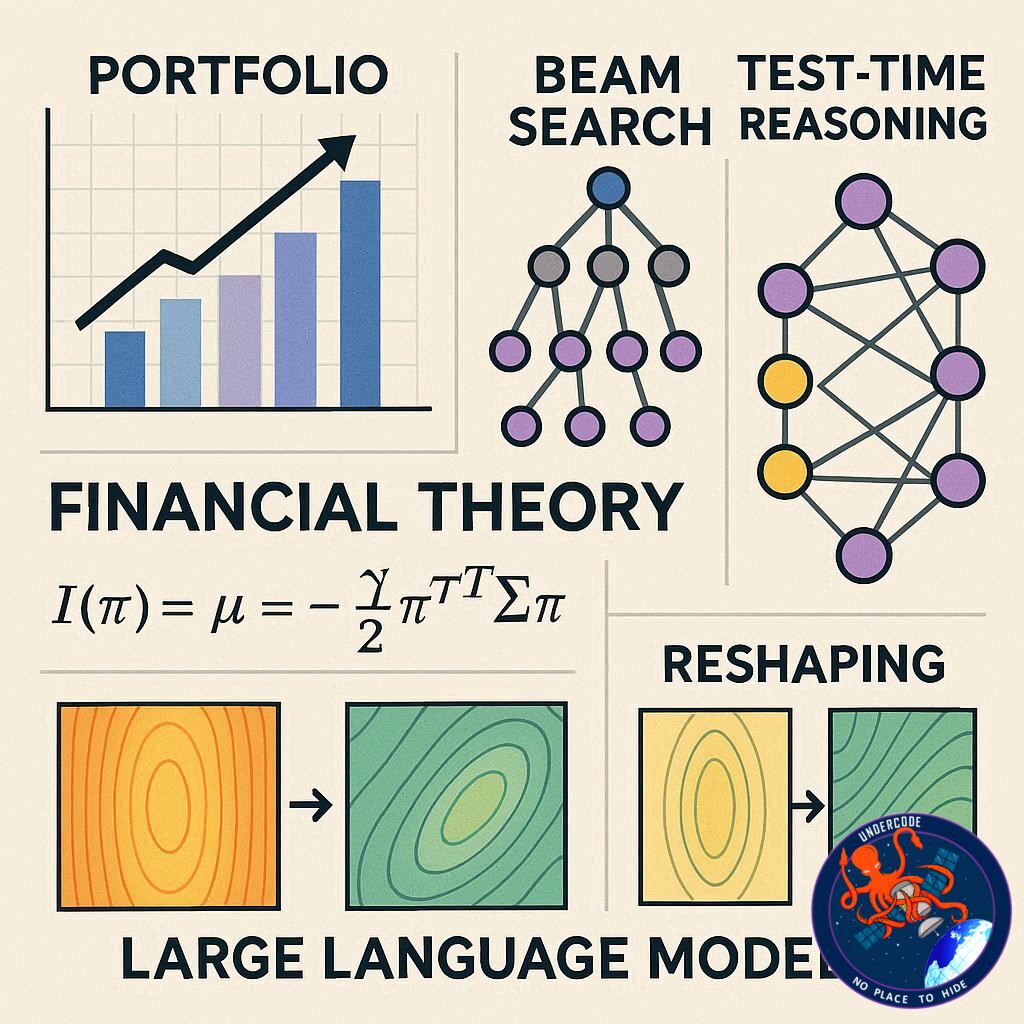
For years, progress in large language models followed a blunt formula: add more parameters, spend more money, and hope intelligence emerges. That era is cracking. Training ever-larger models is hitting economic and technical walls, pushing researchers toward a more surgical idea—test-time compute. Instead of building bigger brains, models are being taught to think longer and reason more carefully during inference. Portfolio Beam Search (PBS) enters this shift as a strikingly original proposal, borrowing ideas from financial portfolio theory to fundamentally rethink how language models explore reasoning paths when solving hard problems.
the Original
The article introduces Portfolio Beam Search (PBS), a decoding strategy designed to extract more value from a fixed test-time compute budget. Rather than greedily following the single highest-scoring reasoning path, PBS treats candidate solutions as financial assets and distributes computational resources across them in a risk-aware, diversified manner. This approach is motivated by the growing realization that scaling inference-time reasoning can rival or even outperform brute-force parameter scaling.
At the center of this framework are Process Reward Models (PRMs), which provide step-by-step feedback during reasoning instead of judging answers only at the end. Traditional decoding methods such as beam search or Best-of-N rely heavily on cumulative reward scores from these models, often leading to “tree collapse,” where early high-scoring paths dominate the search and crowd out potentially better alternatives.
PBS addresses this by reframing decoding as a portfolio-optimization problem inspired by Modern Portfolio Theory. Each candidate reasoning trajectory is treated as an asset with an expected return (its predicted quality) and risk (uncertainty and redundancy). The algorithm dynamically allocates the compute budget by balancing these factors, rather than blindly maximizing reward scores.
To operationalize this idea, PBS constructs a mean vector representing expected returns from PRM scores and a risk matrix that captures both uncertainty in the verifier and semantic similarity between candidates. Uncertainty is modeled through variance in the PRM’s outputs, acting as a proxy for out-of-distribution reasoning steps, while similarity is measured using semantic comparisons to prevent redundant reasoning paths.
At every inference step, PBS solves a constrained optimization problem that determines how much “investment” each candidate receives. Candidates with higher risk-adjusted value are expanded further, while redundant or unreliable ones are pruned. This creates a balanced exploration–exploitation trade-off that maintains diversity without wasting compute.
Empirical results on the MATH-500 benchmark show that PBS dramatically improves sample efficiency. A 1B-parameter model using PBS can match or exceed the performance of standard beam search and other advanced methods with up to eight times less compute. In practical terms, PBS allows smaller models to achieve accuracy levels previously associated with much larger architectures, highlighting the power of smarter inference over raw scale.
What Undercode Say:
Portfolio Beam Search is more than a clever decoding trick—it signals a deeper philosophical shift in how we think about intelligence in machine learning. Instead of assuming that better reasoning emerges from larger models, PBS assumes that reasoning itself is a resource allocation problem. This reframing is subtle but profound.
The analogy to finance is not cosmetic. In real markets, rational investors know that chasing the single highest-return asset is reckless. Risk, uncertainty, and correlation matter. PBS applies the same logic to inference, implicitly acknowledging that reward models are fallible, overconfident, and sometimes blind to their own uncertainty. By penalizing redundancy and uncertainty, PBS treats overconfident but fragile reasoning paths the way a cautious investor treats volatile stocks.
What stands out is how PBS operationalizes diversity. Many decoding methods gesture at “diverse reasoning,” but PBS enforces it mathematically. Semantic similarity becomes a quantifiable risk, not a vague preference. This makes diversity a first-class citizen in inference, rather than an afterthought patched on with heuristics.
There is also a strategic implication here: PBS weakens the dominance of massive models. If a 1B-parameter model can approach the performance of much larger systems simply by allocating inference compute more intelligently, the competitive landscape changes. Research dollars may shift away from trillion-parameter races and toward better search, verification, and uncertainty modeling.
However, PBS also raises hard questions. Its effectiveness depends heavily on the quality and calibration of the Process Reward Model. A poorly trained PRM could distort both expected return and risk estimates, leading the portfolio optimizer astray. In that sense, PBS does not eliminate reliance on verifiers—it deepens it.
Still, the framework is remarkably extensible. More advanced uncertainty estimators, richer similarity metrics, or domain-specific risk functions could be plugged in without breaking the core idea. PBS feels less like a finished product and more like an operating system for inference-time reasoning.
Ultimately, PBS suggests that the future of language models may look less like scaling laws and more like decision theory. Intelligence, in this view, is not just about knowing more—it is about betting wisely when you don’t know enough.
Fact Checker Results
The article’s claims about improved sample efficiency on MATH-500 are consistent with reported benchmark results.
The use of Modern Portfolio Theory is conceptually accurate and mathematically grounded.
Performance gains are real but remain limited to tested domains and compute scales.
Prediction
Portfolio Beam Search or similar risk-aware decoding strategies will become standard components in high-reliability AI systems. As inference costs dominate deployment budgets, methods that squeeze more reasoning out of fewer parameters will reshape how models are evaluated, trained, and monetized.
🕵️📝✔️Let’s dive deep and fact‑check.
References:
Reported By: huggingface.co
Extra Source Hub (Possible Sources for article):
https://www.instagram.com
Wikipedia
OpenAi & Undercode AI
Image Source:
Unsplash
Undercode AI DI v2
Bing
🔐JOIN OUR CYBER WORLD [ CVE News • HackMonitor • UndercodeNews ]
📢 Follow UndercodeNews & Stay Tuned:
𝕏 formerly Twitter 🐦 | @ Threads | 🔗 Linkedin | 🦋BlueSky | 🐘Mastodon


