
Listen to this Post
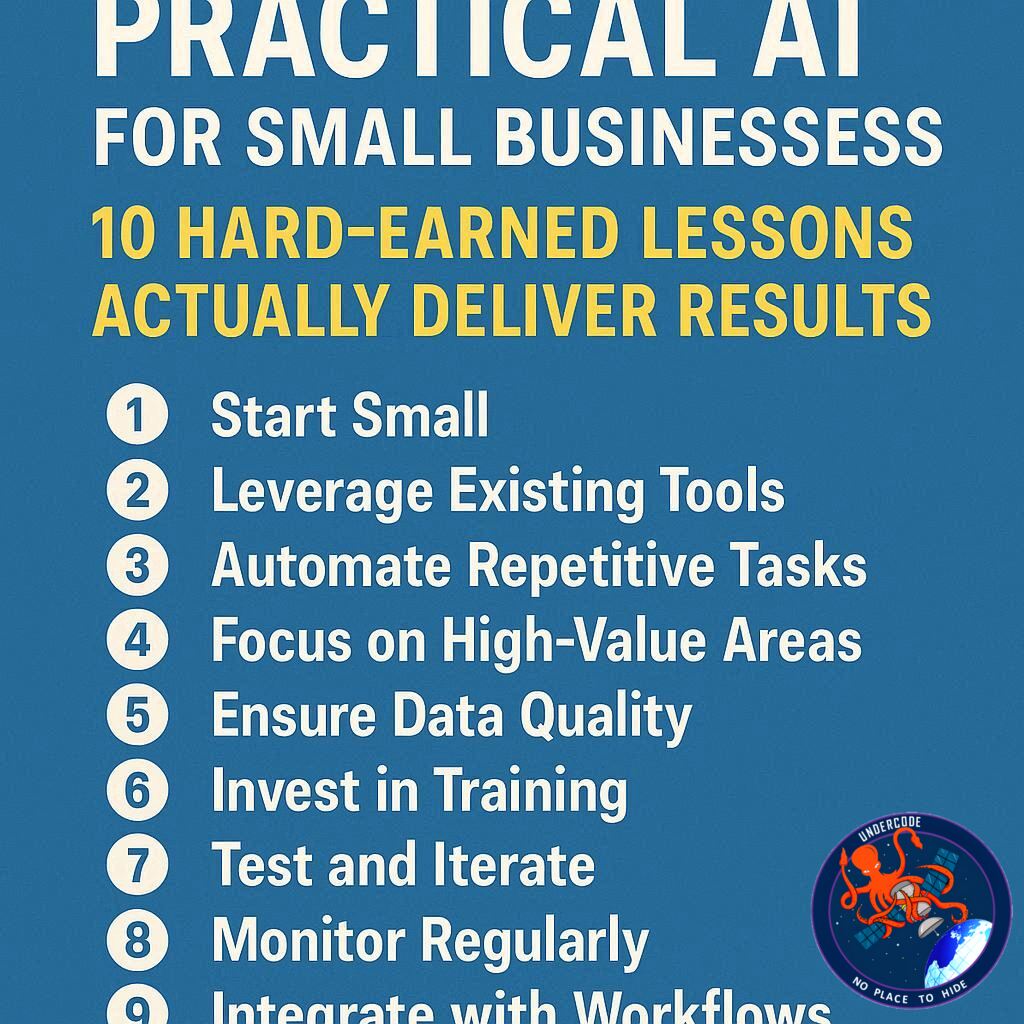 Introduction: Cutting Through the Noise Around AI in Small Business
Artificial intelligence has quickly become one of the most talked-about tools in modern business. Headlines promise massive productivity gains, yet the reality for small businesses often feels far more complicated. While large corporations report measurable growth, smaller firms sometimes struggle to see the same benefits. This contrast creates confusion, especially for entrepreneurs trying to decide whether AI is a smart investment or just another overhyped trend. The truth lies somewhere in between. AI can deliver real, measurable value, but only when used with intention, patience, and a clear focus on outcomes rather than excitement.
Summary: What Actually Works When Using AI in Small Business
The article highlights a grounded, experience-driven approach to adopting AI in small business environments, emphasizing that success comes from discipline rather than enthusiasm. It begins by challenging the idea that AI should be adopted simply because it is trending. Instead, businesses should treat AI like any other investment, only committing resources when there is a clear and direct benefit to operations, cost reduction, or revenue growth. The author strongly recommends starting with free AI tools such as chatbots to explore practical use cases without financial risk. These tools have improved significantly and can already deliver meaningful assistance for everyday tasks.
Financial caution is another key theme. Rather than committing to expensive annual subscriptions, businesses are encouraged to pay monthly until the value of a tool is fully proven. This flexible approach prevents unnecessary long-term costs and allows experimentation without pressure. The author shares a compelling example of spending $200 on a premium AI service for one month, generating multiple products during that time, and then downgrading once the need passed. This illustrates how short-term, targeted use can outperform long-term commitments.
Defining success is also critical. For small businesses, time is often the most valuable resource. AI should be evaluated based on how much time it saves rather than abstract productivity claims. A clear example is reducing a recurring two-hour task to ten minutes using AI-generated images. This kind of measurable efficiency gain is what makes AI worthwhile.
The article also explores practical applications such as using AI for quick data analysis. By uploading financial reports, businesses can receive summaries, trends, and insights that would otherwise take hours to produce. While this offers significant advantages, there is a reminder to remain cautious when sharing sensitive data with cloud-based tools.
Another major lesson is that AI should enhance human expertise, not replace it. AI tools require supervision and guidance, much like inexperienced employees. Without oversight, they can produce errors that cost more time to fix than they save. This is especially important in technical areas like coding. While AI-assisted programming can dramatically boost productivity for experienced developers, it can create major problems for those without technical knowledge.
Creativity is one area where AI shines. It can act as a brainstorming partner for ideas, content, and project planning. However, its outputs should always be reviewed critically, especially when dealing with technical or visual accuracy. The article emphasizes starting small, testing individual use cases, and gradually scaling successful implementations. This step-by-step approach allows businesses to understand AI’s strengths and limitations without overwhelming their operations.
Finally, the most important metric for evaluating AI is time saved. Financial returns may not be immediately clear, but time efficiency provides a reliable indicator of value. Over time, small gains accumulate into significant productivity improvements. The overall message is clear: AI is not a magic solution, but when used thoughtfully, it can become a powerful tool for small business growth.
What Undercode Say: The Real Strategy Behind Sustainable AI Adoption
The most important insight from this article is not about tools, but about mindset. Small businesses often fail with AI not because the technology is weak, but because expectations are unrealistic. There is a dangerous tendency to treat AI as a shortcut to instant scale, replacing thinking, planning, and expertise. That approach almost always backfires.
What stands out here is the disciplined focus on measurable outcomes. Time, not hype, is the true currency of AI value. When a business saves one hour per day, that translates into hundreds of hours per year. That reclaimed time can be reinvested into strategy, customer relationships, or product development. This is where AI becomes transformative, not by replacing humans, but by amplifying their capacity.
Another critical takeaway is the idea of controlled experimentation. Many businesses either overcommit too early or avoid AI entirely. The smarter path is iterative adoption. Test one use case, measure results, refine the process, then expand. This mirrors how successful companies adopt any new technology, from cloud computing to automation systems.
The financial strategy discussed is also more profound than it appears. Monthly subscriptions are not just about saving money, they create flexibility. In a rapidly evolving AI landscape, tools improve or become obsolete within months. Locking into long-term contracts can trap businesses in outdated solutions. Agility becomes a competitive advantage.
The warning about replacing human expertise deserves deeper attention. AI systems lack context, judgment, and accountability. They generate outputs based on patterns, not understanding. This makes them powerful assistants but unreliable decision-makers. Businesses that attempt to replace skilled workers with AI often end up spending more time correcting errors than they would have spent doing the work properly in the first place.
There is also an overlooked psychological factor. AI can create an illusion of productivity. Producing more content, more ideas, or more code does not necessarily mean better outcomes. Without clear goals and evaluation criteria, businesses risk becoming busier without becoming more effective. This is where defining “what a win looks like” becomes essential.
The article also indirectly highlights a shift in competitive dynamics. Small businesses now have access to tools that were once only available to large corporations. Data analysis, content creation, and automation are no longer limited by budget, but by strategy. This levels the playing field, but only for those who use these tools intelligently.
One of the most powerful ideas is the compounding effect of small efficiencies. Saving five minutes on multiple tasks each day might seem insignificant, but over time, these gains accumulate into substantial productivity improvements. This is how AI quietly transforms operations, not through dramatic breakthroughs, but through consistent, incremental gains.
The caution around AI coding is also strategically important. While AI lowers the barrier to entry, it does not eliminate the need for expertise. In fact, it increases the importance of oversight. Businesses that ignore this risk may face technical debt, security issues, or broken systems that are costly to fix.
Finally, the emphasis on gradual scaling reflects a broader truth about innovation. Sustainable growth comes from understanding, not speed. Businesses that rush AI adoption often encounter friction, resistance, and failure. Those that take the time to learn, adapt, and refine their approach are far more likely to succeed.
Fact Checker Results
✅ Large enterprises have reported productivity gains since AI adoption, but results vary significantly for small businesses
✅ Free AI tools like chatbots are widely accessible and increasingly capable for business use
❌ AI does not consistently improve productivity without proper implementation and human oversight
Prediction
📊 AI adoption in small businesses will shift from experimentation to structured workflows within the next 2–3 years
📊 Time-efficiency metrics will replace revenue-based ROI as the primary evaluation method for AI tools
📊 Businesses that combine human expertise with AI systems will outperform those attempting full automation
▶️ Related Video (84% Match):
🕵️📝✔️Let’s dive deep and fact‑check.
References:
Reported By: www.zdnet.com
Extra Source Hub (Possible Sources for article):
https://www.pinterest.com
Wikipedia
OpenAi & Undercode AI
Image Source:
Unsplash
Undercode AI DI v2
Bing
🔐JOIN OUR CYBER WORLD [ CVE News • HackMonitor • UndercodeNews ]
📢 Follow UndercodeNews & Stay Tuned:
𝕏 formerly Twitter 🐦 | @ Threads | 🔗 Linkedin | 🦋BlueSky | 🐘Mastodon


