
Listen to this Post
Introduction
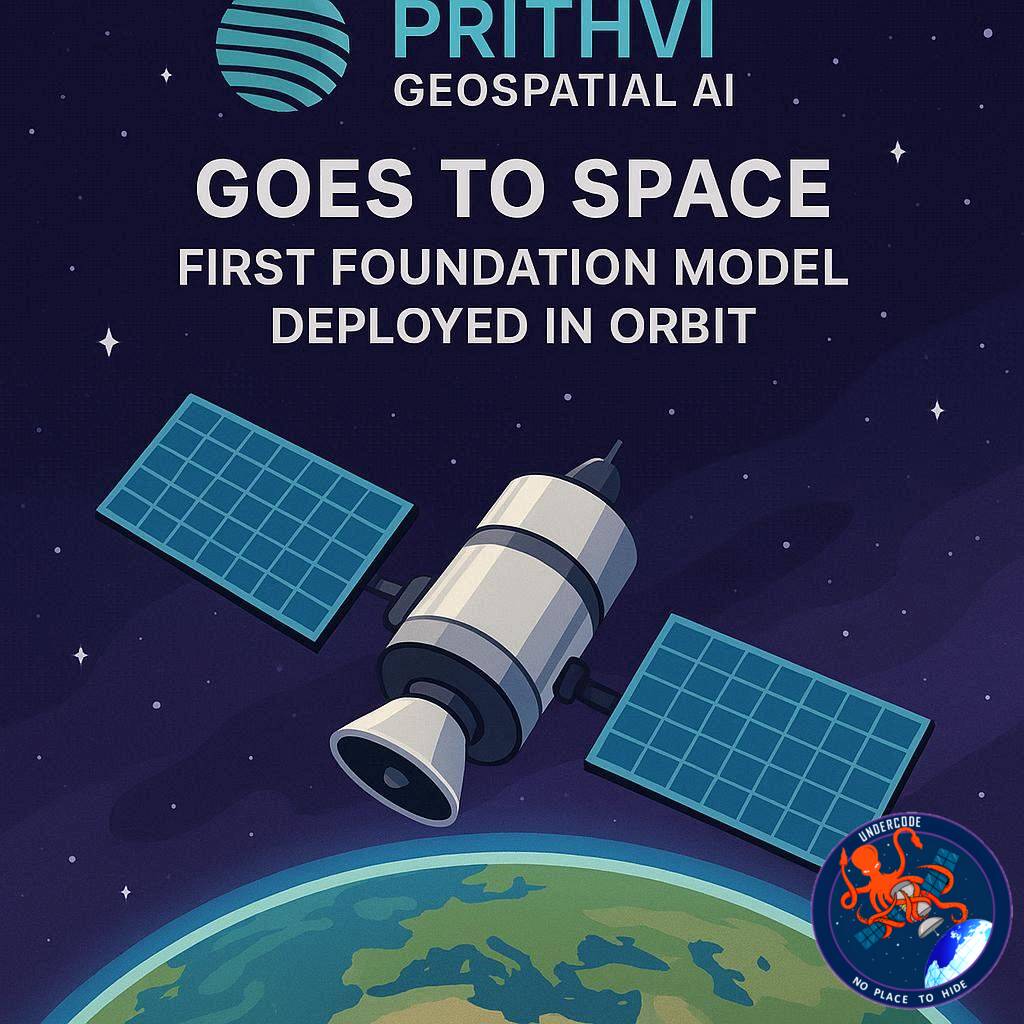
A new milestone in artificial intelligence and space technology has been achieved as researchers successfully deployed NASA and IBM’s open-source Prithvi Geospatial AI foundation model directly into orbit. This marks the first time a geospatial foundation model has operated in space, signaling a major shift in how Earth observation data could be processed in the future. Instead of relying solely on ground-based analysis, satellites may soon be able to interpret complex environmental data in real time while still in orbit.
Summary of the Original
A research collaboration between the University of Adelaide and the SmartSat Cooperative Research Centre in South Australia has successfully deployed a compressed version of the Prithvi Geospatial AI foundation model into orbit. This model was installed on two platforms: the South Australian government’s Kanyini satellite and the Thales Alenia Space IMAGIN-e payload aboard the International Space Station.
Prithvi, developed by NASA and IBM, is an open-source AI model trained on 13 years of Earth observation data. It is designed to perform multiple geospatial tasks such as flood detection, cloud identification, disaster monitoring, crop yield prediction, and land mapping.
The researchers tested the model across both orbital environments to evaluate its performance and adaptability. According to Dr. Andrew Du, the project’s lead researcher, the availability of an open-source foundation model significantly reduced development time since there was no need to train a model from scratch.
A foundation model is trained on vast amounts of unlabeled data, allowing it to learn general patterns that can later be fine-tuned with smaller labeled datasets for specific tasks. This makes it highly flexible compared to traditional specialized AI models.
NASA’s Kevin Murphy highlighted that releasing such models as open-source accelerates global scientific progress by enabling wider collaboration. The Prithvi model was originally trained using NASA’s Harmonized Landsat and Sentinel-2 dataset, combining over a decade of satellite observations from NASA and ESA missions.
Unlike traditional onboard satellite AI systems, which are often lightweight and task-specific due to bandwidth limitations, Prithvi introduces a more flexible architecture. Instead of uploading entirely new models, scientists can simply upload small decoder modules to adapt the system for new tasks, saving significant bandwidth.
This advancement could reshape how satellites process data, enabling near real-time analysis directly in orbit. Future applications may even include interactive systems where operators communicate with satellites using natural language, similar to conversational AI models.
NASA continues expanding its AI foundation model ecosystem, including projects like Surya for heliophysics, with plans to extend similar models into planetary science, astrophysics, and biological research domains.
What Undercode Say:
The deployment of Prithvi in orbit is not just a technical achievement, it represents a structural shift in how Earth observation systems are designed. Traditionally, satellites have acted as passive data collectors, sending raw or lightly processed data back to Earth for analysis. This new approach transforms them into active computational nodes capable of interpreting data in real time.
One of the most significant implications is bandwidth efficiency. Space communication remains expensive and limited, so reducing the need for large data transfers is a major advantage. By embedding intelligence directly into orbiting systems, only processed insights need to be transmitted, not raw datasets.
Another major insight is the role of open-source development in accelerating space innovation. NASA and IBM’s decision to make Prithvi publicly available has enabled research groups like the University of Adelaide to deploy advanced AI without the overhead of training large-scale models from scratch. This dramatically lowers the barrier to entry for space-based AI research.
The concept of foundation models itself is also critical here. Unlike narrow AI systems, these models learn generalized representations from vast datasets. In the context of Earth observation, this means a single model can adapt to multiple environmental tasks, from flood detection to agricultural monitoring, without requiring complete retraining.
This flexibility is particularly valuable in orbit, where hardware updates are impossible and software updates are constrained by communication delays and bandwidth limitations. The modular decoder approach described in the project solves this problem elegantly, allowing task-specific adjustments without redeploying entire systems.
There is also a broader strategic implication: satellites may evolve into autonomous analytical platforms. Instead of being passive imaging tools, they could become intelligent agents capable of decision-making, anomaly detection, and prioritizing which data to transmit.
The long-term vision hinted by researchers, where operators interact with satellites through natural language, suggests a convergence between space systems and large language model interfaces. This could simplify mission control operations and democratize access to satellite data.
However, challenges remain. Running AI models in space introduces constraints related to radiation, hardware reliability, and energy efficiency. Compressing foundation models without losing performance is another ongoing technical hurdle.
Despite these challenges, the successful deployment of Prithvi demonstrates that the direction of space-based AI is moving toward onboard intelligence rather than ground-dependent computation.
In the broader scientific ecosystem, this could lead to faster disaster response systems, improved climate monitoring accuracy, and more responsive environmental forecasting tools.
Ultimately, this development reflects a shift from data collection to data interpretation at the source, a transformation that may redefine how humanity observes and interacts with Earth from space.
Fact Checker Results
✅ The Prithvi model is an open-source foundation model developed by NASA and IBM.
✅ Deployment on orbiting platforms like satellites and ISS payloads has been reported by research teams.
⚠️ Real-world performance benchmarks in orbit are still limited to early demonstrations and testing phases.
Prediction
In the coming years, foundation models like Prithvi are likely to become standard components of satellite systems. We can expect increased automation in Earth observation, with satellites independently detecting environmental events such as floods, wildfires, and crop stress.
As hardware improves and compression techniques advance, onboard AI systems will likely expand beyond analysis into decision support roles. Eventually, satellites may operate as semi-autonomous scientific instruments capable of prioritizing data collection without direct human intervention.
A further evolution could involve multi-satellite AI networks sharing insights in orbit, creating a distributed intelligence layer above Earth that continuously monitors and interprets planetary activity in real time.
🕵️📝Let’s dive deep and fact‑check.
References:
Reported By: science.nasa.gov
Extra Source Hub (Possible Sources for article):
https://www.twitter.com
Wikipedia
OpenAi & Undercode AI
Image Source:
Unsplash
Undercode AI DI v2
Bing
🔐JOIN OUR CYBER WORLD [ CVE News • HackMonitor • UndercodeNews ]
📢 Follow UndercodeNews & Stay Tuned:
𝕏 formerly Twitter 🐦 | @ Threads | 🔗 Linkedin | 🦋BlueSky | 🐘Mastodon


