
Listen to this Post
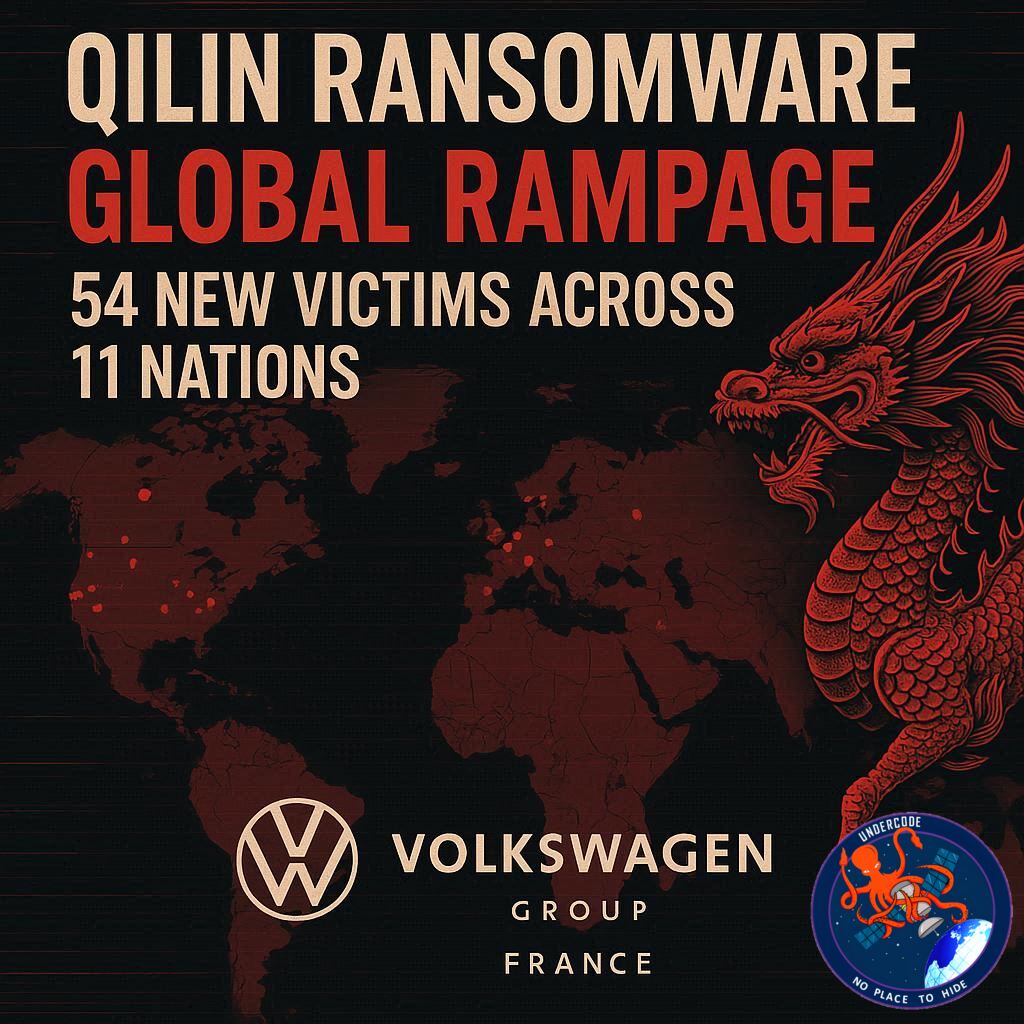
The cyber underworld has once again unleashed a storm. Qilin ransomware — one of the most active and notorious extortion gangs on the dark web — has listed 54 new victims in what experts are calling a “global ransomware spree.” The latest wave of attacks has hit organizations spanning the United States, France, Canada, Germany, Spain, Colombia, Taiwan, Argentina, Malaysia, Cyprus, and Grenada.
According to Dark Web Intelligence (@DailyDarkWeb), the victims’ names were recently published on Qilin’s leak site, suggesting that data exfiltration and encryption attacks have already taken place. Among the most notable victims are Volkswagen Group France, SICE (Spain), and Tong Yang Group (Taiwan) — signaling that both multinational giants and local firms are in Qilin’s crosshairs.
A Cyber Siege That Knows No Borders
The full list paints a grim picture of Qilin’s reach. It includes law firms, healthcare providers, local governments, universities, and corporations from multiple sectors. From JW Howard Attorneys and Massachusetts Bay Community College in the U.S., to Paris Rétina Vision in France, and UT Health Austin in Texas — the group’s campaign appears indiscriminate yet meticulously coordinated.
European victims include EURORDIS (the European Organization for Rare Diseases), Typology, and Urban Linker, alongside several French construction and design companies. In Asia, Tong Yang Group (Taiwan) and SFG Technology Sdn Bhd (Malaysia) stand out as key industrial targets, while Ditransa and Alqueria mark Colombia’s entry into the list. Even smaller municipalities like City of Riviera Beach, Florida and Town of Addis in the U.S. were not spared.
The pattern is clear: Qilin’s attacks span from the corporate boardroom to public institutions, disrupting both private and public infrastructures. By targeting diverse industries — from shipping and healthcare to automotive and architecture — the ransomware syndicate aims to maximize impact and pressure victims into paying.
Qilin’s modus operandi often involves double extortion tactics: stealing sensitive data before encrypting systems, and then threatening to leak or sell it if ransom demands aren’t met. Their leak site on the dark web functions as both a scoreboard and a tool of psychological warfare, publicly shaming victims and showcasing their power to the cybercriminal ecosystem.
Security analysts believe this coordinated strike may indicate that Qilin has expanded its affiliate network — enabling simultaneous attacks across different countries. Such affiliate-based models allow regional hackers to “license” Qilin’s ransomware toolkit in exchange for a share of the ransom profits, creating a scalable cybercrime franchise.
The mention of corporate giants like Volkswagen Group France raises alarm across Europe’s automotive and manufacturing sectors, both of which rely heavily on digital operations and vendor networks. A successful breach in one part of the supply chain could ripple through multiple business ecosystems, exposing sensitive production and logistics data.
Meanwhile, the inclusion of academic and healthcare entities — UT Health Austin and PQCNC Hospitals — reflects ransomware’s growing assault on institutions that handle critical data but often lack robust cybersecurity defenses. The breach of such organizations can endanger patient privacy, research data, and public trust.
Qilin’s resurgence also mirrors a broader trend: ransomware gangs are shifting from random attacks to strategic, global operations, blending professional branding, multilingual ransom notes, and even “customer support” chat portals for negotiation.
What Undercode Say:
This incident underscores a fundamental shift in the ransomware landscape — from opportunistic attacks to industrialized cyber extortion. Qilin’s latest spree isn’t just about profit; it’s a declaration of dominance. The group’s ability to compromise over fifty organizations across eleven nations signals a high level of coordination, technical sophistication, and resource availability.
Unlike smaller, transient ransomware cells, Qilin operates like a corporate entity: organized, scalable, and data-driven. Their leaks are timed for maximum psychological and financial impact, often following global business hours and media cycles. By listing all victims simultaneously, they amplify panic and attract widespread attention — a tactic reminiscent of marketing rollouts, but weaponized for fear.
What makes this particularly concerning is the diversity of targets. This isn’t a niche attack on one sector — it’s systemic disruption. From healthcare (UT Health Austin) to automotive (Volkswagen), from law firms to local governments, Qilin is mapping out the arteries of the global economy. Every hit increases leverage, visibility, and reputation within the dark web economy.
Moreover, the group’s focus on Western and developed economies suggests geopolitical undertones. While no confirmed state sponsorship has been linked to Qilin, their operations echo the precision of state-level cyber units — leveraging advanced persistence mechanisms, encrypted communication channels, and adaptive malware that can bypass traditional firewalls.
From an analytical standpoint, Qilin’s behavior aligns with the “ransomware-as-a-service” evolution. They act as the supplier, affiliates as distributors, and victims as revenue streams. This structure decentralizes risk while expanding reach. Each new affiliate potentially brings regional expertise — such as local-language phishing campaigns or knowledge of domestic business networks.
The involvement of French and German firms like Typology, Urban Linker, and ZEF’s Center for Development Research also exposes Europe’s growing vulnerability to cybercrime amid digital transformation. Despite GDPR and other regulations, many organizations underestimate the sophistication of new ransomware ecosystems, assuming legacy security systems are sufficient.
If unaddressed, such attacks can cascade into economic destabilization. A ransomware hit on a major manufacturer like Volkswagen doesn’t just stall production — it ripples through supply chains, dealerships, and financial institutions tied to the company’s operations.
The lesson here isn’t just about cybersecurity hygiene; it’s about resilience. Organizations must invest not only in prevention but also in rapid recovery capabilities — segmented backups, offline data storage, and transparent communication strategies. Qilin’s success thrives on chaos, secrecy, and delayed response.
The global nature of this attack reinforces one truth: ransomware is no longer a local crime. It’s a cross-border industry fueled by cryptocurrency, anonymity, and weak international coordination. Until global law enforcement creates unified frameworks for digital accountability, groups like Qilin will continue to thrive in the shadows.
Fact Checker Results:
✅ Qilin ransomware has officially listed 54 new victims on its leak site.
✅ Major companies such as Volkswagen Group France, SICE, and Tong Yang Group confirmed among them.
❌ No verified ransom payment disclosures yet from affected organizations.
Prediction: 🌐💀
Expect Qilin to escalate its operations into late 2025, with a focus on Europe’s industrial and healthcare sectors. As global law enforcement tightens tracking of crypto payments, ransomware groups may pivot to new extortion models — including data auctions and reputational blackmail. The next wave won’t just steal data; it will manipulate it, blending truth and fabrication to cause chaos on a psychological level.
🕵️📝✔️Let’s dive deep and fact‑check.
References:
Reported By: x.com
Extra Source Hub (Possible Sources for article):
https://www.reddit.com/r/AskReddit
Wikipedia
OpenAi & Undercode AI
Image Source:
Unsplash
Undercode AI DI v2
Bing
🔐JOIN OUR CYBER WORLD [ CVE News • HackMonitor • UndercodeNews ]
📢 Follow UndercodeNews & Stay Tuned:
𝕏 formerly Twitter 🐦 | @ Threads | 🔗 Linkedin | 🦋BlueSky | 🐘Mastodon


