
Listen to this Post
Introduction
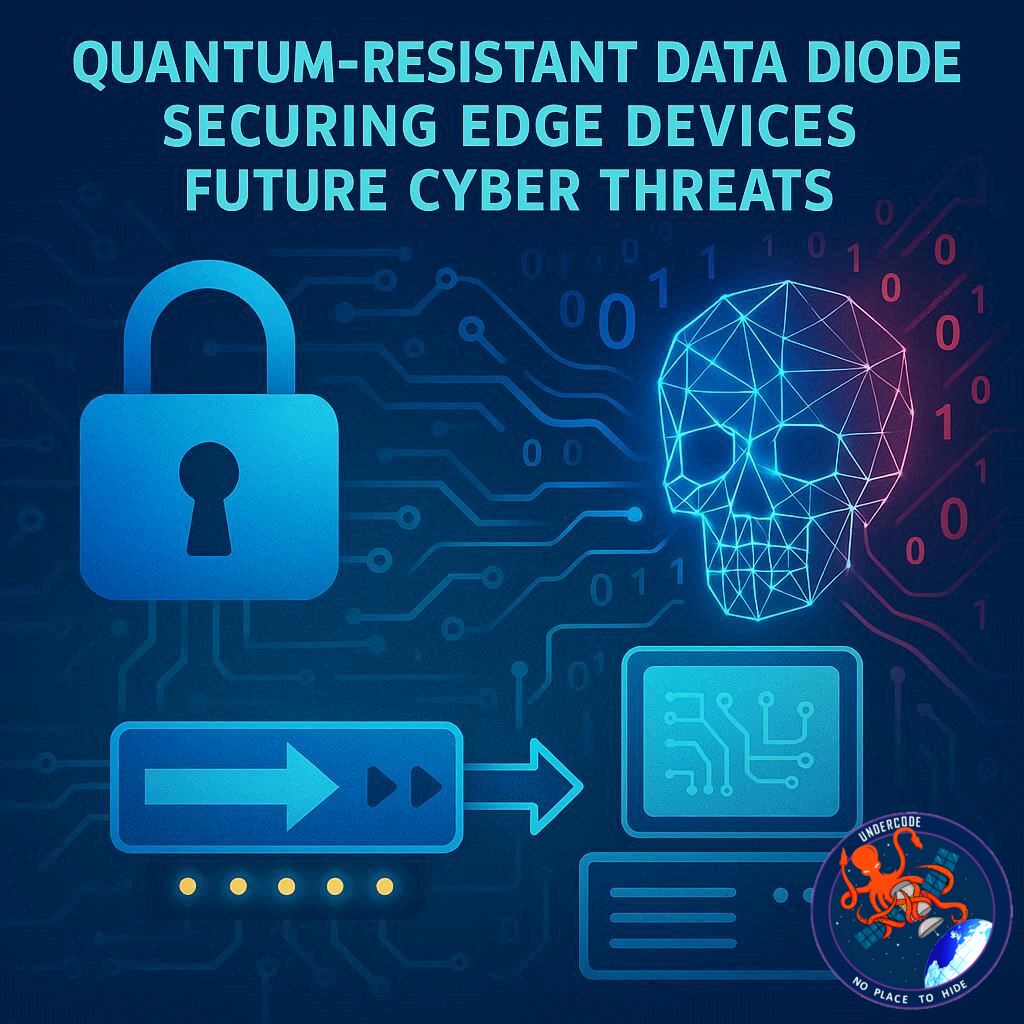
As quantum computing advances, the potential to break classical encryption threatens to compromise sensitive data across industries. Traditional cybersecurity measures, focused mainly on servers and central infrastructures, leave critical edge devices—such as satellites, industrial machinery, and research labs—vulnerable. Forward Edge-AI’s Isidore Quantum offers a revolutionary solution: a compact, low-power, quantum-resistant data diode designed to protect operational technology (OT) endpoints from the looming threat of quantum-enabled cyberattacks. This innovation represents a major leap in safeguarding sensitive data at the edge.
Protecting Edge Endpoints with Quantum-Resistant Hardware
Forward Edge-AI, a startup founded in 2020, has developed the Isidore Quantum device to secure sensitive OT endpoints. Unlike conventional approaches that primarily focus on servers and public key infrastructure (PKI), Isidore Quantum ensures data flows only one way out of critical systems while encrypting it with post-quantum cryptography (PQC) standards. Co-developed with the U.S. government and Microsoft, it offers organizations a proactive defense against attackers who might try to harvest encrypted data today and decrypt it with future quantum computers.
Validation Through Government Pilots
Ross Coffman, former deputy commanding general of the U.S. Army Futures Command and president of Forward Edge-AI, emphasizes that Isidore Quantum has been rigorously tested in 23 government pilots, including deployments with the Army, Navy, Air Force, and U.S. Space Force. The device is even operating on an autonomous vessel circumnavigating the globe, underscoring its readiness for high-stakes applications.
Addressing the Quantum Threat Timeline
Although the emergence of quantum processors capable of breaking AES encryption is uncertain, research estimates suggest such machines could appear between 2030 and the mid-2030s. This timeline places sensitive data currently in storage or in transit at significant risk. In response, U.S. federal guidance urges agencies to replace traditional encryption systems with quantum-safe protocols, highlighting the critical need for solutions like Isidore Quantum.
Applications Across High-Value Sectors
Isidore Quantum targets organizations that handle confidential or high-value data, including research institutions, utilities, manufacturing plants, energy facilities, satellites, and financial systems. Its small, palm-sized form factor allows it to protect edge devices without the need for extensive infrastructure overhauls.
Data Diodes: Unidirectional Security
Data diodes are network devices that allow data to flow in only one direction, preventing incoming cyber threats. Isidore Quantum supports NIST’s ML-KEM and ML-DSA quantum-resistant encryption standards, achieving sub-0.5 millisecond latency and up to 2 Gbps throughput—comparable to conventional Ethernet switches but in a far smaller, energy-efficient package. Its design is suitable for edge nodes, front-end OT equipment, and even satellites, ensuring high-speed, secure data transfer without slowing operations.
Unique Low-Power Design
The device is fanless, thermally optimized, and consumes less than 8 watts, making it practical for deployment across enterprise and public-sector environments. This low Size, Weight, and Power (SWaP) design differentiates Isidore Quantum from other data diodes that lack post-quantum readiness.
Advanced Encryption and AI Integration
Isidore Quantum includes three processors: two encryption units and a network interface device (NID). The encryption units enforce unidirectional AES-256 and PQC transfers over dual tunnels, while the NID uses machine learning to detect attack patterns and respond autonomously. This combination prevents side-channel attacks and man-in-the-middle exploits, essentially acting as a “perfect firewall” that generates ephemeral keys without relying on traditional certificate management systems.
Global Reach and Strategic Partnerships
Beyond U.S. military deployments, Forward Edge-AI has expanded internationally, with Taiwan’s National Central University deploying Isidore to protect research data. Strategic partners such as Lumen Technologies are integrating the device into managed security services for enterprises, including satellite communications and remote field operations.
Certification and Compliance
Isidore Quantum has achieved compliance with NIST’s FIPS 140-3 cryptographic standards and is supported by a certification program involving the NSA, Lumen Technologies, and partners from Japan and South Korea. This program ensures that trained specialists can deploy quantum-safe networks in mission-critical environments.
What Undercode Say: Analyzing the Edge Security Revolution
Forward Edge-AI’s Isidore Quantum represents a pivotal shift in cybersecurity strategy, addressing the blind spot of edge endpoints that traditional PQC roadmaps often ignore. By combining unidirectional data flow with post-quantum encryption, the device mitigates the harvest-and-decrypt-later (HNDL) threat, which is especially relevant for industries handling long-term sensitive information.
The compact, low-power design demonstrates an understanding of operational constraints in edge environments. Devices deployed in satellites, autonomous vessels, or industrial control systems cannot afford latency or high power consumption. Isidore Quantum solves this by maintaining Ethernet-level throughput while enforcing quantum-safe security protocols.
The integration of AI-driven network interface units adds an adaptive layer of defense. Unlike static firewalls, Isidore Quantum learns communication patterns across channels and executes autonomous responses, reflecting a shift toward proactive cybersecurity rather than reactive patching. This could redefine standards for operational technology in both civilian and military applications.
Forward Edge-AI’s strategy also underscores the importance of certification and interoperability. By collaborating with international partners and government agencies, the company is creating a quantum-safe ecosystem that goes beyond mere hardware, including human expertise in secure deployment.
From an analytical perspective, Isidore Quantum is an anticipatory solution. Given projected quantum computing advancements, organizations that delay quantum-resistant implementation risk massive exposure. The device allows incremental adoption—enterprises can protect specific high-risk nodes without overhauling entire infrastructures.
The combination of unidirectional flow, PQC encryption, low SWaP design, and AI-driven anomaly detection positions Isidore Quantum not just as a product but as a framework for the next decade of cybersecurity. It exemplifies how future-proof solutions must integrate cryptography, operational practicality, and intelligent defense mechanisms simultaneously.
Strategically, this device also raises the bar for competitors. While companies like Owl Cyber Defense, OPSWAT, and Waterfall Security Solutions offer traditional data diodes, Isidore Quantum is the first to claim true quantum-resistant protection for edge devices. Its patented architecture with three processors and dual encryption tunnels provides resilience that surpasses existing industry offerings.
Furthermore, the solution aligns with U.S. government directives, ensuring early adoption could position private and public organizations for compliance while simultaneously mitigating future risk. Its use in global research collaborations, including Taiwan’s NCU, illustrates cross-border applicability, which is increasingly critical in a connected world.
In essence, Forward Edge-AI’s approach demonstrates that quantum-resilient cybersecurity is no longer purely theoretical. By addressing high-risk edge nodes with a practical, certified, and AI-augmented solution, Isidore Quantum is setting a precedent for how organizations can defend sensitive data in the coming quantum era.
Fact Checker Results
✅ Isidore Quantum is validated by 23 government pilots, including U.S. military branches.
✅ The device uses post-quantum cryptography standards like ML-KEM and ML-DSA.
❌ Current quantum computers are not yet capable of breaking AES or RSA-2048 encryption.
Prediction
📊 Over the next decade, quantum-resistant edge devices like Isidore Quantum will become standard for critical infrastructure, satellites, and industrial OT systems. Companies adopting early may avoid costly breaches and gain a strategic advantage in both compliance and cybersecurity resilience. Emerging partnerships across Asia, Europe, and the U.S. will likely accelerate global deployment, making quantum-safe data diodes a new baseline in operational security.
▶️ Related Video (88% Match):
https://www.youtube.com/watch?v=IbXKdiGk6y0
🕵️📝✔️Let’s dive deep and fact‑check.
References:
Reported By: www.darkreading.com
Extra Source Hub (Possible Sources for article):
https://www.discord.com
Wikipedia
OpenAi & Undercode AI
Image Source:
Unsplash
Undercode AI DI v2
Bing
🔐JOIN OUR CYBER WORLD [ CVE News • HackMonitor • UndercodeNews ]
📢 Follow UndercodeNews & Stay Tuned:
𝕏 formerly Twitter 🐦 | @ Threads | 🔗 Linkedin | 🦋BlueSky | 🐘Mastodon


