
Listen to this Post
Introduction
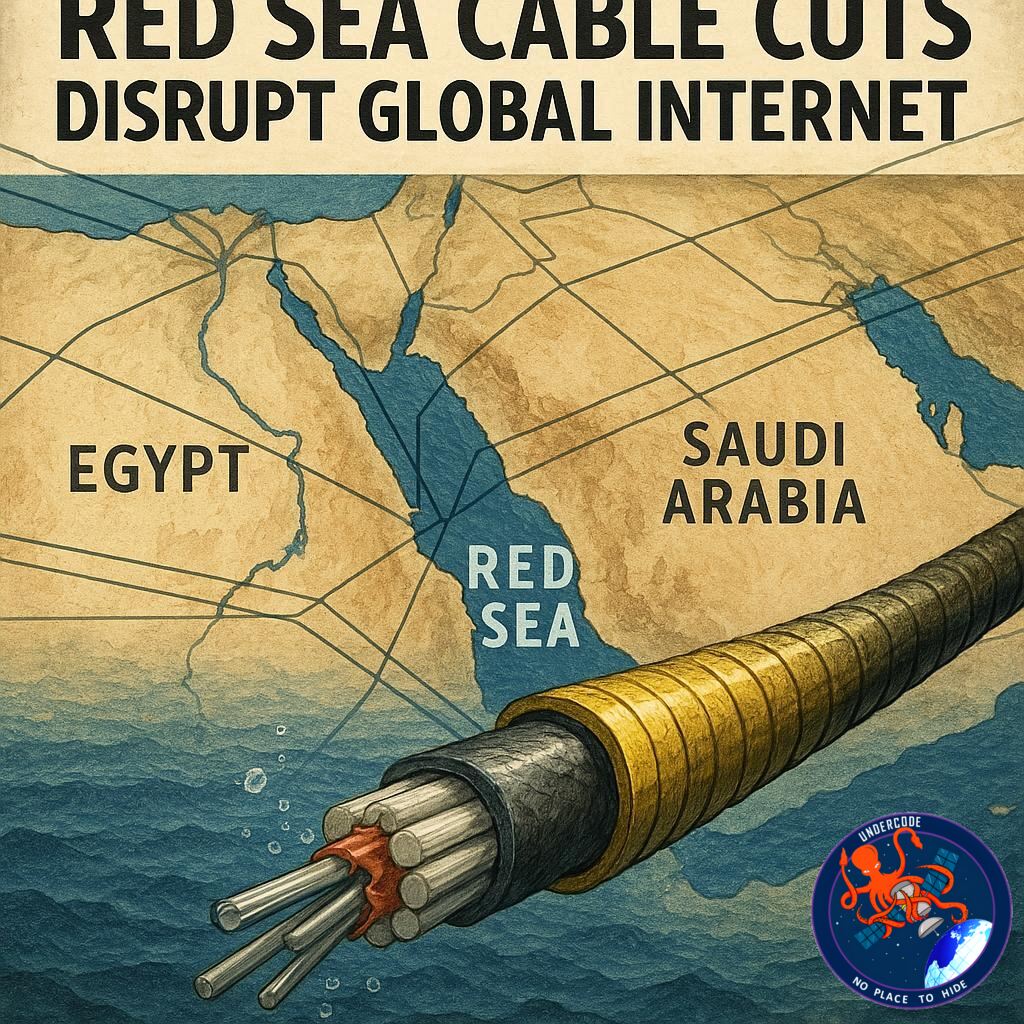
In today’s hyperconnected world, the internet is the backbone of global business, communication, and even national security. Yet, a series of undersea cable cuts in the Red Sea has exposed just how fragile this system can be. The disruption has rippled across major regions—including India, Saudi Arabia, Pakistan, and the UAE—slowing connectivity, straining cloud services, and causing significant latency issues. As nations and corporations scramble to restore normalcy, the incident has once again highlighted the strategic vulnerability of one of the world’s most important digital arteries.
the Original
The Red Sea is one of the most critical routes for global telecommunications, carrying nearly 17% of the world’s internet traffic between Europe, Asia, and Africa. Recently, multiple undersea cables in this region were damaged, resulting in widespread connectivity issues across the Middle East and South Asia.
Microsoft confirmed on its status page that customers in the Middle East were facing higher latency due to the cuts, although Azure services were eventually restored. According to Bloomberg, repairing cables in the region has become increasingly difficult amid ongoing Houthi rebel attacks on commercial vessels.
Experts suggest that undersea cables are vulnerable to various causes of damage, including ship anchors, accidental mishaps, or deliberate targeting. The current disruptions coincided with heightened conflict in the region, as Yemen’s Houthi rebels intensified their operations linked to the Israel-Hamas war. Yemen’s internationally recognized government blamed the Houthis directly, calling the attacks a threat to the world’s digital lifeline.
Reports confirmed that Pakistan, Saudi Arabia, Kuwait, India, and the UAE were among the most affected regions. Network monitoring company NetBlocks traced the outages to failures in two key cable systems near Jeddah, Saudi Arabia: SMW4 (operated by Tata Communications) and IMEWE (managed by a consortium led by Alcatel Submarine Networks). These failures caused severe disruptions for telecom providers like Etisalat and Du in the UAE, with users experiencing slow speeds and intermittent connections.
The incident underscores not only the Red Sea’s vital role in global internet infrastructure but also the growing geopolitical risks threatening digital stability worldwide.
What Undercode Say:
The undersea cable cuts in the Red Sea are not just a technical glitch—they are a powerful reminder of how vulnerable our interconnected world is to geopolitical instability. The global internet feels like an invisible cloud, but in reality, it depends on thousands of kilometers of fragile fiber-optic cables lying on the ocean floor. When those cables are damaged—whether by accident or intention—the ripple effects can be devastating.
What makes this case particularly alarming is the mix of technical vulnerability and political conflict. The Red Sea, a vital chokepoint for global trade and digital communication, is also a battlefield for power struggles. The Houthis have already demonstrated their ability to disrupt global shipping, and now, whether directly or indirectly, internet infrastructure is caught in the crossfire.
From an economic perspective, the consequences are massive. Financial transactions, e-commerce, cloud computing, and even video conferencing rely on stable, low-latency internet connections. When cables are cut, businesses lose productivity, banks face transaction delays, and millions of ordinary users struggle to stay connected. Countries like India and the UAE, which have thriving tech and business ecosystems, face immediate economic risks when connectivity slows.
This also raises a larger strategic question: how prepared are we to secure our digital arteries? Unlike satellites, which can be better shielded and rerouted, undersea cables are physical objects vulnerable to human error, natural disasters, and armed conflicts. Yet, governments and corporations often treat them as secondary infrastructure, only realizing their importance when disaster strikes.
The repairs themselves are complicated. Specialized ships are needed to locate, retrieve, and repair the cables—a process that can take weeks or even months. Add to that the security threats in the Red Sea, and the timeline for full restoration becomes unpredictable.
Looking forward, global cooperation will be essential. Protecting undersea cables cannot be left to one nation or one company—it requires coordinated international security, diversified routing, and even investment in alternative technologies like satellite internet. However, even those alternatives have limits; satellites cannot yet handle the sheer volume of data carried by fiber optics.
The broader lesson is clear: the internet is not as invincible as it seems. Just as energy pipelines or oil routes can be geopolitical flashpoints, so too can digital infrastructure. As digital dependence grows, so does the incentive for hostile groups to weaponize connectivity. The Red Sea incident should serve as a wake-up call not only for the Middle East but for every nation reliant on the seamless flow of data.
🔍 Fact Checker Results
✅ 17% of global internet traffic passes through the Red Sea (widely reported by telecom experts).
✅ SMW4 and IMEWE cable failures confirmed by NetBlocks and international operators.
❌ No direct evidence yet proving Houthis intentionally cut the cables, though their involvement is suspected.
📊 Prediction
The Red Sea cable disruption is likely to accelerate global discussions on digital infrastructure security. Expect more investment in redundancy, such as additional cable routes through the Mediterranean and terrestrial fiber across Asia. Satellite providers like Starlink may see increased demand as backup solutions, particularly in regions prone to conflict. However, the strategic importance of the Red Sea ensures that similar disruptions will continue to pose risks unless stronger international protections are put in place.
🕵️📝✔️Let’s dive deep and fact‑check.
References:
Reported By: timesofindia.indiatimes.com
Extra Source Hub:
https://stackoverflow.com
Wikipedia
OpenAi & Undercode AI
Image Source:
Unsplash
Undercode AI DI v2
🔐JOIN OUR CYBER WORLD [ CVE News • HackMonitor • UndercodeNews ]
📢 Follow UndercodeNews & Stay Tuned:
𝕏 formerly Twitter 🐦 | @ Threads | 🔗 Linkedin | 🦋BlueSky | 🐘Mastodon


