
Listen to this Post
A New Challenger in the Smart Glasses Race
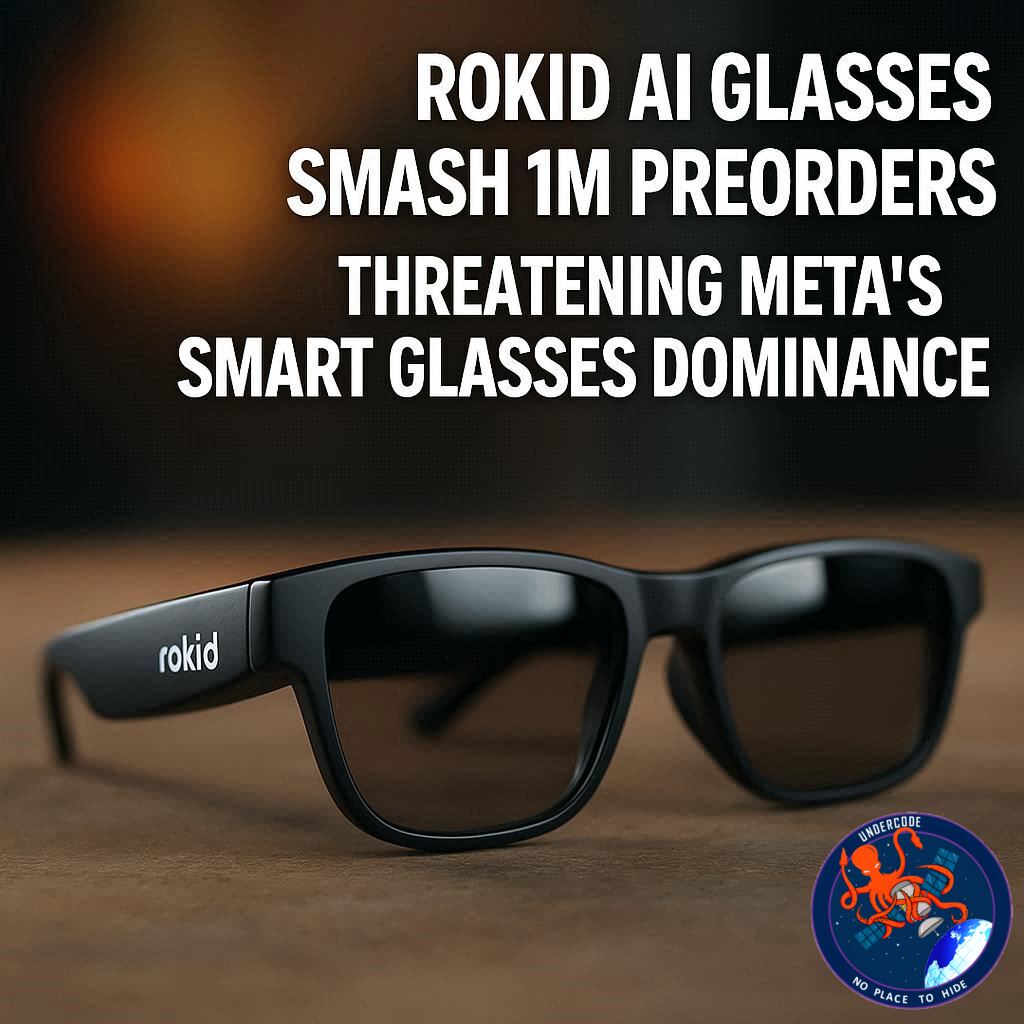
The smart glasses market has been heating up, dominated largely by Meta’s Ray-Ban collaborations. But a new contender, Rokid, is now stealing the spotlight. In just three days, Rokid’s Kickstarter campaign skyrocketed past \$1 million in pre-orders, far surpassing its modest \$20,000 goal. This unexpected surge highlights both consumer appetite for next-generation wearable tech and the growing competition Meta faces as more brands step into the arena.
Rokid is not a newcomer. Founded in 2014, the company has long specialized in smart devices, particularly AR glasses and immersive experiences. Their latest product, Rokid Glasses, aims to merge the everyday convenience of smart glasses with advanced augmented reality capabilities. With native ChatGPT integration, support for 89 languages, a heads-up display, and sleek design at just 49 grams, these glasses are positioning themselves as a more feature-rich alternative to Meta’s Ray-Bans.
Rokid’s Meteoric Rise in Pre-Orders
On August 26, Rokid launched its campaign with a goal to raise \$20,000 by October 10. Instead, it crossed the million-dollar mark within 72 hours. This isn’t just a lucky break—it’s a sign that the market is hungry for alternatives to Meta’s ecosystem.
Globally, Rokid has already secured over 300,000 orders, many of which likely come from retailers and distribution partners. The Kickstarter campaign in the U.S. represents a smaller portion, with around 2,500 orders as of September 5, but it underscores the brand’s ability to attract international attention.
The retail price is set at \$599, but early backers enjoy a 20% discount, making the device available at \$479. Rokid expects to ship the glasses by November 2025, with mass production kicking off in October.
Key Features That Outshine Meta Ray-Bans
Rokid Glasses don’t just compete—they surpass Meta’s Ray-Bans in several areas:
Language support: 89 vs. Meta’s 4
Photo orientation: Horizontal and vertical vs. only vertical
Battery: 210 mAh vs. 154 mAh
AI integration: ChatGPT vs. Meta’s Llama model
Audio memos: Built-in vs. no equivalent
Lens system: Magnetized pop-in vs. fixed traditional lenses
Despite these upgrades, Rokid maintains the same weight and sleek look as Meta’s flagship Wayfarer-style Ray-Bans.
The Market Context and Competition
Meta is preparing to unveil its highly anticipated “Hypernova” smart glasses at its Meta Connect event on September 17. With a rumored \$800 price tag, a color screen in one eye, and gesture controls via a neural wristband, Hypernova aims to push boundaries. Alongside it, Meta is also expected to refresh its Ray-Ban lineup with more affordable models (\$300–\$500) to maintain mass-market dominance.
Other competitors, including Samsung with its teased Galaxy Glasses, and startups like Brilliant Labs, are also eyeing this space. However, Rokid stands out because it bridges the gap—more advanced than entry-level audio glasses but less futuristic (and less expensive) than Hypernova.
Consumer Appeal and Adoption Strategy
Rokid’s strength lies in appealing to early adopters—those who value features and innovation over brand prestige or fashion variety. While Meta relies on Ray-Ban’s iconic styling and broad retail network, Rokid offers cutting-edge tech for enthusiasts who want more than a stylish accessory.
Regional variations will further enhance adoption: in China, the glasses support wireless payments, while in the U.S. and global markets, turn-by-turn navigation will be included. By tailoring features to markets, Rokid is attempting a localization strategy that Meta hasn’t fully embraced.
What Undercode Say:
Rokid’s breakthrough in the smart glasses market is more than just a Kickstarter success story—it’s a signal of shifting consumer expectations. The days when smart glasses were simply about pairing fashion with lightweight tech are ending. Users increasingly want functional AI integration, seamless utility, and AR capabilities. Rokid is capitalizing on that demand.
The \$1 million in pre-orders doesn’t only showcase hype; it also validates the company’s global reach and credibility. With 300,000 units already ordered worldwide, Rokid has momentum that many startups never achieve. Unlike small crowdfunded gadgets that never see mass production, Rokid is well-established, with over a decade of hardware development and partnerships across industries. This makes its Kickstarter more of a marketing campaign than a funding necessity.
Still, challenges remain. Meta’s Ray-Ban partnership gives it unmatched retail access, brand recognition, and style variety. For many consumers, glasses are fashion-first, tech-second. Rokid risks being seen as the “nerdy” alternative unless it finds ways to make its product appealing beyond early adopters.
Price positioning is another key factor. At \$599 retail, Rokid sits in a delicate spot—cheaper than Meta’s Hypernova but pricier than basic Ray-Bans. This may restrict its mass-market adoption, leaving it primarily in the hands of tech enthusiasts rather than mainstream consumers.
The localization strategy is smart, but it could fragment the product line. Different features in different regions might create uneven experiences, making global marketing more complex. Meta’s universal product strategy ensures consistency, something Rokid will need to balance carefully.
Ultimately, Rokid has carved itself a niche as the feature-packed alternative in a market dominated by brand-driven players. If it can leverage partnerships, refine its retail strategy, and maintain strong supply chains, it could grow into a serious competitor—not just to Meta, but also to Samsung and Google as they re-enter the space.
The coming months will be pivotal. Meta’s September announcements could overshadow Rokid if they deliver a true game-changer. However, Rokid’s momentum demonstrates that there is room for multiple winners in this emerging market. If it delivers on its promises in November 2025, Rokid might become the first real disruptor to challenge Meta’s wearable dominance.
🔍 Fact Checker Results
✅ Rokid surpassed \$1M in pre-orders in under 72 hours.
✅ Features like ChatGPT integration and 89-language support are confirmed.
❌ Retail dominance in the U.S. is still uncertain, as Meta maintains stronger distribution.
📊 Prediction
By late 2026, Rokid will likely establish itself as a solid second player in the smart glasses market, behind Meta but ahead of smaller startups. If Meta’s Hypernova remains niche due to its high price, Rokid’s \$599 option could appeal to practical tech adopters. Long-term, expect the market to split between fashion-driven smart glasses (Meta/Ray-Ban) and feature-heavy AI glasses (Rokid and others)—with Samsung and Google eventually weighing in.
🕵️📝✔️Let’s dive deep and fact‑check.
References:
Reported By: www.zdnet.com
Extra Source Hub:
https://www.quora.com/topic/Technology
Wikipedia
OpenAi & Undercode AI
Image Source:
Unsplash
Undercode AI DI v2
🔐JOIN OUR CYBER WORLD [ CVE News • HackMonitor • UndercodeNews ]
📢 Follow UndercodeNews & Stay Tuned:
𝕏 formerly Twitter 🐦 | @ Threads | 🔗 Linkedin | 🦋BlueSky | 🐘Mastodon


