
Listen to this Post
Introduction
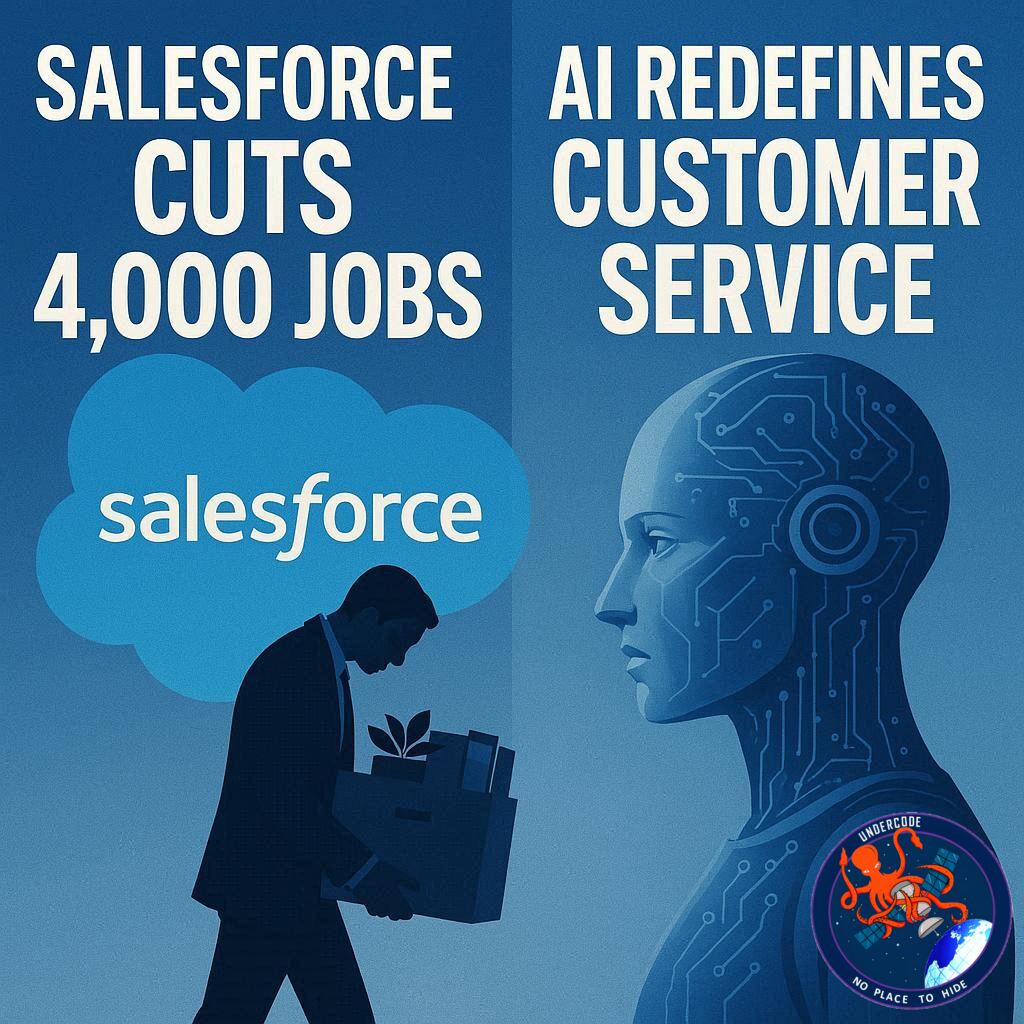
Salesforce, a global leader in cloud-based software, is making a dramatic pivot in its workforce strategy. CEO Marc Benioff announced that 4,000 customer support roles have been eliminated, with artificial intelligence now handling nearly half of all client interactions. The decision reflects a sweeping transformation not just in customer support, but in how AI reshapes entire business operations—from sales to productivity. Yet, the move also raises questions about the future of employment, given Benioff’s earlier promises that AI would augment rather than replace human workers.
Salesforce Slashes Support Roles Amid AI Takeover
Salesforce CEO Marc Benioff confirmed that the company has reduced its customer support workforce from 9,000 to 5,000 employees, marking a nearly 45% cut. Speaking on the Logan Bartlett podcast, Benioff explained, “I was able to rebalance my headcount on my support. I’ve reduced it from 9,000 heads to about 5,000 because I need less heads.”
The cuts follow Salesforce’s successful integration of AI agents that now manage 50% of customer conversations, while human agents oversee the remaining cases. Benioff described this transformation as “eight of the most exciting months of my career,” crediting AI for tackling challenges that humans alone could not address.
AI Clears a Historic Backlog of Sales Leads
The company’s AI adoption goes beyond customer support. Benioff revealed that Salesforce had accumulated over 100 million uncalled sales leads during its 26-year history due to a lack of staff. AI-powered “agentic sales” systems are now reaching out to every prospect, handling tasks that were previously unimaginable at scale.
Central to this shift is Salesforce’s “omnichannel supervisor,” a coordination layer that allows AI and human agents to work together. Much like Tesla’s self-driving mode, AI determines when it needs to hand off tasks to humans, ensuring oversight in complex cases.
Benioff’s Changing Tone on AI Job Losses
The layoffs come just months after Benioff publicly downplayed the risks of AI-driven unemployment. In July 2025, he argued in a Fortune interview that AI would “augment, not replace” workers and dismissed predictions of massive job displacement from leaders like Dario Amodei of Anthropic.
At the time, Benioff stressed that AI’s 90% accuracy rate meant humans would remain essential for fact-checking and oversight. He insisted, “The humans are not going away.” Furthermore, he announced Salesforce would avoid hiring new engineers, lawyers, or service agents, focusing instead on expanding sales staff to help customers adopt AI tools.
The latest move, however, contradicts these assurances. By cutting 4,000 jobs, Salesforce has demonstrated that AI efficiency gains can—and do—lead to significant workforce reductions, even if the broader company still employs more than 76,000 people.
What Undercode Say:
Salesforce’s latest move is a textbook case of corporate AI disruption. On one hand, the company has solved one of its longest-standing problems: the inability to handle massive volumes of customer leads and service requests. On the other hand, it has exposed the reality that AI adoption inevitably reshapes labor markets—often at the expense of human jobs.
The reduction of 4,000 support positions is not just a number—it represents a strategic shift. By allowing AI to handle 50% of customer interactions, Salesforce has essentially declared that human capacity is no longer necessary at previous levels. This means the traditional model of scaling service teams as the business grows is now obsolete.
What stands out most is the contradiction between Benioff’s July assurances and September actions. In July, he dismissed fears of AI-induced unemployment, positioning Salesforce as a champion of augmentation rather than replacement. But in September, the company delivered one of the largest AI-related workforce cuts in the enterprise software sector. This is a lesson in how fast executive narratives can shift when efficiency gains become too compelling to ignore.
Another crucial point is the sales backlog story. For decades, Salesforce sat on 100 million untouched leads. Humans couldn’t catch up—but AI could. This shows how AI is not merely a cost-saving tool but also a revenue driver. By reaching out to previously untapped prospects, AI isn’t just replacing labor—it’s expanding business opportunities that humans could never fully exploit.
However, the Tesla comparison is telling. Just as self-driving cars still need human oversight, Salesforce’s AI requires human intervention when it encounters ambiguity. This hybrid model may be the future of enterprise AI: machines handle scale and routine, humans handle nuance and exceptions.
But the shadow hanging over this progress is workforce morale. Employees who once believed AI would be a support system now see it as a competitor. This could influence retention, recruitment, and Salesforce’s corporate reputation. Customers, too, may wonder whether the company is prioritizing efficiency over empathy in its service model.
Ultimately, Salesforce’s pivot illustrates the inevitable reality: AI will displace jobs, even in companies that claim otherwise. The promise of augmentation cannot fully shield workers from the efficiency logic of corporations. The challenge now is not whether AI will replace people—it’s how fast, in which sectors, and how companies will manage the social fallout.
🔍 Fact Checker Results
✅ Salesforce confirmed 4,000 job cuts, reducing support staff to 5,000.
✅ AI now handles 50% of Salesforce customer conversations.
❌ Benioff’s July claims that AI “wouldn’t cause mass unemployment” directly contradict the September layoffs.
📊 Prediction
Salesforce’s move will likely spark a broader trend across the tech industry. Competitors like Oracle, SAP, and Microsoft may accelerate AI adoption in customer service and sales, leading to further layoffs in white-collar roles. While AI-human collaboration will remain crucial, companies will increasingly favor machines for efficiency and scale. Over the next 12–18 months, more CEOs who once dismissed AI job loss fears will face the same contradiction as Benioff—publicly downplaying risks while privately cutting staff to embrace automation.
🕵️📝✔️Let’s dive deep and fact‑check.
References:
Reported By: timesofindia.indiatimes.com
Extra Source Hub:
https://www.quora.com/topic/Technology
Wikipedia
OpenAi & Undercode AI
Image Source:
Unsplash
Undercode AI DI v2
🔐JOIN OUR CYBER WORLD [ CVE News • HackMonitor • UndercodeNews ]
📢 Follow UndercodeNews & Stay Tuned:
𝕏 formerly Twitter 🐦 | @ Threads | 🔗 Linkedin | 🦋BlueSky | 🐘Mastodon


