
Listen to this Post
Introduction: A Brewing Crisis Inside Samsung’s Semiconductor Powerhouse
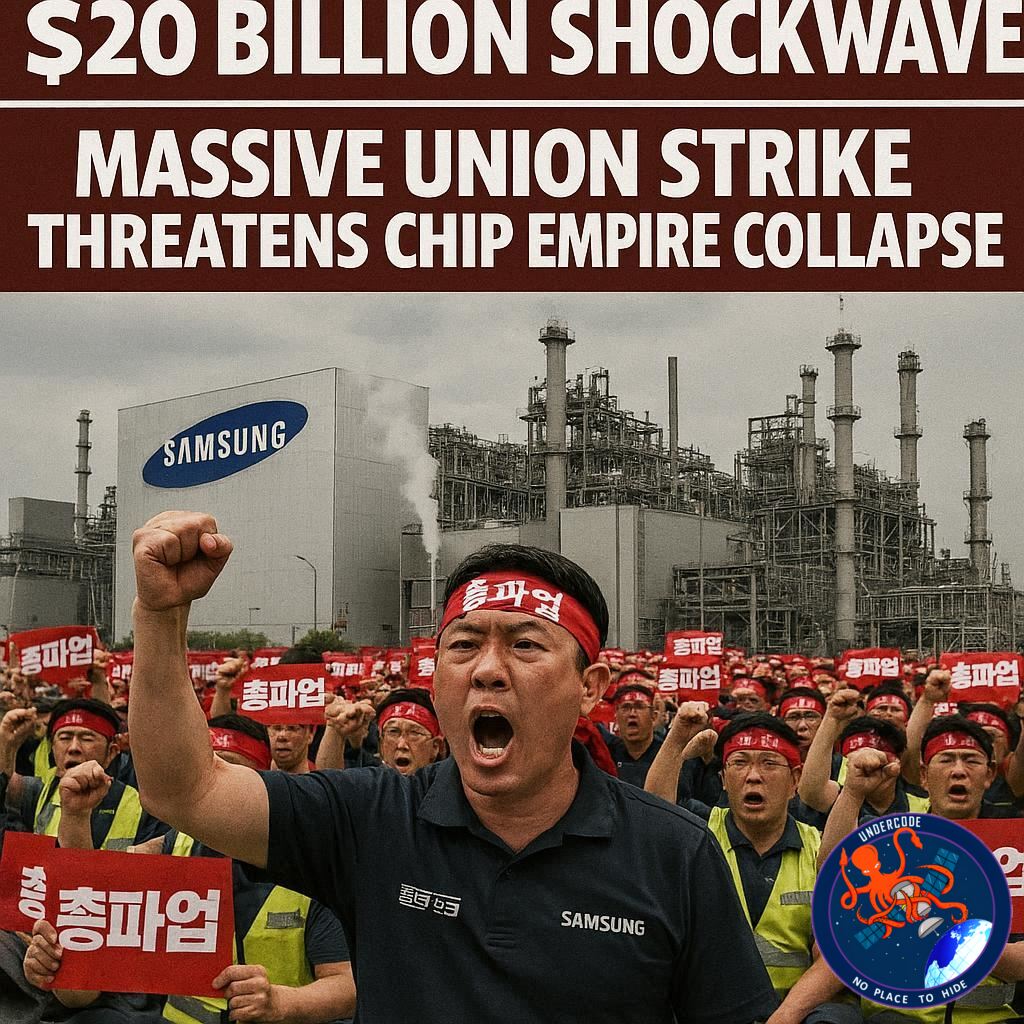
Samsung Electronics is standing at the edge of a major industrial disruption as labor tensions escalate into a potential full-scale strike. With over 40,000 workers prepared to walk out, the company’s semiconductor division—one of the most advanced in the world—faces production instability that could ripple through the global chip market. At stake are not just bonuses and incentives, but billions in output, supply chain stability, and national economic pressure in South Korea.
Full Summary: Samsung’s Strike Standoff and Semiconductor Risk Spiral
The largest labor union at Samsung Electronics has warned it may launch a full strike starting May 21 if its demands for bonuses and improved incentives are not met.
The dispute centers on long-standing disagreements over compensation and working conditions.
More than 40,000 employees are reportedly prepared to participate in the strike action.
If the strike proceeds, analysts estimate losses could reach up to $20 billion in production impact.
Negotiations between union leaders and management have repeatedly broken down.
A recent round of talks failed, leaving both sides without a clear resolution path.
The semiconductor division is especially vulnerable due to its complex manufacturing ecosystem.
Chip production relies on ultra-advanced equipment and highly synchronized processes.
Unlike traditional manufacturing, semiconductor output cannot be quickly paused or restarted.
Any shutdown requires a carefully planned “warm-down” process that takes at least a week.
Immediate production halts risk damaging expensive wafers and equipment stability.
To mitigate losses, Samsung may reduce wafer input rather than fully stop production.
The company is also considering shifting output toward higher-margin chips like HBM.
Such adjustments aim to preserve profitability during potential labor disruptions.
However, scaling production down is itself a costly and delicate operation.
Global demand for memory chips is currently in a sensitive supply cycle phase.
A disruption could tighten supply and increase volatility in semiconductor pricing.
The South Korean government is reportedly monitoring the situation closely.
Authorities are concerned about broader economic consequences if a strike occurs.
Samsung remains one of the country’s most critical export-driven corporations.
Its semiconductor exports significantly influence national trade performance.
Union leaders maintain their position that demands must be met before May 21.
Management has not yet announced any agreement or compromise.
The deadlock continues to intensify pressure on both sides.
Industry observers warn that prolonged disruption could reshape market dynamics.
Competitors may benefit if Samsung’s output temporarily declines.
Supply chain customers could face delays in chip allocation.
The situation remains unresolved as the deadline approaches rapidly.
All eyes are now on whether last-minute negotiations will succeed.
Failure to reach an agreement could trigger one of Samsung’s most expensive labor crises in years.
What Undercode Say:
The crisis at Samsung Electronics is not just a labor dispute but a structural stress test of the global semiconductor supply chain.
The $20 billion risk figure reflects not only lost production but cascading effects across dependent industries.
Modern chip manufacturing is uniquely fragile because it operates on continuous, precision-driven cycles that cannot tolerate abrupt human interruptions.
Even a short strike introduces inefficiencies that take weeks to recover from.
Samsung’s reliance on advanced nodes makes operational flexibility extremely limited.
This rigidity gives labor unions unexpected leverage in negotiations.
From a strategic perspective, the union’s timing amplifies pressure during a sensitive global memory cycle.
Demand for DRAM and HBM is already fluctuating due to AI-driven computing expansion.
Any supply shock could amplify price volatility across the semiconductor market.
Samsung’s contingency plan to shift toward high-margin products like HBM is economically rational but operationally complex.
Such a shift requires recalibration of production lines that are already optimized for efficiency.
Reducing wafer input instead of full shutdown shows how constrained semiconductor operations really are.
The “warm-down” requirement highlights how physical and chemical stability is embedded into chip fabrication.
Unlike software industries, semiconductor production cannot be paused like a digital process.
This creates a unique labor-management asymmetry where downtime carries exponential costs.
Government involvement signals that this is now a macroeconomic issue, not just a corporate dispute.
South Korea’s export dependence on semiconductors means even short disruptions have national impact.
The situation also exposes fragility in global supply diversification efforts.
Even with multiple chipmakers worldwide, Samsung remains a critical node in memory supply chains.
Competitors like TSMC focus more on logic chips, leaving memory supply more concentrated.
If the strike proceeds, downstream electronics manufacturers may face delayed production schedules.
AI hardware companies could also experience indirect supply pressure.
The negotiation breakdown suggests deeper structural dissatisfaction among workers.
Bonuses and incentives are often symbolic of broader wage and workload concerns.
Samsung’s challenge is balancing profitability with workforce stability in a capital-intensive industry.
Short-term cost savings from delayed concessions may be outweighed by long-term production losses.
A $20 billion estimate underscores how high the stakes have become in modern chip geopolitics.
The crisis demonstrates how labor dynamics can intersect with national economic strategy.
It also reveals that semiconductor dominance depends as much on human capital as on technology.
If unresolved, this dispute may push Samsung to rethink its industrial resilience model.
Ultimately, the outcome will signal how vulnerable even the world’s most advanced chipmakers are to internal labor shocks.
🔍 Fact Checker Results
The strike threat from Samsung’s labor union is consistent with reported ongoing labor disputes in South Korea’s tech sector.
The $20 billion loss estimate is a projection and not a confirmed realized loss.
Government mediation involvement aligns with South Korea’s historical intervention in major industrial disputes.
📊 Prediction
If negotiations fail before May 21, a partial production slowdown is the most likely short-term outcome rather than a complete shutdown.
Samsung will likely prioritize high-margin semiconductor products like HBM to minimize financial damage.
A prolonged strike could temporarily tighten global memory chip supply and push prices upward across the industry.
🕵️📝Let’s dive deep and fact‑check.
References:
Reported By: www.sammobile.com
Extra Source Hub (Possible Sources for article):
https://www.stackexchange.com
Wikipedia
OpenAi & Undercode AI
Image Source:
Unsplash
Undercode AI DI v2
Bing
🔐JOIN OUR CYBER WORLD [ CVE News • HackMonitor • UndercodeNews ]
📢 Follow UndercodeNews & Stay Tuned:
𝕏 formerly Twitter 🐦 | @ Threads | 🔗 Linkedin | 🦋BlueSky | 🐘Mastodon


