
Listen to this Post
Introduction
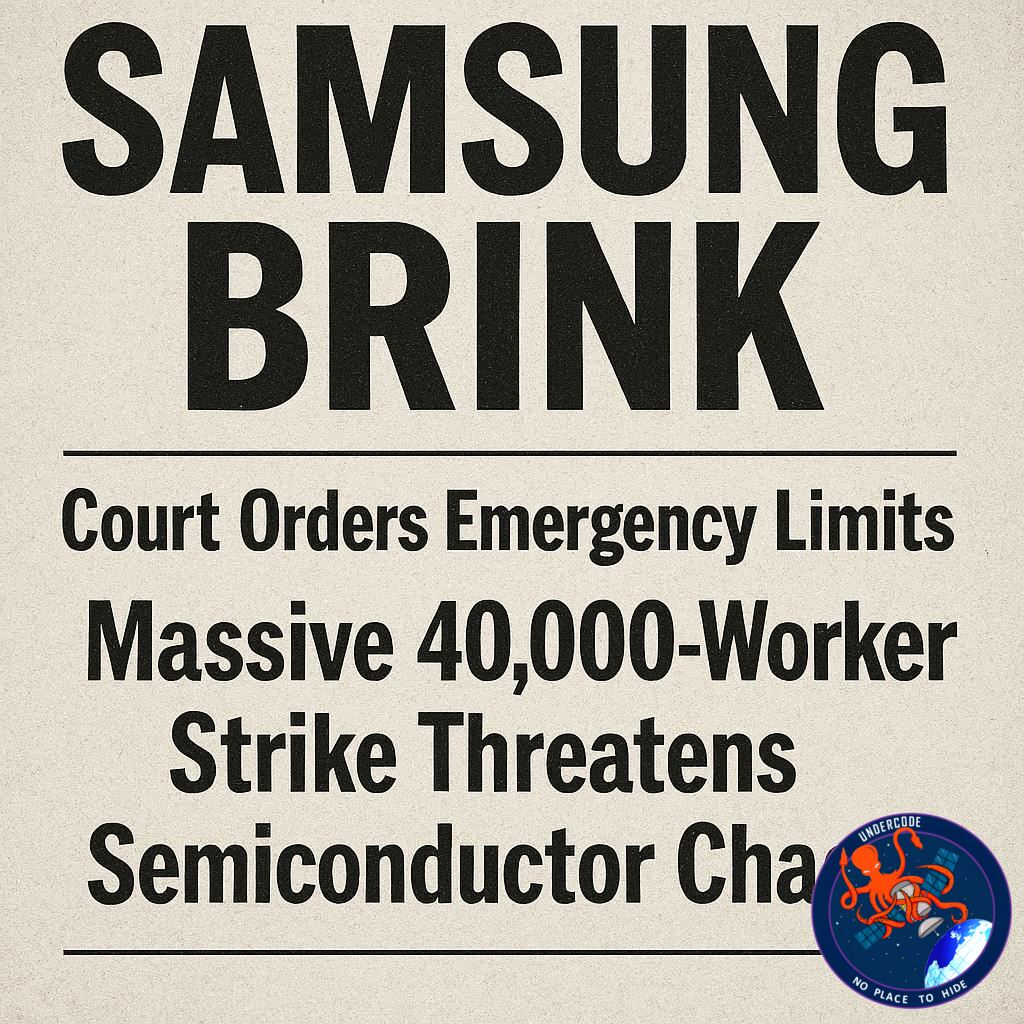
A major confrontation is unfolding inside Samsung Electronics as labor tensions escalate into one of the most serious industrial standoffs in recent years. With over 40,000 workers potentially entering a full strike, the situation has moved beyond internal negotiations and into the courtroom. A South Korean district court has now stepped in with emergency restrictions aimed at preventing a total shutdown of Samsung’s critical semiconductor operations. The stakes are enormous, not just for the company, but for the global chip supply chain that depends heavily on Samsung’s output.
📄 the Situation (Expanded 30-Line Overview)
Samsung Electronics is currently facing a rapidly intensifying labor dispute involving its largest union and more than 40,000 employees.
The union has threatened a full-scale strike beginning May 18 if demands are not met.
Such a strike would potentially shut down key manufacturing operations across semiconductor facilities.
In response, Samsung petitioned a district court in Seoul to intervene and prevent a total operational collapse.
The court ruled that while a strike is legally allowed, essential operations must continue.
This includes maintaining minimum workforce levels even during industrial action.
The ruling is designed to protect highly sensitive semiconductor manufacturing equipment.
These systems are extremely expensive and cannot be easily restarted once shut down.
Any full stoppage could lead to damage in raw materials and production lines.
The court also restricted unions from blocking access to facilities or taking over company property.
Samsung Electronics Labor Union, the largest among three unions, is directly affected by the ruling.
Violations of the court order carry heavy financial penalties per day.
Each union could face fines of approximately $66,000 daily for non-compliance.
Union leader Choi Seung-ho could also be fined around $6,600 per day individually.
Negotiations between management and unions are still ongoing.
However, no meaningful breakthrough has been reached so far.
The possibility of a strike continues to pressure both sides.
A full shutdown would cost Samsung billions of dollars in losses.
It would also worsen existing semiconductor supply shortages globally.
Memory chip markets are particularly vulnerable to disruptions.
Industry analysts warn of cascading effects across multiple tech sectors.
Smartphone, PC, and data center production could all be impacted.
Competitors may benefit temporarily from Samsung’s instability.
However, global supply constraints would likely offset any gains.
Consumers could face delays and price increases in electronics.
The court’s intervention has reduced union leverage significantly.
Still, the underlying conflict remains unresolved.
The situation is now a high-stakes balance between labor rights and industrial continuity.
All eyes remain on upcoming negotiations and potential escalation.
What Undercode Say:
Samsung’s Production Risk Under Legal Pressure
The court ruling effectively creates a controlled strike environment rather than a full shutdown scenario, but the risks to Samsung’s semiconductor dominance remain significant. Even with mandatory minimum staffing, production efficiency is likely to decline sharply. Semiconductor fabrication is not a flexible process—it relies on continuous, tightly controlled operations. Any disruption, even partial, can introduce defects or slow output cycles. The legal intervention reduces catastrophic shutdown risk but does not eliminate operational instability. Samsung now faces a delicate balancing act between compliance and productivity, where even minor workforce reductions can translate into massive output volatility across its chip manufacturing pipeline.
Union Strategy and Leverage Breakdown
The union’s original leverage depended heavily on the threat of total operational paralysis, a strategy now weakened by the court’s restrictions. By forcing minimum operational staffing, the court has effectively neutralized the most aggressive bargaining tool available to workers. This shifts the dispute from a shutdown threat to a prolonged attrition battle. Financial penalties further discourage escalation, creating internal pressure within the union itself. However, the lack of a breakthrough in negotiations suggests deep structural disagreements remain unresolved. The union may be forced to reconsider its strategy, potentially moving toward targeted disruptions or prolonged negotiation tactics rather than outright shutdown leverage.
Semiconductor Supply Chain Shock Potential
Even a partial disruption at Samsung carries global consequences due to its dominant role in memory chip production. The semiconductor supply chain is already under pressure, and any reduction in output can ripple through industries dependent on DRAM and NAND flash memory. Data centers, smartphone manufacturers, and PC builders are particularly exposed to shortages. While the court ruling prevents a full blackout scenario, reduced efficiency and labor instability still pose a supply risk. Markets could react preemptively, with inventory hoarding and price volatility emerging even before actual production declines materialize.
Economic and Industry Ripple Effects
A full strike scenario would have triggered billions in losses for Samsung, but even the current restricted strike environment introduces economic uncertainty. Investors typically react strongly to labor instability in high-tech manufacturing sectors, especially when production continuity is uncertain. The broader semiconductor industry could experience pricing fluctuations, delayed product launches, and increased operational costs. Competitors may attempt to fill short-term gaps, but global capacity constraints limit meaningful substitution. Ultimately, the dispute highlights how fragile modern electronics supply chains remain when concentrated production hubs face labor disruption.
🔍 Fact Checker Results
✔ The court did order minimum operations during the strike period.
✔ Samsung’s semiconductor facilities are highly sensitive to shutdown risks.
✔ No confirmed full production shutdown has occurred at this stage.
📊 Prediction
The dispute is likely to move into a prolonged negotiation phase rather than an immediate full-scale strike escalation. However, partial disruptions and intermittent labor actions remain highly probable. Samsung will prioritize maintaining semiconductor output stability, while the union may shift toward sustained pressure tactics instead of total shutdown strategies. Global chip markets could experience short-term volatility, but a complete supply chain collapse is unlikely unless negotiations fully break down.
🕵️📝Let’s dive deep and fact‑check.
References:
Reported By: www.sammobile.com
Extra Source Hub (Possible Sources for article):
https://www.facebook.com
Wikipedia
OpenAi & Undercode AI
Image Source:
Unsplash
Undercode AI DI v2
Bing
🔐JOIN OUR CYBER WORLD [ CVE News • HackMonitor • UndercodeNews ]
📢 Follow UndercodeNews & Stay Tuned:
𝕏 formerly Twitter 🐦 | @ Threads | 🔗 Linkedin | 🦋BlueSky | 🐘Mastodon


