
Listen to this Post
 Introduction: A Silent Power Shift in the AI Hardware Race
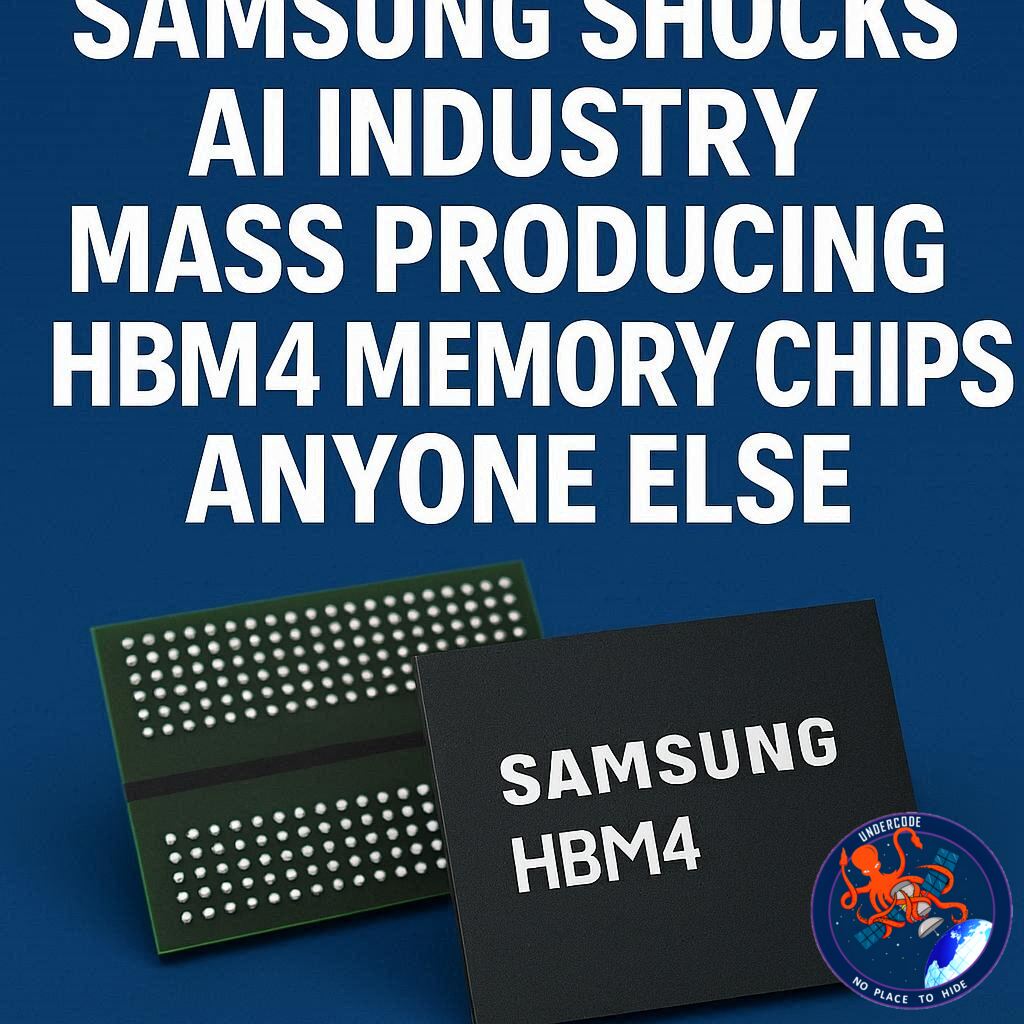
While most attention in the tech world is focused on flashy AI models and next-gen smartphones, a quieter but far more critical battle is unfolding deep inside data centers. Memory bandwidth has become the real bottleneck for artificial intelligence, and whoever solves it first gains a massive advantage. In a surprise move, Samsung has officially announced that it is the world’s first company to begin mass production of sixth-generation high-bandwidth memory, known as HBM4. This development positions Samsung at the heart of the next wave of AI accelerators powering everything from generative AI to advanced scientific computing.
the Original
Samsung has confirmed that it has started mass production of HBM4 memory chips, marking a major milestone in the global semiconductor industry. These chips are designed for the world’s most powerful AI accelerators and signal Samsung’s return to the top of the high-bandwidth memory market after losing momentum to competitors like Micron and SK hynix last year.
The company revealed that its HBM4 chips are built using 1c DRAM technology, which belongs to the 10-nanometer-class, sixth-generation DRAM process. This is currently the most advanced DRAM manufacturing technology available, giving Samsung a clear technological edge. On top of that, the chips leverage a 4nm fabrication process to boost performance while improving power efficiency, and Samsung claims it has already secured stable production yields.
In terms of raw performance, Samsung’s HBM4 operates at 11.7Gbps, which is roughly 46% faster than the 8Gbps standard defined by JEDEC. Compared to Samsung’s own HBM3E memory, the new chips are about 22% faster. A single HBM4 stack can deliver up to 3.3TB/s of memory bandwidth, comfortably exceeding customer requirements that sit around 3TB/s.
Samsung is initially offering HBM4 in capacities ranging from 24GB to 36GB, and shipments to customers have already begun. To meet growing demand, the company also plans to introduce 16-layer HBM4 variants that can reach capacities of up to 48GB. Looking ahead, Samsung confirmed that HBM4E is scheduled for the second half of 2026, followed by custom HBM solutions in 2027.
According to Hwang Sang-joon, Vice President of Memory Development at Samsung Electronics, the breakthrough was achieved by moving beyond previously proven processes and embracing cutting-edge technologies, ensuring enough performance headroom to satisfy rapidly growing customer demands.
What Undercode Say:
Samsung’s HBM4 announcement is far more than a routine product update; it is a strategic statement aimed directly at the AI hardware market. Over the past two years, high-bandwidth memory has become the limiting factor for AI accelerators, often more critical than the compute cores themselves. By reaching mass production first, Samsung gains a powerful advantage in securing long-term contracts with AI chip designers and hyperscale data center operators.
The use of 1c DRAM combined with a 4nm process shows that Samsung is willing to push manufacturing complexity to regain leadership. This is particularly important after a period where SK hynix dominated HBM3 and HBM3E supply for major AI players. Samsung’s ability to stabilize yields at such an advanced node suggests that its foundry and memory divisions are now better aligned than in previous generations.
Performance numbers also matter here. Exceeding JEDEC standards by such a wide margin gives Samsung room to tailor these chips for demanding customers without immediately hitting physical limits. A single stack delivering 3.3TB/s of bandwidth means fewer stacks are needed per accelerator, potentially lowering power consumption and board complexity for AI hardware makers.
Capacity scalability is another quiet win. Starting at 24GB and scaling to a planned 48GB configuration allows Samsung to address both mid-range and ultra-high-end AI accelerators. This flexibility is crucial as AI workloads diversify, from inference-focused systems to massive training clusters.
Looking ahead, Samsung’s roadmap signals confidence. Announcing HBM4E for late 2026 and custom HBM solutions for 2027 tells customers that this is not a one-off achievement, but a sustained push. If Samsung can maintain yield stability and competitive pricing, it could reshape supply dynamics in the AI memory market and reduce over-reliance on a single supplier. move puts Samsung back in a position of influence at a time when AI hardware demand is exploding.
Fact Checker Results
Samsung has officially announced mass production of HBM4 memory chips, which aligns with publicly stated specifications.
The reported performance figures exceed JEDEC standards, consistent with Samsung’s claims.
Future plans for HBM4E and custom HBM chips remain forward-looking and subject to execution timelines.
Prediction
Samsung’s early lead in HBM4 production will likely translate into major supply deals with AI accelerator vendors throughout 2026. If competitors fail to catch up quickly, Samsung could reclaim dominant market share in high-bandwidth memory and become a central player in the next generation of AI infrastructure.
🕵️📝✔️Let’s dive deep and fact‑check.
References:
Reported By: www.sammobile.com
Extra Source Hub (Possible Sources for article):
https://www.github.com
Wikipedia
OpenAi & Undercode AI
Image Source:
Unsplash
Undercode AI DI v2
Bing
🔐JOIN OUR CYBER WORLD [ CVE News • HackMonitor • UndercodeNews ]
📢 Follow UndercodeNews & Stay Tuned:
𝕏 formerly Twitter 🐦 | @ Threads | 🔗 Linkedin | 🦋BlueSky | 🐘Mastodon


