
Listen to this Post
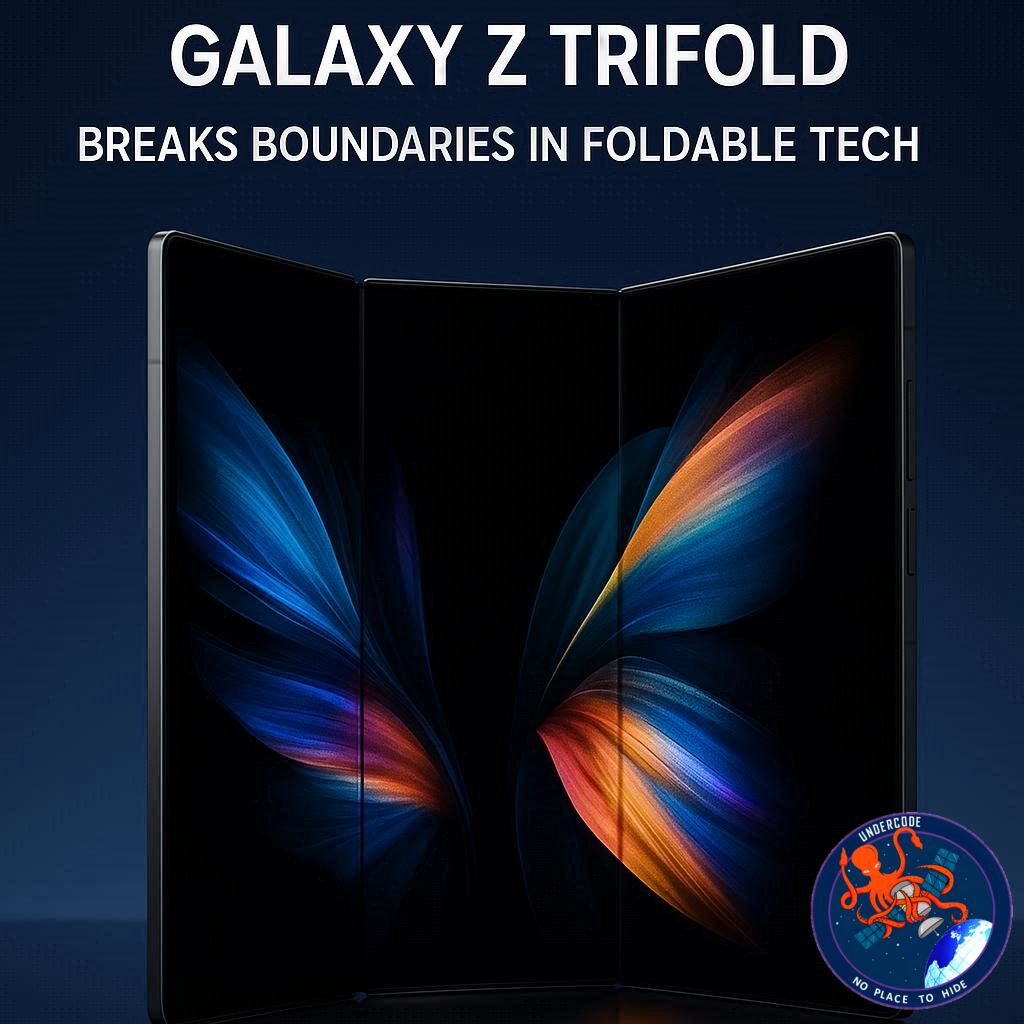
In a moment that could redefine smartphone engineering, Samsung has introduced its first-ever Galaxy Z TriFold, marking the company’s official entry into the tri-foldable device era. This unveiling, which took place just yesterday, stunned tech enthusiasts across the globe—not just for what was shown, but also for what wasn’t revealed.
While Samsung showcased the futuristic device inside a glass case, the brand refrained from sharing key specifications such as the name’s full confirmation, hardware details, pricing, or availability. Still, that didn’t stop onlookers and tech reporters from making some intriguing discoveries.
According to insights shared by KED, Samsung’s tri-folding marvel measures around 4.2mm thick when unfolded, and between 12mm to 15mm when folded, making it slightly thinner than its closest rival—the Huawei Mate XT Ultimate, which measures 4.8mm open and 12.8mm closed. The most remarkable detail, however, lies in the screen’s barely noticeable creases, a significant leap forward in foldable display craftsmanship.
Insiders close to Samsung hinted that the Galaxy Z TriFold could debut before the end of 2025, aligning with subtle mentions found within the Google app’s codebase, signaling that the product’s existence is no longer just a concept. The device is expected to hit select regions—China, Singapore, South Korea, Taiwan, and the UAE—but, disappointingly, the United States might not be on the initial launch list.
Though Samsung remains tight-lipped about pricing and other hardware details, the timing of this reveal hints that the brand is preparing for a new phase in its mobile ecosystem—possibly tied to the upcoming One UI 8.5 update. This software upgrade promises deeper customization and enhanced optimization for flexible displays, a feature that could perfectly complement the tri-fold’s unique structure.
The Galaxy Z TriFold isn’t just another addition to the foldable lineup—it’s a statement of intent. It signals Samsung’s confidence in evolving beyond the dual-fold form factor that once felt futuristic but now feels almost traditional. The glass-enclosed tease leaves the tech world buzzing, suggesting that what’s coming next might change how we define mobility and digital versatility.
What Undercode Say:
Samsung’s unveiling of the Galaxy Z TriFold isn’t merely a product showcase—it’s a turning point in the narrative of foldable devices. For years, Samsung dominated the foldable market with its Z Fold and Z Flip series, but as competitors like Huawei and Honor closed the innovation gap, the company needed something bold—something that reclaims its position as the trendsetter rather than the follower.
By introducing a tri-fold architecture, Samsung aims to solve one of the biggest challenges in foldable design: maximizing screen real estate without compromising portability. The 4.2mm open thickness is a testament to engineering finesse, as it pushes the boundaries of what’s physically possible with flexible AMOLED technology. More importantly, early reports highlighting minimal screen creases show Samsung’s refinement in hinge mechanisms and display layering—areas that previously drew criticism from Fold-series users.
What’s most strategic here is Samsung’s regional rollout plan. By targeting high-tech hubs like South Korea, Singapore, and the UAE, Samsung is building an ecosystem around early adopters who influence global tech trends. This controlled release allows the company to test logistics, pricing, and software integration before scaling production globally. The absence of a U.S. launch may appear disappointing, but it’s likely a deliberate move to avoid the complexity of carrier agreements and competitive saturation.
From a technological standpoint, the Galaxy Z TriFold could redefine the relationship between smartphones and tablets. Imagine a device that transitions seamlessly between a compact phone and a near-13-inch productivity slate—perfect for creators, gamers, and professionals on the move. The tri-fold format could easily position itself as a bridge between mobile computing and portable workstations, setting the stage for Samsung’s long-term vision of “multi-modal devices.”
Pairing this hardware with One UI 8.5 might also hint at deeper system-level optimization for flexible multi-display layouts—an area where Samsung’s experience in user interface design gives it an advantage. Features like dynamic app continuity, split-screen multitasking, and AI-based window management could become the backbone of the tri-fold experience.
Yet, innovation alone isn’t enough. The challenge will be pricing. With Huawei’s Mate XT Ultimate already commanding a luxury price tag, Samsung’s strategy will likely determine how accessible this category becomes. If Samsung prices it competitively, it could spark a fresh wave of tri-fold adoption; if not, it risks being seen as a niche experiment rather than a mass-market revolution.
Still, what stands out most is Samsung’s confidence. Locking the prototype inside glass wasn’t about secrecy—it was about symbolism. It told the world: “This is real. It’s ready. But not for everyone—yet.” And that sense of controlled mystery might be the very spark that reignites excitement in a market that has grown too familiar with incremental upgrades.
In essence, the Galaxy Z TriFold isn’t just a phone—it’s a glimpse into the future of compact computing. It’s Samsung’s reminder that innovation still belongs to the brave.
Fact Checker Results:
✅ The Galaxy Z TriFold was showcased at Samsung’s event but without public specs or pricing.
✅ It’s thinner than Huawei’s Mate XT Ultimate, confirmed by visual analysis.
❌ The U.S. launch has not been confirmed and appears unlikely in 2025.
Prediction:
🔮 Expect Samsung to officially launch the Galaxy Z TriFold in late December 2025, strategically timed with the Galaxy S25 series marketing cycle.
💡 One UI 8.5 will likely debut alongside it, featuring specialized tri-display support.
🚀 By 2026, tri-fold designs could begin replacing tablets for productivity users, marking the next leap in hybrid mobile computing.
🕵️📝✔️Let’s dive deep and fact‑check.
References:
Reported By: www.sammobile.com
Extra Source Hub (Possible Sources for article):
https://www.quora.com/topic/Technology
Wikipedia
OpenAi & Undercode AI
Image Source:
Unsplash
Undercode AI DI v2
Bing
🔐JOIN OUR CYBER WORLD [ CVE News • HackMonitor • UndercodeNews ]
📢 Follow UndercodeNews & Stay Tuned:
𝕏 formerly Twitter 🐦 | @ Threads | 🔗 Linkedin | 🦋BlueSky | 🐘Mastodon


