
Listen to this Post
Introduction: How Scream Changed Horror Forever
When Scream slashed its way into cinemas in 1996, it didn’t just revive a fading slasher genre—it rewrote the rulebook. By blending sharp self-awareness, genuine terror, and razor-edged satire, director Wes Craven and writer Kevin Williamson created a horror film that knew exactly what it was doing—and trusted the audience to keep up. Three decades later, with Scream 7 arriving in theaters and original star Neve Campbell returning, the franchise stands at a defining crossroads. Before the next Ghostface strikes, it’s worth looking back at how every Scream film stacks up.
the Original
The Scream franchise, now turning 30, has become one of horror’s most influential and self-reflective series, built on the idea that its characters understand the very rules of horror movies they’re trapped inside. Beginning as a meta-slasher that both mocked and celebrated genre conventions, the original film sparked a long-running franchise praised for its intelligence, scares, and ability to evolve with cultural shifts. Over the years, the series has experimented with sequels, trilogies, reboots, and “requels,” sometimes succeeding brilliantly and sometimes stumbling badly.
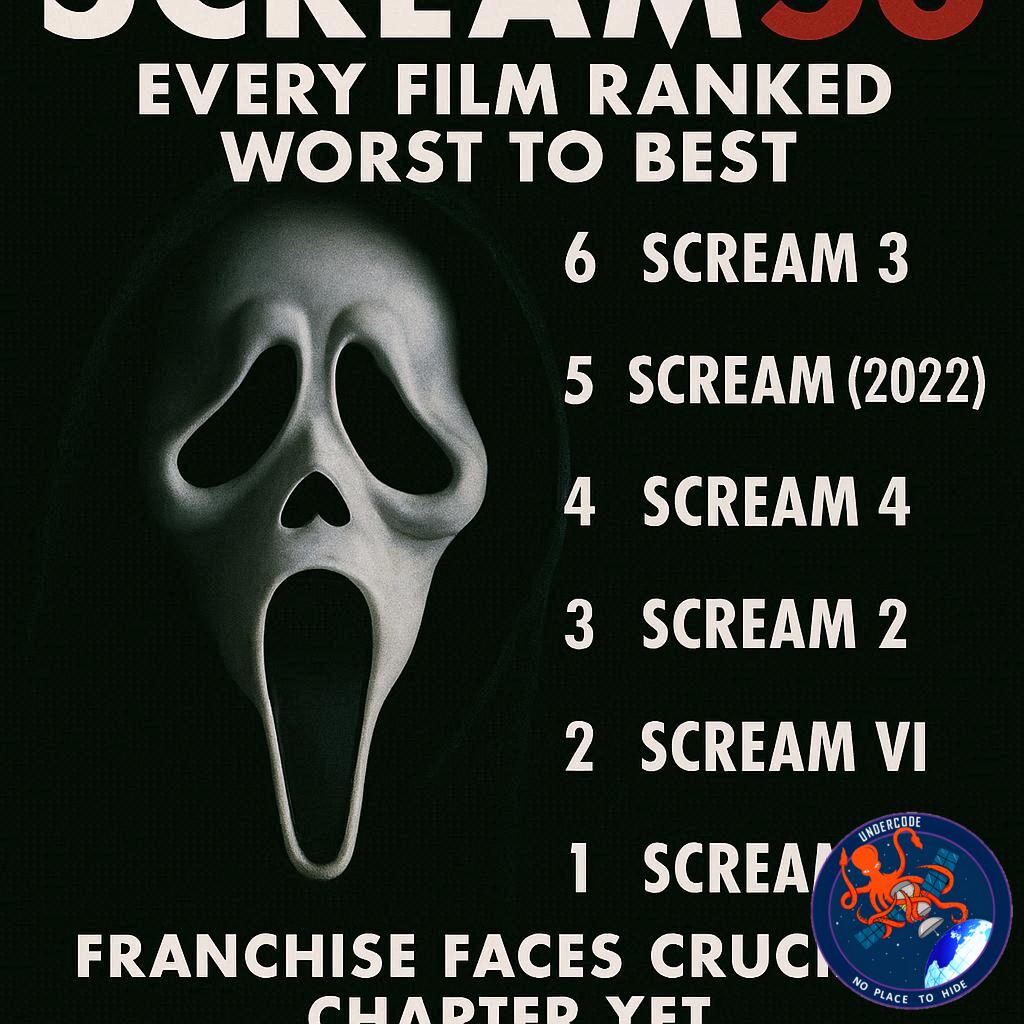
The ranking places Scream 3 at the bottom, widely viewed as the franchise’s weakest entry due to its toned-down violence, messy script, and abandoned narrative ambitions. Despite a clever Hollywood setting and thematic potential, it failed to deliver, with only a scene-stealing supporting performance preventing it from being entirely forgettable. Slightly higher is Scream VI, which moved the action to New York but struggled to justify its existence, relying on brutality over substance and suffering from the absence of Sidney Prescott.
Mid-ranking is Scre4m, a surprisingly sharp commentary on reboots and internet-era fame that subverted the Final Girl trope and offered one of the franchise’s boldest twists, even if its execution wasn’t flawless. Taking third place is Scream, a confident revival that tackled toxic fandom while honoring the original’s legacy, proving the series could still matter in a modern horror landscape. Runner-up Scream 2 expanded the mythology with intelligence and emotional weight, exploring trauma, revenge, and sequels themselves with rare self-awareness. Unsurprisingly, the crown belongs to the original Scream (1996), a film whose influence, quotability, and cultural impact remain unmatched, standing as one of the most important horror movies ever made.
What Undercode Say:
The enduring power of Scream lies in its honesty. Unlike many long-running franchises that become trapped by nostalgia, Scream survives because it constantly interrogates its own existence. Each sequel doesn’t just ask “Who is Ghostface?” but “Why does this movie exist at all?” That question is the franchise’s greatest weapon—and also its biggest risk.
The weakest entries (Scream 3 and Scream VI) fail precisely because they forget this core philosophy. When the meta-commentary becomes thin or performative, the films turn into standard slashers wearing a Scream mask. Excessive fan service, over-explained lore, and safe storytelling dilute what once felt dangerous and subversive. In contrast, the strongest sequels (Scream 2, Scre4m, and Scream 2022) succeed by confronting uncomfortable truths: fame as currency, trauma as spectacle, and fandom as something that can curdle into entitlement.
What’s especially striking is how accurately the franchise tracks cultural anxiety. The original tapped into media sensationalism and moral panic. Scre4m dissected social-media narcissism before it fully metastasized. Scream 2022 went straight for the jugular of toxic fandom, exposing how nostalgia can turn violent when audiences feel “owed” a story. This is why Scream still matters—it doesn’t just reflect horror trends, it reflects us.
With Kevin Williamson returning and Neve Campbell back in the lead, Scream 7 represents a rare chance at course correction. The franchise doesn’t need bigger set pieces or higher body counts; it needs sharper commentary and emotional sincerity. If the film understands that Scream works best when it criticizes its own audience as much as its killers, it could reclaim its position at the top of modern horror. If it doesn’t, it risks becoming exactly what it once mocked.
Fact Checker Results
The franchise timeline, release years, and creative involvement of Wes Craven, Kevin Williamson, and Neve Campbell are accurate and well-documented. The ranking reflects critical and fan consensus trends rather than box-office performance alone. Claims about Scream’s genre influence are supported by decades of horror scholarship and industry analysis.
Prediction
Scream 7 will either reaffirm the franchise as horror’s smartest self-critic or expose the limits of meta-storytelling in a nostalgia-saturated era. If it leans into character, consequence, and cultural bite, it could become the strongest sequel since Scream 2. If it plays safe, Ghostface may finally run out of rules to break.
🕵️📝✔️Let’s dive deep and fact‑check.
References:
Reported By: www.euronews.com
Extra Source Hub (Possible Sources for article):
https://www.reddit.com
Wikipedia
OpenAi & Undercode AI
Image Source:
Unsplash
Undercode AI DI v2
Bing
🔐JOIN OUR CYBER WORLD [ CVE News • HackMonitor • UndercodeNews ]
📢 Follow UndercodeNews & Stay Tuned:
𝕏 formerly Twitter 🐦 | @ Threads | 🔗 Linkedin | 🦋BlueSky | 🐘Mastodon


