
Listen to this Post
🔥 Introduction: Earth’s Relentless Heatwave Continues
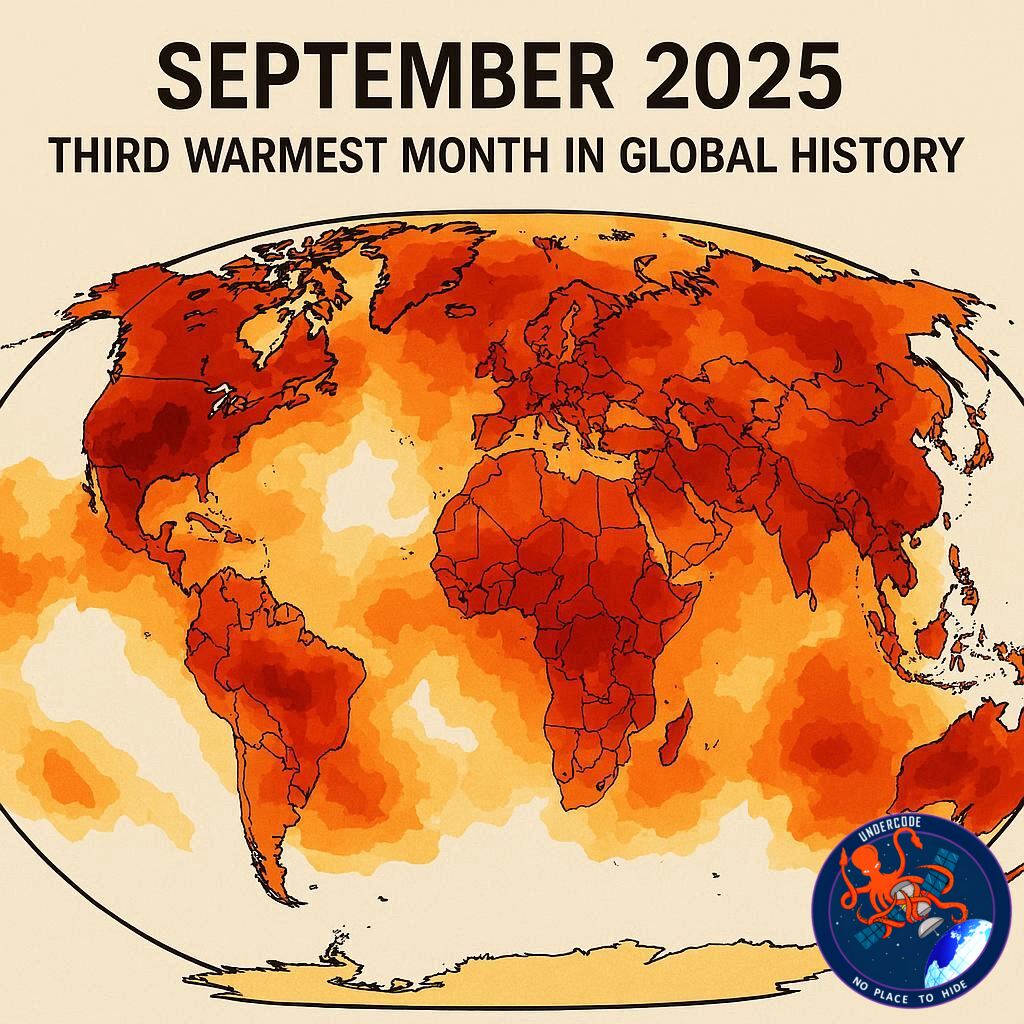
As the seasons shift from summer to autumn, one thing remains constant — the Earth’s unrelenting heat. New climate data from the Copernicus Climate Change Service (C3S) has confirmed that September 2025 was the third-warmest on record, extending a streak of record-shattering global temperatures. The planet’s land and oceans continued to simmer, with Europe and Scandinavia witnessing striking anomalies. Scientists warn that such warmth is not merely seasonal fluctuation — it’s a symptom of escalating human-driven climate change.
🌍 the Report
September 2025 proved exceptionally warm across the globe. Data from Copernicus revealed that the average surface air temperature reached 16.11°C, which is 0.66°C above the 1991–2020 average. Only 2023 and 2024 recorded higher temperatures, making 2025 dangerously close to breaking previous records.
The oceans, which act as Earth’s natural heat buffers, showed alarming trends too. The global average sea surface temperature hit 20.72°C, ranking third-highest for any September on record. Notably, the North Pacific experienced extreme warmth, while some regions in the central and eastern equatorial Pacific were closer to normal — a rare moderation amid widespread heating.
In Europe, the average land temperature climbed to 15.95°C, 1.23°C higher than the long-term average. Eastern Europe and Fennoscandia (including Scandinavia and Finland) were hotspots of above-average warmth, while western Europe had slightly cooler but still abnormal conditions.
Meanwhile, precipitation patterns swung wildly. Parts of northwestern and central Europe, as well as Italy and Croatia, saw heavy rain and flooding — clear signs of a warming atmosphere that can hold and release more moisture. Conversely, regions like Spain, the Balkans, and Ukraine suffered drier conditions.
This combination of warmer air, hotter seas, and unstable rainfall highlights how global warming is reshaping weather systems in real time. Experts, such as Samantha Burgess from Copernicus, stress that persistent high temperatures are the new normal, driven by greenhouse gas accumulation and changes in cloud cover that amplify heat retention.
📊 What Undercode Say: Deep Climate Analysis
The Copernicus data underscores a disturbing truth — climate stabilization is slipping out of reach. The 2025 readings reveal systemic warming patterns across continents and oceans that can no longer be considered natural variability. Let’s break down the underlying signals:
🌡️ 1. Atmospheric Heat Lock
The average global temperature anomaly of +0.66°C might seem minor, but it signifies billions of tons of trapped heat energy. Such consistent warming strengthens feedback loops — for example, reduced cloud cover and melting polar ice decrease the Earth’s ability to reflect sunlight, further intensifying global heat.
🌊 2. Oceanic Stress Points
The ocean’s role as a carbon sink is under immense strain. With an average sea surface temperature of 20.72°C, marine ecosystems face cascading impacts — coral bleaching, disrupted fish migration, and rising sea levels. The North Pacific’s heat concentration may contribute to powerful typhoons and erratic weather across Asia and the Americas.
🌦️ 3. Europe’s Weather Whiplash
Europe’s dual condition — floods in some regions, drought in others — is becoming a climate signature. Moisture-rich air masses collide with drier systems, producing destructive rainfall in certain zones while starving others of precipitation. Countries like Italy and Croatia, once known for moderate climates, are now on the frontline of extreme weather volatility.
🌬️ 4. The Scandinavian Spike
Fennoscandia’s temperature surge reveals the polar amplification effect. Arctic-adjacent regions are warming at twice the global average, leading to glacial retreat, thawing permafrost, and loss of Arctic sea ice north of Svalbard and Franz Josef Land. These effects not only accelerate sea level rise but also release trapped methane — a greenhouse gas far more potent than CO₂.
🌱 5. The Ecological Domino
The warming oceans and land temperatures are causing biological disarray. Crop cycles are shifting, fish stocks migrating, and weather predictability fading. The economic implications are profound — from food insecurity to insurance market destabilization due to the soaring costs of climate-related disasters.
🌡️ 6. The Fossil Fuel Factor
Fossil fuel emissions remain the primary culprit. Despite global pledges, CO₂ concentrations continue to climb, trapping heat and altering atmospheric circulation. This imbalance creates jet stream distortions that prolong heatwaves or cold snaps in unexpected regions, adding to weather extremity.
⚡ 7. The 2025 Tipping Point?
Scientists warn that if these patterns persist, 2025 could mark a critical threshold — a prelude to sustained years above 1.5°C warming, the limit set by the Paris Agreement. This would amplify humanitarian crises, force mass migrations, and disrupt global food supply chains.
🧊 8. Shrinking Ice and Rising Seas
Sea ice deficits in the Arctic — especially north of Europe — are not only visual warnings but direct contributors to sea level rise. Reduced albedo (the reflection of solar radiation) means faster heat absorption and further warming. The meltwater adds freshwater to oceans, disrupting salinity balance and marine currents like the Gulf Stream.
💨 9. Rainfall Extremes and Flooding
Regions like Valencia and Northern Italy are witnessing historic floods, fueled by atmospheric rivers and high-intensity storms. Climate models predict such extremes will double in frequency by the 2030s if emissions continue unchecked.
💧 10. Drought Zones Expanding
Conversely, drier areas in southern Europe are seeing soil degradation and agricultural stress, reducing crop yields and threatening water security.
🌎 11. Human Cost and Adaptation
Beyond temperature charts, this crisis is reshaping human life. Cities are investing in cooling infrastructure, while coastal regions race to fortify against sea-level rise. Yet, adaptation alone cannot replace the urgent need for emission cuts.
✅ Fact Checker Results
Claim: September 2025 was the third-warmest on record.
Verdict: ✅ True — confirmed by the Copernicus Climate Change Service.
Claim: Europe’s temperature anomaly exceeded +1°C.
Verdict: ✅ True — Europe averaged +1.23°C above normal.
Claim: Sea temperatures were below normal globally.
Verdict: ❌ False — global ocean temperatures ranked among the top three highest.
🔮 Prediction: What Lies Ahead?
If current trends persist, 2026 may surpass 2025 as global heat intensifies. The next decade could witness year-round climate disruptions — stronger hurricanes, melting Arctic summers, and unprecedented droughts in Europe. Unless nations drastically cut greenhouse gas emissions, humanity may face irreversible tipping points by 2035, transforming our planet into a permanently overheated world.
🕵️📝✔️Let’s dive deep and fact‑check.
References:
Reported By: www.euronews.com
Extra Source Hub:
https://www.digitaltrends.com
Wikipedia
OpenAi & Undercode AI
Image Source:
Unsplash
Undercode AI DI v2
🔐JOIN OUR CYBER WORLD [ CVE News • HackMonitor • UndercodeNews ]
📢 Follow UndercodeNews & Stay Tuned:
𝕏 formerly Twitter 🐦 | @ Threads | 🔗 Linkedin | 🦋BlueSky | 🐘Mastodon


