
Listen to this Post
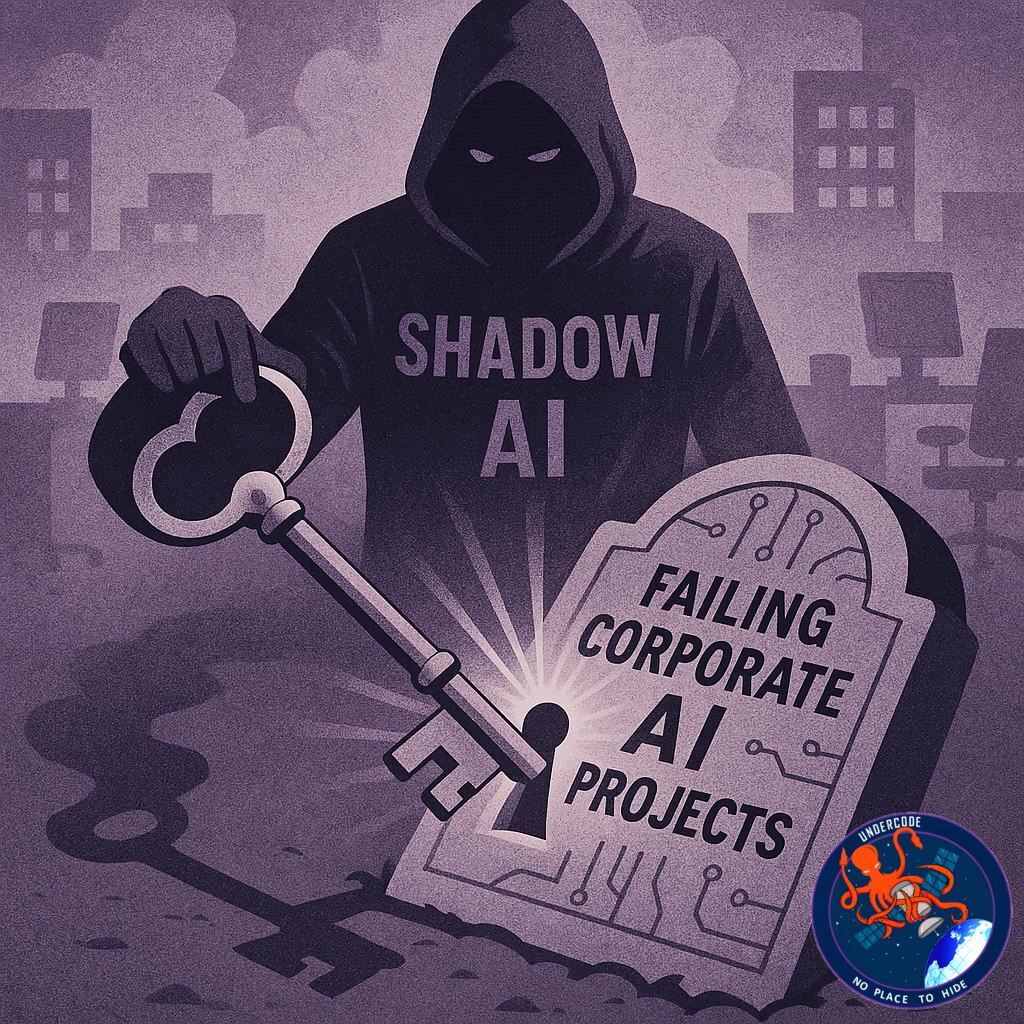
Artificial Intelligence has become the boardroom obsession of our time, yet the majority of large-scale AI projects continue to fail. Despite billions in investments and relentless hype, companies struggle to move from pilot programs to real business outcomes. What’s striking, however, is that while enterprise AI pilots stumble, employees are already succeeding with what’s known as “shadow AI” — informal, bottom-up usage of AI tools like ChatGPT, Claude, and Gemini. These small, tactical applications may hold the secret to finally unlocking AI’s promise.
Why Corporate AI Projects Fail
Recent studies underline the scale of the problem. MIT NANDA revealed that 95% of enterprise generative AI pilots fail to deliver measurable revenue gains. McKinsey’s 2025 State of AI survey similarly showed that over 80% of companies report no enterprise-level profit impact from their AI efforts. The message is clear: AI isn’t failing because of weak technology — it’s failing because of flawed strategies.
The biggest roadblock is enterprise integration. Tools don’t naturally blend into workflows, and many firms lack the operational know-how to scale from flashy pilots to production-ready systems. McKinsey adds that AI only delivers value when companies redesign workflows, track key performance indicators, and adapt operating models. Pilots left in “demo mode” impress investors briefly but add little long-term value.
Too often, executives treat AI as a quick-fix cost-cutting weapon — laying off staff, automating superficially, and boosting margins for a short period. But this short-sighted approach creates deeper liabilities:
Knowledge debt: Critical expertise disappears with layoffs, leaving companies weaker.
Talent loss: Skilled employees avoid brittle, half-functioning systems and leave.
Worsening customer experience: Understaffed teams and poor AI bots frustrate customers, damaging revenue.
This isn’t value creation — it’s financial engineering dressed as innovation.
The Rise of Shadow AI
The irony is that while enterprise pilots flounder, employees are already proving AI’s value on their own terms. Workers use generative AI to draft emails, summarize reports, generate code snippets, and analyze customer feedback. These grassroots applications succeed because they are task-specific, time-saving, and practical.
Shadow AI doesn’t aim to replace entire roles but instead amplifies productivity, helping people work smarter. By ignoring or banning these bottom-up use cases, leaders miss crucial signals. The best strategy is to embrace and scale the AI tools employees already find useful, transforming hidden innovation into structured enterprise value.
The Barrier of AI Readiness
Even with enthusiasm, most firms remain unprepared for true AI adoption. Readiness requires more than just licensing powerful models. Companies need:
Clean, consolidated data instead of siloed, fragmented information.
Clear use cases and expectations defined from the start.
Robust implementation roadmaps that address people, processes, governance, and change management.
Without this foundation, AI remains a series of flashy demos with no durable business impact. Interestingly, employees experimenting with AI often drive this maturation faster than executives. Bottom-up innovation may be the spark that finally compels leadership to adopt scalable strategies.
Designing AI for Long-Term Value
For AI to deliver lasting results, companies should:
Focus on tasks, not entire roles: Reduce cycle time, cut customer effort, and redeploy saved capacity to higher-value work.
Move beyond pilots: Treat AI tools like real products with KPIs, owners, and adoption targets.
Enable learning systems: Use feedback loops so AI continuously improves.
Invest in cross-functional teams that oversee security, data, process design, and customer experience.
Preserve institutional knowledge while automating, ensuring expertise doesn’t vanish.
Every AI project should answer a simple boardroom test: How will this create customer value in the next 90–180 days, while building capabilities for the next 18–24 months?
The ultimate winners won’t be those that slash costs fastest but those that redesign workflows so humans and machines elevate outcomes together.
What Undercode Say:
Looking at the failures of enterprise AI, one trend stands out — big companies are approaching AI like a financial trick, not a transformational tool. The obsession with quarterly margins blinds executives to AI’s true power: amplifying productivity, improving customer satisfaction, and enabling employees to innovate.
Shadow AI proves that people already know how to make AI useful. An analyst who automates reporting with ChatGPT is more valuable than a company-wide pilot that never leaves demo mode. These micro-successes are showing leaders exactly where AI fits best: in tactical, everyday use cases where time saved compounds into efficiency and growth.
If companies don’t acknowledge and channel shadow AI, they risk a widening gap between top-down strategy and bottom-up reality. Employees will keep using AI regardless of corporate policy, and the firms that learn from them will outpace those that impose bans.
Another problem is data quality. Enterprises drowning in siloed data can’t feed AI systems properly. Shadow AI sidesteps this by working with whatever an employee has at hand. Leaders should see this as an indicator: start small, fix data pipelines gradually, and scale the models around proven use cases.
The narrative around AI should also shift away from headcount reduction. Cutting staff for short-term savings is not innovation; it’s accounting. Real AI transformation is about enabling staff to do more, learn faster, and deliver better experiences. In the long run, customers reward businesses that raise standards, not those that hollow themselves out.
Finally, executives must accept that AI is not plug-and-play. It requires governance, cultural change, and clear goals. Companies that treat AI like a serious product — with owners, feedback loops, and defined KPIs — will thrive. Those that treat it like a showpiece for investors will keep burning millions with little to show for it.
The lesson is clear: shadow AI is not a threat, it’s a guidepost. Leaders must watch where employees innovate and scale those practices responsibly. That’s how AI finally moves from hype to value.
🔍 Fact Checker Results
✅ MIT and McKinsey data confirm high failure rates of enterprise AI pilots.
✅ Shadow AI adoption by employees is widespread and task-focused.
❌ AI is not failing due to weak technology — the problem lies in flawed strategies and poor integration.
📊 Prediction
Within the next three years, companies that harness shadow AI will begin to outperform those relying on rigid, top-down pilots. Early adopters who align with grassroots innovation will see faster efficiency gains, improved customer satisfaction, and stronger retention of talent. Those ignoring shadow AI will continue wasting millions on “demo projects” that never reach production — and may even lose market share to more agile competitors.
🕵️📝✔️Let’s dive deep and fact‑check.
References:
Reported By: www.zdnet.com
Extra Source Hub:
https://www.discord.com
Wikipedia
OpenAi & Undercode AI
Image Source:
Unsplash
Undercode AI DI v2
🔐JOIN OUR CYBER WORLD [ CVE News • HackMonitor • UndercodeNews ]
📢 Follow UndercodeNews & Stay Tuned:
𝕏 formerly Twitter 🐦 | @ Threads | 🔗 Linkedin | 🦋BlueSky | 🐘Mastodon


