
Listen to this Post
🎯 Introduction:
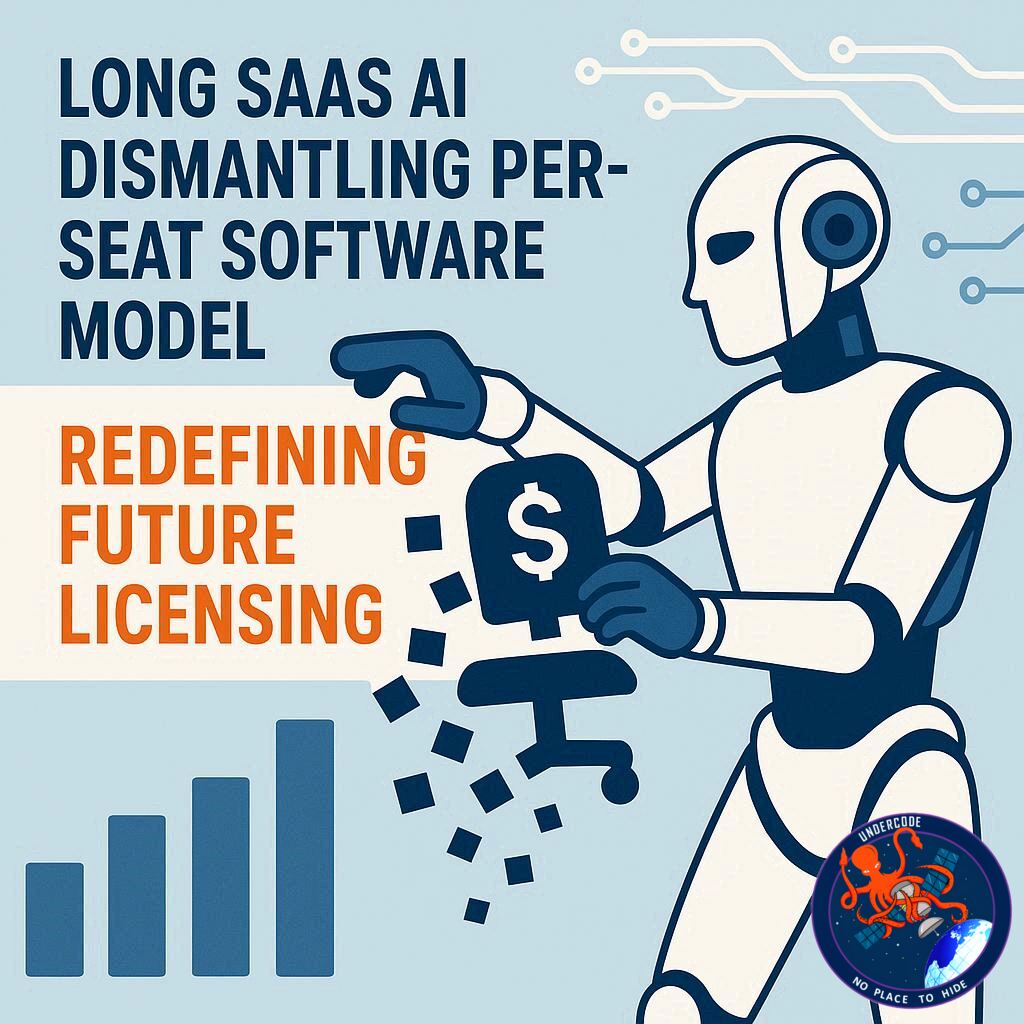
For decades, software licensing was built around the idea of the individual user. Every “seat” in an organization represented another payment, another license, another source of predictable revenue for software vendors. But that model is crumbling. Artificial Intelligence, with its autonomous agents and outcome-driven logic, is breaking the very foundation of how businesses buy and sell software. We’re entering the “post-SaaS” era—an age where software licenses are no longer purchased by humans but by intelligent systems acting on their behalf. This transformation isn’t a distant forecast; it’s unfolding right now, and it’s shaking the entire software economy.
🧩 The Great Software Shift: From Seats to Systems
A recent analysis by McKinsey paints a striking picture of the future. Traditional per-seat licenses, the bedrock of SaaS revenue models, are becoming obsolete. AI-powered agents, capable of interacting, negotiating, and executing software functions autonomously, will soon replace human buyers in most digital transactions. Software will no longer be sold per person—it will be consumed dynamically, based on use, output, or measurable outcomes.
According to McKinsey’s findings, vendors like OpenAI and Anthropic are leading this revolution, redefining how software is built, priced, and delivered. The old SaaS model, once revolutionary in its own right, is being overtaken by a far more fluid ecosystem driven by intelligent automation and value-based pricing.
The implications are massive. Jeremy Schneider, one of the report’s lead authors, called it a “foundational shift redefining what software is, who builds it, who uses it, and how companies are organized.” In other words, the change is not just technical—it’s structural, economic, and even philosophical.
💸 The End of Licensing, the Rise of Outcomes
The days of paying for every employee who logs into an app are fading fast. Instead, companies will soon pay for what actually happens—the measurable outcomes produced by software agents. This consumption-based approach aligns pricing with performance, rewarding vendors for tangible results rather than access rights.
As Ali Gohar from Software Finder explained, “We’re on the cusp of an industry where software companies need to sell outcomes, not licenses.” If one employee uses a tool twelve hours a day while another logs in once a week, should both pay the same? Under AI-driven models, they won’t. This creates a fairer, more scalable system for both customers and developers.
🔄 The AI Economy and Vendor Realignment
McKinsey’s data suggests that 40% of software vendors expect AI to unlock over 20% additional revenue growth, while 11% anticipate growth beyond 50%. The logic is simple: efficiency sells. Companies embracing agent-based architectures are cutting costs by more than 20%, according to industry analyst George Brown. Those who resist will find themselves uncompetitive within a few years.
However, with opportunity comes chaos. Customer churn, vendor switching, and the fragmentation of value pools will likely skyrocket as businesses reassess their software stacks. AI makes it easier than ever to swap one service for another—or even to build your own using open frameworks. The era of vendor lock-in is ending.
🤖 Agents Buying for Agents
Perhaps the most fascinating (and unsettling) trend is the idea of agent-to-agent commerce. Imagine a world where software agents negotiate, purchase, and execute services autonomously on behalf of organizations. George Brown predicts that such automation could reduce “seat counts” by up to 70%.
Yet this model presents new challenges. How do you measure consumption? How do you trust performance data generated by an autonomous system? Businesses risk being trapped in opaque pricing bundles where “outcomes” are defined by vendors rather than users. Experts like Ofir Bloch warn buyers to “verify that vendors can measure what they’re charging for” before committing to consumption-based contracts.
⚖️ Trust, Ethics, and Oversight
Natasha Chryssafi from Wolters Kluwer highlights a critical point: as AI agents take over more operational roles, trust and transparency become paramount. Human oversight, ethical governance, and data accountability will determine which vendors thrive in the new ecosystem. “Customers will need assurance that systems operate reliably and responsibly,” she said.
This ethical dimension could become the next major differentiator in software markets. AI-driven automation without transparency is simply not sustainable.
🧱 Building the Post-SaaS Infrastructure
The shift to a fully agentic software economy won’t happen overnight. Rob Fuller from Blend360 notes that the technology stack for autonomous agent-to-agent operations is still immature. For now, most companies rely on “human-in-the-loop” systems where people supervise AI interactions. But as integration improves and AI grows more capable, the market will likely accelerate toward full automation.
The transition resembles the leap from on-premises systems to cloud computing—except this time, it’s faster, deeper, and potentially more disruptive.
💡 What Undercode Say:
The end of per-seat licensing isn’t just a pricing adjustment—it’s a paradigm shift in how we define software value. Traditional SaaS revolved around access: the more people who used your app, the higher your revenue. AI reverses that logic. Now, value flows from results, not users. This realignment forces every vendor to rethink their core proposition: Are they selling tools, or are they selling intelligence that delivers outcomes?
From an analytical perspective, this evolution mirrors larger trends across the digital economy. We’re moving from ownership to utility, from licenses to logic, and from users to use cases. In practical terms, this means the market will reward software that thinks rather than software that waits for instructions.
For enterprises, the implications are twofold. First, procurement strategies must evolve to evaluate vendors on measurable impact rather than number of users. Second, internal IT departments must prepare for a hybrid reality—where human and AI agents collaborate, sometimes even compete, for efficiency.
Economically, this will fragment revenue streams across the industry. Smaller vendors with specialized AI agents will thrive in niche markets, while larger SaaS providers must pivot fast or risk obsolescence. The rise of tokenized, consumption-based pricing may initially confuse buyers, but it will ultimately democratize software access, making advanced capabilities more affordable to smaller firms.
There’s also a psychological shift at play. In the old SaaS world, users felt ownership through interface interaction. In the new model, they may never “see” the software at all—only the results it produces. This invisible automation challenges traditional user experience design and may redefine what “customer satisfaction” even means.
Still, the biggest question remains: Who holds accountability when agents make decisions autonomously? Governance frameworks, auditing systems, and explainable AI will become as important as the technology itself. Without them, trust will collapse—and the market with it.
The post-SaaS world isn’t about replacing humans. It’s about redefining productivity through intelligent delegation. Those who adapt early will gain exponential leverage. Those who cling to the per-seat past will be left paying for empty chairs.
🔍 Fact Checker Results
✅ McKinsey’s analysis confirms that AI-driven software models will shift toward consumption and outcome-based pricing within 3–5 years.
✅ Over 60% of surveyed vendors expect fundamental changes to their business models due to AI.
❌ Fully autonomous agent-to-agent ecosystems are not yet mature; most deployments still require human supervision.
📊 Prediction
🚀 Within the next decade, more than 80% of SaaS platforms will abandon per-seat licensing entirely.
🤖 AI-driven procurement systems will handle the majority of enterprise software purchases.
💼 Vendors who fail to adopt transparent, outcome-based billing models will lose competitiveness and market trust.
🕵️📝✔️Let’s dive deep and fact‑check.
References:
Reported By: www.zdnet.com
Extra Source Hub (Possible Sources for article):
https://www.linkedin.com
Wikipedia
OpenAi & Undercode AI
Image Source:
Unsplash
Undercode AI DI v2
Bing
🔐JOIN OUR CYBER WORLD [ CVE News • HackMonitor • UndercodeNews ]
📢 Follow UndercodeNews & Stay Tuned:
𝕏 formerly Twitter 🐦 | @ Threads | 🔗 Linkedin | 🦋BlueSky | 🐘Mastodon


