
Listen to this Post
Introduction
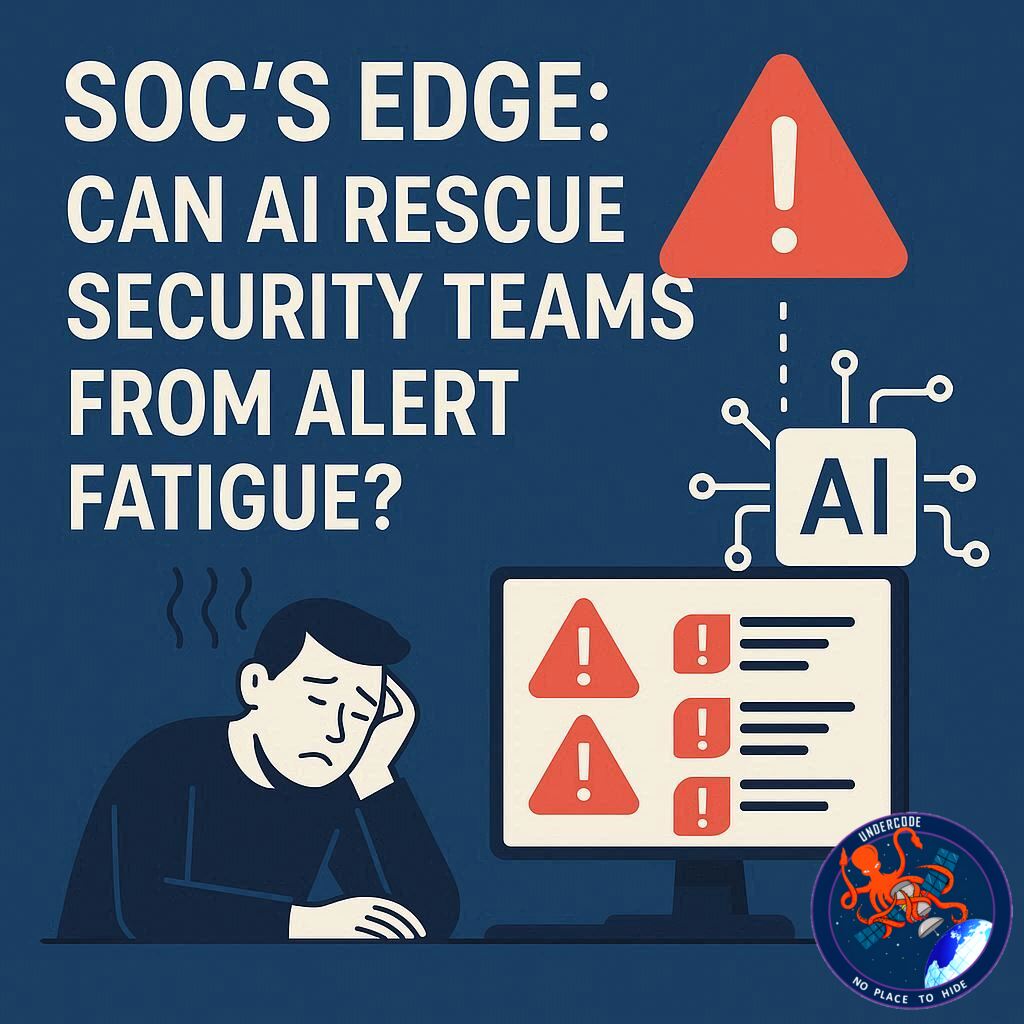
Security Operations Centers (SOCs) are drowning in data. Every day, analysts are bombarded with thousands of alerts, many of which never get properly investigated. As cybercriminals embrace artificial intelligence (AI) to make their attacks faster, stealthier, and more adaptive, the defenders are under crushing pressure. This has sparked a critical debate: Can AI truly save the SOC, or will it only add another layer of complexity?
The Rising Tide of SOC Challenges
SOCs face an overwhelming challenge with security alerts: small-to-medium enterprises (SMEs) handle around 500 alerts per day, while large enterprises may see up to 3,000. Shockingly, 40% of these alerts are never reviewed, and 57% of companies intentionally suppress detection rules to reduce the noise. This creates an environment where critical threats may go unnoticed.
A Prophet Security study, surveying 282 CISOs and analysts, revealed that 55% already use AI in triage and investigations, while 60% plan to test AI-powered SOC solutions in the next year. An impressive 83% believe AI will handle over half of SOC workloads within three years. The top use cases are alert triage (67%), detection tuning (65%), and threat hunting (64%), with remediation still lagging behind (43%).
The problem isn’t just the volume of alerts, but the sheer number of tools generating them—on average, 17 per organization, sometimes 20 or more in large firms. Instead of clarity, this data overload creates blindness. Analysts can’t separate real threats from background noise, leading to “alert fatigue.” As Peter Coroneos of Cybermindz notes, vigilance declines over time, leaving defenders vulnerable.
To cope, teams silence alerts, creating long-term “visibility debt.” Experts warn that this trade-off lets attackers exploit gaps. Burnout is another growing crisis: cybersecurity staff are desensitized, rushing investigations, and even leaving the industry. Lisa Ventura of the AI and Cyber Security Association warns that morale is collapsing under relentless noise.
Adding to the stress, cybercriminals are using AI to evolve attacks faster than defenders can analyze them. By the time a SOC finishes investigating one breach, the attack has already mutated. This creates a cybersecurity “uncertainty principle” where defenders always chase outdated threats.
AI-powered SOCs promise relief by automating triage, enriching alerts, and filtering noise. However, experts stress that AI must be integrated carefully. Without explainability and trust, it risks worsening alert fatigue. AI is best seen as an assistant—not a replacement—for human analysts. Machines can process scale and speed, but only humans can provide judgment, nuance, and context.
Ultimately, experts agree on a hybrid approach: AI handles repetitive work, while analysts focus on strategy, threat hunting, and decision-making. This balance could protect both organizations and the mental health of defenders. As Nikki Webb puts it, “AI can filter and enrich, but it cannot replace human judgment.”
What Undercode Say:
The modern SOC has reached a breaking point. The numbers tell a stark story—thousands of alerts daily, most unreviewed, analysts overwhelmed, and risks intentionally accepted. This is not a sustainable defense model.
From a strategic perspective, the challenge lies in information overload vs. decision quality. More tools don’t equal more security; they create chaos. Just as in military operations, clarity and prioritization are more valuable than sheer firepower. SOCs must evolve into intelligence-driven operations where AI isn’t just filtering alerts but transforming raw data into actionable intelligence.
There’s also a human capital crisis. Skilled analysts are burning out and leaving, creating a talent gap that money alone can’t fix. Training SOC professionals to work alongside AI—knowing when to trust and when to challenge its outputs—will be vital. This demands investment in both technical AI literacy and human resilience programs such as vigilance training and stress management.
The AI arms race between attackers and defenders is another key dimension. Offensive AI adapts in real time, generating polymorphic attacks that can evade traditional defenses. Defensive AI must evolve just as quickly, not as a static product but as a living system capable of learning and counter-learning. This raises governance challenges around transparency, ethics, and accountability.
From an operational standpoint, AI can dramatically cut noise by clustering, enriching, and discarding false positives. However, it must also feed analysts with contextual intelligence, such as attack intent, risk impact, and business relevance. Otherwise, SOCs risk drowning in filtered but meaningless data.
Looking ahead, SOCs may need to transition from alert-driven models to proactive intelligence hubs. Instead of reacting to alarms, they’ll need to anticipate threats, simulate attack scenarios, and orchestrate responses in real time. AI is essential for this shift, but its value will depend entirely on how well it’s integrated with human expertise.
The bottom line: AI will not save the SOC alone—it will only empower the SOC that learns to use it wisely.
✅ Fact Checker Results
SOCs truly face thousands of alerts daily, with most going unreviewed.
AI adoption in SOCs is already happening, but it’s not a magic solution.
Human expertise remains irreplaceable in making final security judgments.
🔮 Prediction
In the next 3–5 years, AI-powered SOCs will become the norm, not the exception. Organizations that combine AI-driven automation with resilient, well-trained human analysts will achieve the best defense posture. However, companies that rely solely on AI without strengthening human oversight risk catastrophic blind spots. The SOC of the future will be AI-augmented, human-led, and intelligence-driven.
🕵️📝✔️Let’s dive deep and fact‑check.
References:
Reported By: www.securityweek.com
Extra Source Hub:
https://www.quora.com
Wikipedia
OpenAi & Undercode AI
Image Source:
Unsplash
Undercode AI DI v2
🔐JOIN OUR CYBER WORLD [ CVE News • HackMonitor • UndercodeNews ]
📢 Follow UndercodeNews & Stay Tuned:
𝕏 formerly Twitter 🐦 | @ Threads | 🔗 Linkedin | 🦋BlueSky | 🐘Mastodon


