
Listen to this Post
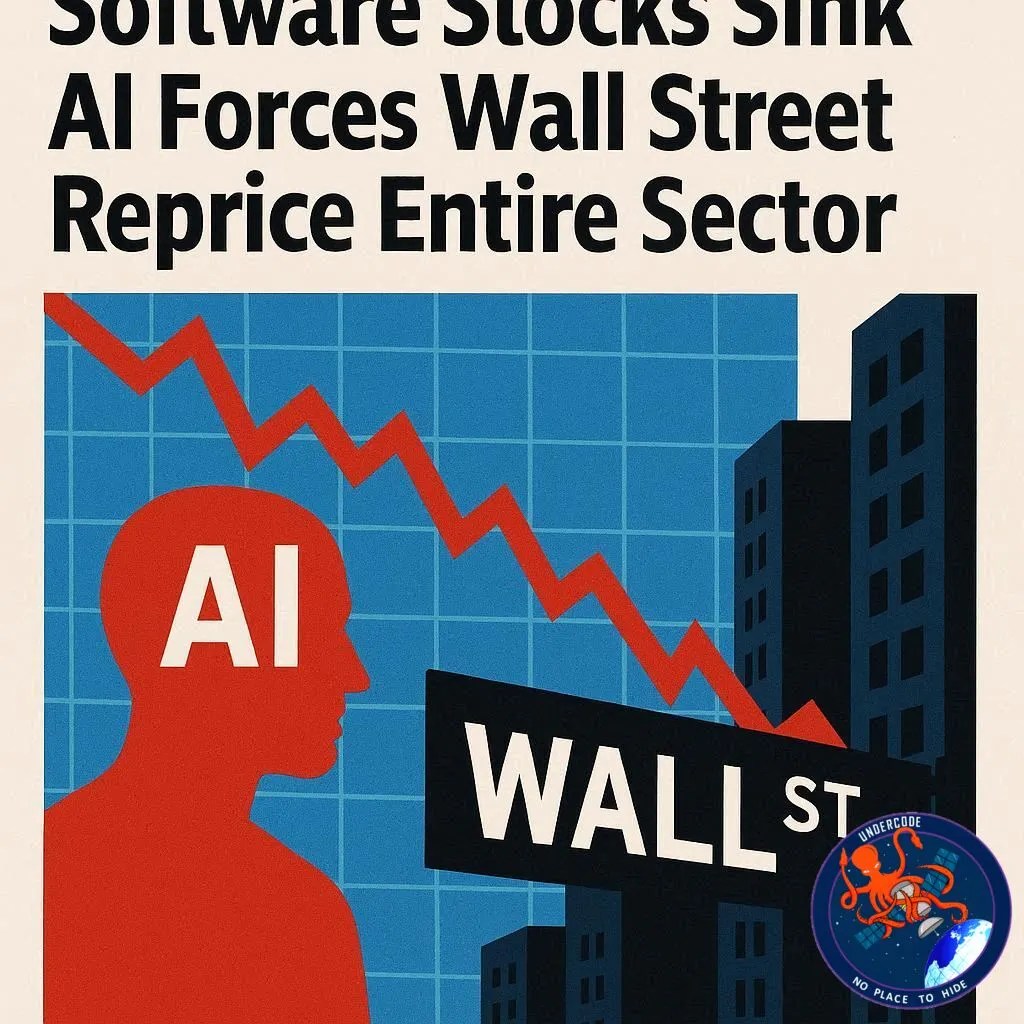
Introduction: When Software Confidence Collides With Artificial Intelligence
For years, software stocks were treated as the market’s safest growth bet—recurring revenue, sticky customers, and margins that only seemed to expand. That confidence cracked this week. Investors abruptly began pricing in a future where artificial intelligence doesn’t just enhance software products, but potentially replaces large parts of the software services industry altogether. The result was a sharp, sector-wide selloff that rippled through markets and raised an uncomfortable question: what is software really worth in an AI-first world?
Market Shock: A Sudden and Broad Software Selloff
Software stocks took a decisive hit as investors rushed to reassess long-held assumptions. The decline wasn’t isolated to a handful of speculative names; it spread quickly across established, profitable companies. This marked one of the clearest examples yet of how markets may react when AI is seen not as a feature, but as a structural threat to an entire industry.
Catalyst: Anthropic’s New Enterprise Automation Push
The immediate trigger for the selloff was Anthropic’s announcement of new AI automation capabilities designed for multiple enterprise sectors. These tools promised deeper integration, faster workflows, and broader autonomy than previous generations of AI assistants. For investors, the message was unsettling: AI is moving faster than expected into territory long dominated by specialized software vendors.
Early Casualties: Legal and Data-Driven Software Names
Selling pressure first emerged in legal software and data-adjacent companies. Names like Experian, the London Stock Exchange Group, Thomson Reuters, and LegalZoom were among the earliest to slide. These businesses rely heavily on structured data, document workflows, and research—areas where AI models are advancing at exceptional speed.
Sector-Wide Contagion: From Niche to Everything
What began as targeted selling quickly broadened. Investors didn’t stop at legal tech; they exited software positions across the board. The logic was blunt: if AI can disrupt one high-margin software niche, it can likely threaten others as well.
ETF Reality Check: IGV’s Historic Decline
The iShares Expanded Tech-Software Sector ETF (IGV) fell more than 14% over just six trading sessions, following a 15% drop in January. That January performance marked its worst monthly decline since 2008, underscoring the severity of the shift in sentiment and the scale of investor fear.
Wall Street Mood: Sentiment Turns Toxic
According to Jefferies, software sentiment has reached its “worst ever” level. Bloomberg Intelligence analyst Anurag Rana went even further, describing the sector as “radioactive.” Such language is rare for an industry that has long been Wall Street’s darling.
Investor Logic: When Uncertainty Triggers Total Exit
While analysts broadly agree that AI will create both winners and losers within software, the problem is visibility. Investors cannot yet determine which companies will adapt successfully and which will be hollowed out. Faced with that uncertainty, many are choosing the simplest option: sell everything.
Anthropic’s Positioning: Complement, Not Competitor
Anthropic has been careful to frame its AI tools as complementary rather than competitive. The company emphasizes that its systems are designed to connect securely with existing software platforms, not immediately replace them.
The “AI Home Page” Concept
Anthropic’s vision positions its AI, Claude, as a kind of universal interface. Instead of logging into multiple enterprise tools, users could interact primarily through Claude, while traditional software operates quietly in the background.
Embedded Interfaces: AI as the Front Door
Claude can reportedly render interfaces directly within its environment. According to Anthropic’s enterprise product leadership, this could significantly increase engagement by allowing users to interact with business systems through natural language rather than traditional dashboards.
The Hidden Threat: Disintermediation
Even if AI starts as a complement, the long-term risk is disintermediation. If users spend most of their time inside AI interfaces, the underlying software providers may lose pricing power, brand recognition, and eventually relevance.
Analyst Warning: Multiples Under Pressure
Piper Sandler analyst Billy Fitzsimmons highlighted concerns around “seat-compression” and “vibe coding” narratives. These ideas suggest fewer human users and faster AI-driven development cycles, potentially capping valuation multiples across the sector.
Revenue Risk: Fewer Seats, Lower Growth
If AI reduces the number of licenses needed or accelerates automation, software companies may struggle to justify premium pricing. Even modest changes to seat counts can have outsized effects on recurring revenue models.
Historical Perspective: This Isn’t Software’s First Scare
Wall Street has turned against software before. During the rise of mobile computing, many feared desktop-centric software companies—especially Microsoft—would become obsolete.
Microsoft’s Survival Story
Despite those fears, Microsoft’s stock has risen nearly 789% over the past decade. The company adapted, expanded into cloud services, and integrated new platforms rather than resisting them.
A Familiar Pattern: Fear Before Adaptation
According to Bloomberg Intelligence, this cycle happens frequently in software. New technology sparks panic, valuations compress, and only later does clarity emerge around which firms successfully evolve.
Limits of Control: What Software Firms Can’t Fix
In the short term, there’s little companies can do to counter broad market fear. Even strong earnings and guidance may not offset existential concerns about business model disruption.
Valuation Question: Pricing the AI Risk
The central issue now is valuation. How should investors price software companies whose core offerings could be partially or fully automated by AI within a few years?
Duration Unknown: How Long Will the Fear Last?
Market observers are watching closely to see whether this “software apocalypse” narrative fades quickly or becomes a prolonged drag on the sector.
What Undercode Say:
A Structural Reset, Not a Temporary Panic
This selloff feels different from routine tech corrections. AI is not just another platform shift; it challenges the very interface between humans and software. That alone forces a rethinking of long-term value.
Interfaces Matter More Than Features
Historically, software companies owned the interface and the workflow. AI threatens that ownership by inserting itself as the primary interaction layer, turning many applications into interchangeable back-end services.
Moats Are Shrinking Faster Than Expected
Data, once considered an unassailable moat, is becoming less exclusive as AI models grow more capable of synthesizing and reasoning across diverse inputs. This weakens traditional competitive advantages.
Winners Will Be Invisible at First
The companies that survive and thrive may not be obvious today. They are likely those that redesign themselves around AI-native workflows rather than merely adding AI features to legacy products.
Pricing Power Is the Real Battlefield
The core risk isn’t total replacement overnight—it’s gradual erosion of pricing power. When customers question why they need ten tools instead of one AI interface, margins come under pressure.
Enterprise Budgets Will Follow Efficiency
As AI delivers efficiency gains, enterprises will demand cost reductions. Software vendors that can’t clearly justify their slice of the budget will face renegotiations or churn.
Platform Consolidation Is Likely
AI favors consolidation. Instead of dozens of specialized tools, enterprises may prefer fewer platforms augmented by AI, accelerating M&A and market concentration.
Sentiment May Overshoot Reality
Markets often overshoot in both directions. While fear is justified, complete sector abandonment may undervalue companies that adapt quickly and redefine their role in the AI stack.
Long-Term Value Still Exists
Software isn’t disappearing—it’s mutating. Code, infrastructure, and domain expertise remain critical, even if AI changes how they’re consumed.
The Real Divide: AI-Native vs AI-Retrofitted
The long-term split will likely be between companies built for an AI-first world and those awkwardly retrofitting AI into outdated architectures.
Fact Checker Results
Market Decline Confirmation
The reported decline in software ETFs and major software names aligns with recent market performance. ✅
Anthropic Capability Claims
Anthropic’s positioning of AI as an enterprise interface layer is consistent with public product statements. ✅
Historical Comparison Accuracy
The reference to Microsoft’s long-term stock performance reflects widely available market data. ❌ (percentage varies slightly by measurement window)
Prediction
Short-Term Volatility Ahead 📉
Software stocks are likely to remain volatile as investors digest AI’s real versus perceived impact.
Clear Winners Will Emerge 🚀
Within the next 12–24 months, a subset of software companies will re-rate higher as AI-native leaders become evident.
Valuations Will Reset, Not Collapse 🔄
Rather than a permanent decline, the sector is heading toward a valuation reset that reflects new risk—but also new opportunity.
🕵️📝✔️Let’s dive deep and fact‑check.
References:
Reported By: axioscom_1770159461
Extra Source Hub (Possible Sources for article):
https://www.stackexchange.com
Wikipedia
OpenAi & Undercode AI
Image Source:
Unsplash
Undercode AI DI v2
Bing
🔐JOIN OUR CYBER WORLD [ CVE News • HackMonitor • UndercodeNews ]
📢 Follow UndercodeNews & Stay Tuned:
𝕏 formerly Twitter 🐦 | @ Threads | 🔗 Linkedin | 🦋BlueSky | 🐘Mastodon


