
Listen to this Post
A Defining Moment for Global Artificial Intelligence Governance
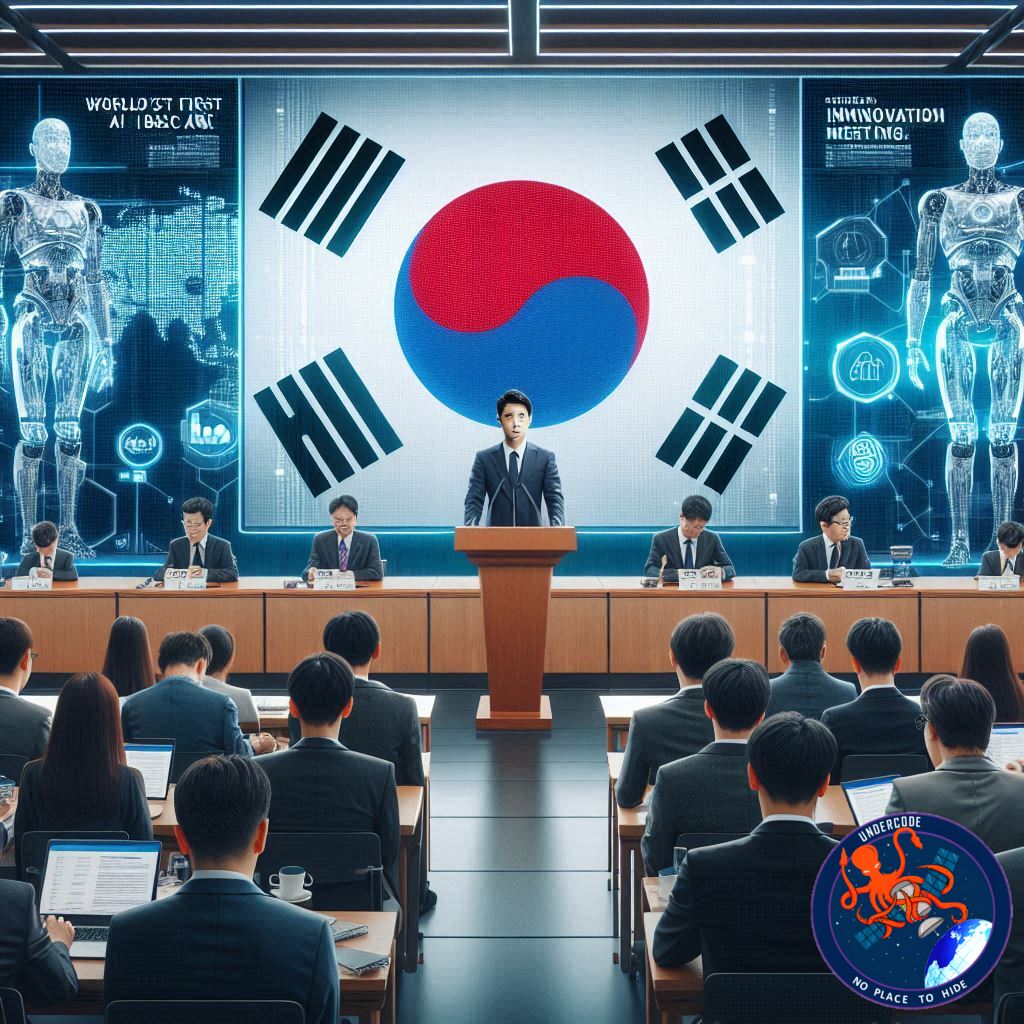
South Korea has formally released the AI Basic Act, a sweeping legal framework the government positions as the world’s first fully comprehensive law governing artificial intelligence. The legislation is not symbolic or experimental, it is already in force across public and private sectors, placing Seoul ahead of every major economy, including the European Union. While policymakers frame the act as a strategic leap toward becoming a top three global AI power, the response at home has been far more complex. Startups, particularly those operating at early stages of AI development, warn that regulatory uncertainty could slow innovation before it has the chance to scale. The law represents ambition, but also exposes a growing tension between national leadership and entrepreneurial freedom.
A Unified Law That Changes the Pace of AI Regulation
South Korea’s AI Basic Act consolidates nineteen previously fragmented regulatory proposals into a single, enforceable framework. Unlike the European Union’s AI Act, which will roll out gradually through 2027, South Korea’s law is already operational. This immediate enforcement reshapes how AI is developed, deployed, and commercialized inside the country. The government argues that clarity and early leadership will attract trust and global relevance, yet startups fear that speed may come at the cost of flexibility. By becoming first, South Korea has also become the testing ground for how strict AI governance interacts with fast-moving innovation.
High-Impact AI Systems Under Human Control
At the heart of the law lies a focus on what regulators define as “high-impact” AI systems. These include technologies involved in nuclear safety, drinking water production, transportation infrastructure, healthcare services, and financial decision-making such as credit scoring and loan screening. In these areas, companies must guarantee meaningful human oversight, ensuring that automated systems do not operate unchecked in environments where errors could carry severe consequences. This requirement signals a clear policy stance, AI may assist, but it must not replace human responsibility in critical systems.
Transparency, Disclosure, and the Burden of Labeling
Another core requirement of the AI Basic Act is transparency. Companies must notify users in advance when AI systems are involved and clearly label or watermark AI-generated content that could be mistaken for reality. This applies especially to synthetic media, automated decision outputs, and generative models. While the goal is to reduce misinformation and manipulation, many developers argue that technical implementation remains unclear. Distinguishing AI output from human-created content is not always straightforward, particularly in advanced generative systems designed to mimic natural expression.
Startup Anxiety and the Fear of Regulatory Risk
Despite a one-year grace period during which no administrative fines will be imposed, South Korea’s startup ecosystem has reacted with visible concern. A survey conducted by the Startup Alliance shows that only two percent of AI-focused startups currently have a formal compliance plan. Nearly half admit they do not fully understand the law. Founders describe the language as vague, raising fears that cautious legal interpretation could discourage experimentation. The sentiment is not outright opposition to regulation, but frustration at being first. Many question why a young ecosystem must shoulder global regulatory leadership before achieving scale.
Government Response and Institutional Support Measures
President Lee Jae-myung has acknowledged these concerns, calling for policies that maximize industry potential while managing unintended consequences. In response, the Ministry of Science and ICT has launched an AI Act Support Desk to help companies determine their regulatory obligations. After the grace period ends, non-compliant firms may face fines of up to 20,400 USD, a figure the government emphasizes as moderate compared to penalties under the EU framework. The message is clear, enforcement will exist, but support will accompany it.
What Undercode Say:
Strategic Leadership Versus Ecosystem Readiness
South Korea’s AI Basic Act is less about control and more about positioning. By moving first, the country is attempting to define global norms rather than react to them. However, leadership in regulation does not automatically translate to leadership in innovation. The gap between policy ambition and startup readiness is the central risk. Regulation that outpaces ecosystem maturity often benefits large incumbents more than emerging players.
The Hidden Advantage of Early Standard Setting
There is a long-term strategic upside often overlooked. Companies that learn to operate under strict AI governance early may gain a competitive edge globally. Compliance readiness can become an exportable advantage, especially as other regions adopt similar rules. South Korean firms that survive this transition may find themselves uniquely prepared for international markets shaped by trust, safety, and accountability.
Vague Language as a Structural Weakness
The most legitimate criticism from startups lies in ambiguity. Vague regulatory definitions push companies toward conservative interpretations, slowing iteration cycles. In AI development, speed and experimentation are critical. Without clearer technical guidance, founders may overcomply, draining resources that should be directed toward research and product development.
Human Oversight as a Signal to Global Markets
The emphasis on human oversight in high-impact AI systems sends a strong message to global partners and investors. South Korea is signaling that safety and accountability are non-negotiable. While this may deter speculative or low-quality deployments, it strengthens trust in AI systems emerging from the country. In regulated industries like finance and healthcare, this trust can translate directly into market access.
Regulatory Support Will Decide the Outcome
The AI Act Support Desk is not a side feature, it is the linchpin of success. If guidance remains practical, fast, and technically informed, startups can adapt without losing momentum. If support becomes bureaucratic or slow, regulatory friction will compound. The law itself is only half the story, execution will define whether South Korea becomes an AI powerhouse or a cautionary tale.
🔍 Fact Checker Results
✅ South Korea has implemented a unified AI law ahead of the EU.
✅ The law includes human oversight and transparency requirements.
❌ Claims that startups will immediately face heavy fines are misleading.
📊 Prediction
📈 South Korea will influence future global AI regulatory models.
⚖️ Short-term startup friction will give way to compliance-driven innovation.
🌍 Firms aligned early with the AI Basic Act will gain international credibility.
▶️ Related Video (82% Match):
🕵️📝✔️Let’s dive deep and fact‑check.
References:
Reported By: timesofindia.indiatimes.com
Extra Source Hub (Possible Sources for article):
https://www.twitter.com
Wikipedia
OpenAi & Undercode AI
Image Source:
Unsplash
Undercode AI DI v2
Bing
🔐JOIN OUR CYBER WORLD [ CVE News • HackMonitor • UndercodeNews ]
📢 Follow UndercodeNews & Stay Tuned:
𝕏 formerly Twitter 🐦 | @ Threads | 🔗 Linkedin | 🦋BlueSky | 🐘Mastodon


