
Listen to this Post
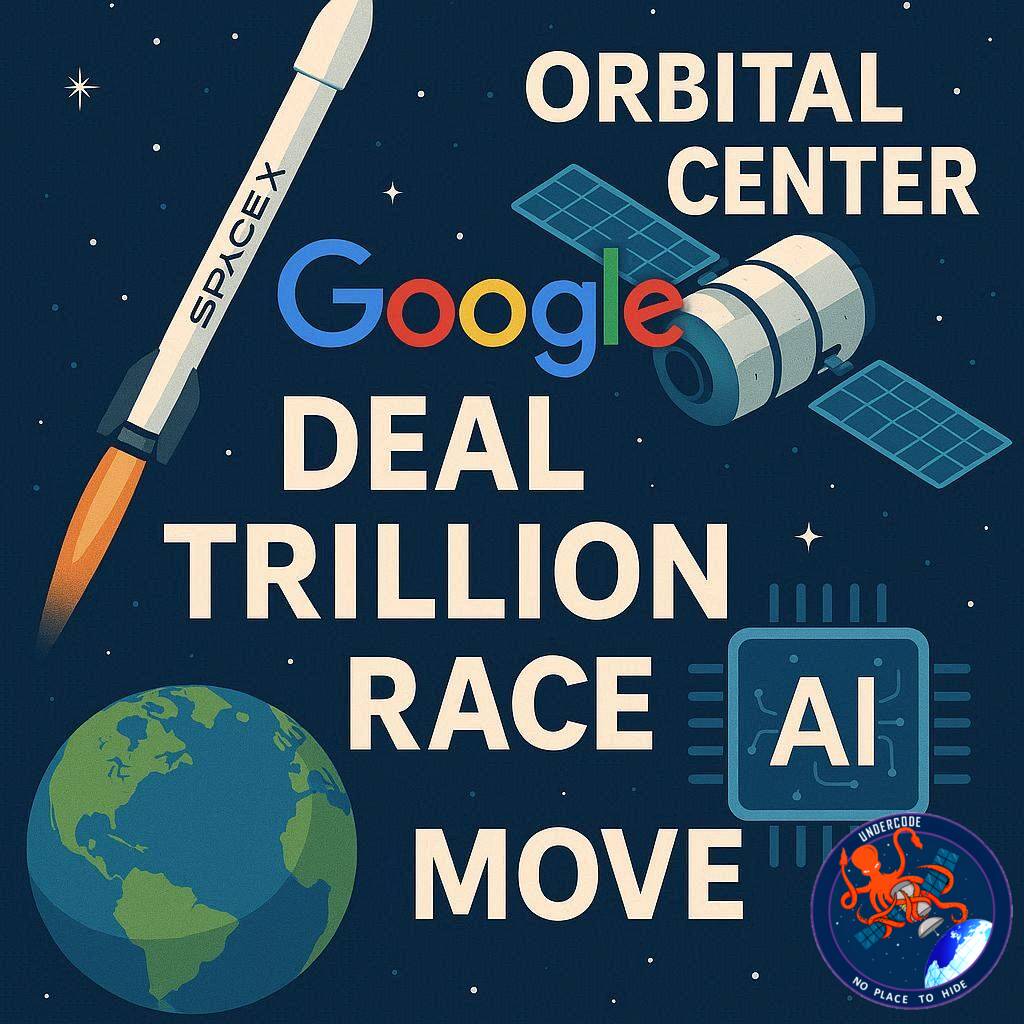 Introduction: A Shock Partnership That Could Redefine the Internet’s Future
A new wave of technological ambition is taking shape as SpaceX and Google reportedly explore a groundbreaking partnership that could shift artificial intelligence infrastructure beyond Earth. According to a Wall Street Journal report, the two companies are in discussions over a rocket launch agreement aimed at deploying orbital data centers. The idea is as radical as it sounds: instead of expanding Earth-based server farms that consume massive amounts of electricity, AI computation could be moved into space. The motivation is simple but urgent—AI systems are demanding more power than the planet can sustainably provide. If successful, this collaboration could mark the beginning of a new industrial era where data centers no longer sit on land, but orbit above it.
the Original Report (Condensed Narrative Overview)
SpaceX and Google are reportedly negotiating a partnership focused on launching space-based data centers using SpaceX rockets. The talks center around supporting Google’s growing interest in orbital computing, an emerging field designed to solve Earth’s escalating energy crisis caused by artificial intelligence workloads. The report suggests this deal would enable Google to deploy experimental satellites and computing hardware into orbit.
The core driver behind the initiative is the rapid explosion in global data center electricity consumption, which already accounts for a significant share of worldwide energy usage and is projected to double within the decade. AI-focused infrastructure is growing even faster, with demand rising at unprecedented rates.
Traditional Earth-based infrastructure is increasingly constrained by power availability, cooling requirements, land usage, and environmental concerns. AI training facilities alone can consume as much electricity as entire cities, placing strain on national grids and accelerating operational costs.
Orbital data centers offer a theoretical solution by leveraging uninterrupted solar energy in space. Solar panels in orbit can produce significantly more energy than on Earth due to constant sunlight and lack of atmospheric interference.
Additionally, heat generated by computation can be radiated directly into space, removing the need for water-based cooling systems. This eliminates some of the most expensive and resource-intensive aspects of modern data centers.
Elon Musk has long promoted this vision, arguing that space-based computing is the only scalable path for AI expansion. He believes Earth will eventually become too limited to support the exponential growth of computational demand.
Google, through its internal initiative Project Suncatcher, is also developing prototype satellite systems equipped with specialized AI chips to test computing in orbit.
SpaceX’s infrastructure, including Starlink and Starship, positions it as a potential leader in deploying massive satellite constellations capable of hosting distributed computing networks.
The company has even filed regulatory plans suggesting future deployments of large-scale orbital systems that could support enormous computing capacity.
However, significant technical challenges remain, including radiation resistance for hardware, data transmission speed, orbital debris risks, and the cost of launching large-scale infrastructure.
Despite these obstacles, early experiments and competing efforts from other tech and aerospace companies suggest that space-based computing is transitioning from theory to early-stage reality.
The partnership, if finalized, could redefine not only cloud computing but the entire global digital economy, pushing humanity’s computational backbone beyond Earth itself.
What Undercode Says: AI, Power Crisis, and the Space Infrastructure Gold Rush
The Hidden Driver Behind the Deal: Electricity as the New Bottleneck
The real story is not space—it is energy. AI has outgrown the efficiency curve of Earth-based power systems. When data centers begin consuming electricity on the scale of mid-sized nations, the limitation is no longer software or chips but physical infrastructure. This deal reflects a shift where computation is becoming an energy industry first and a technology industry second.
SpaceX as the Physical Backbone of a New Cloud Era
SpaceX is uniquely positioned because it controls both launch frequency and satellite deployment through Starlink. If orbital data centers become viable, SpaceX would effectively become the “AWS of space.” This is not just transportation—it is ownership of the access layer to orbital infrastructure.
Google’s Strategic Fear of Falling Behind AI Compute Demand
Google’s involvement signals urgency. The company is facing exponential compute demand from AI models while competing with rivals who are aggressively scaling infrastructure. Orbital computing is not a luxury experiment—it is a hedge against future grid constraints and regulatory bottlenecks on Earth.
Orbital Computing as the Next Stage of Cloud Evolution
Cloud computing evolved from centralized servers to distributed global data centers. The next logical step is geographic expansion beyond Earth itself. If latency and reliability challenges are solved, orbit becomes a massive, untapped compute zone with constant solar energy and no cooling costs.
The Economics of Space-Based Data Centers
Launch costs remain the largest barrier, but reusable rocket technology is changing that equation. If SpaceX continues reducing cost per kilogram to orbit, the economics of space-based computation begin to resemble terrestrial hyperscale data centers. At that tipping point, orbital infrastructure stops being experimental and becomes competitive.
Energy Abundance Versus Engineering Scarcity
Space solves energy abundance but introduces engineering scarcity. Radiation, hardware degradation, and maintenance constraints replace electricity bills and cooling systems. The industry is essentially trading one set of limitations for another.
The Strategic Monopoly Question
If SpaceX dominates orbital deployment and Google anchors early compute systems, a duopoly over space-based cloud infrastructure could emerge. That raises long-term questions about pricing power, access control, and geopolitical dependency on private orbital networks.
AI Growth Curve Versus Planetary Constraints
AI scaling laws suggest compute demand doubles at a pace that Earth’s infrastructure cannot sustain indefinitely. This creates a mismatch between technological ambition and physical capacity. Orbital computing is one attempt to resolve that mismatch before it slows innovation.
The Early-Mover Advantage Problem
Companies entering now are not just building technology—they are setting standards. If Google and SpaceX define orbital computing architecture first, competitors may be forced to adopt their protocols, similar to how AWS shaped cloud standards.
The Risk of Overestimating Near-Term Feasibility
Despite bold projections, orbital data centers are not imminent at scale. The gap between prototype satellites and fully operational orbital cloud systems remains enormous. Many technical milestones still require breakthroughs rather than incremental improvements.
The Bigger Picture: Computing as an Off-Planet Industry
This partnership represents a shift in mindset: computing is no longer tied to geography. If successful, humanity’s digital infrastructure may gradually detach from Earth entirely, mirroring how early industrial economies once detached from localized production.
🔍 Fact Checker Results
Energy Consumption Claims
✔ Global data center energy usage is indeed rising rapidly, and AI workloads are a major driver of that increase.
Space Solar Efficiency
✔ Solar panels in orbit receive more consistent sunlight than on Earth, significantly improving theoretical energy output.
Timeline Projections
❌ Predictions about orbital AI becoming “economically dominant within 3 years” remain speculative and unverified.
📊 Prediction: The Next Phase of the Space-AI Economy
Orbital data centers are likely to begin as experimental satellite clusters rather than full-scale computing hubs. Over the next decade, early deployments will focus on niche AI workloads, scientific computing, and latency-tolerant processing. If launch costs continue to fall and radiation-hardened chips mature, a hybrid model may emerge where Earth-based data centers handle real-time computing while space-based systems handle energy-intensive training. The long-term trajectory points toward a split infrastructure world—where intelligence is trained above Earth but deployed below it.
🕵️📝Let’s dive deep and fact‑check.
References:
Reported By: www.teslarati.com
Extra Source Hub (Possible Sources for article):
https://www.discord.com
Wikipedia
OpenAi & Undercode AI
Image Source:
Unsplash
Undercode AI DI v2
Bing
🔐JOIN OUR CYBER WORLD [ CVE News • HackMonitor • UndercodeNews ]
📢 Follow UndercodeNews & Stay Tuned:
𝕏 formerly Twitter 🐦 | @ Threads | 🔗 Linkedin | 🦋BlueSky | 🐘Mastodon


