
Listen to this Post
 Introduction: A Turning Point in AI, Energy, and Tesla’s Expanding Vision
The global race for artificial intelligence dominance is no longer just about algorithms—it is about raw compute power, energy infrastructure, and industrial-scale partnerships. A newly revealed agreement between SpaceXAI and Anthropic signals one of the largest compute expansions ever attempted, granting Anthropic access to a massive data center capable of running over 220,000 NVIDIA GPUs. At the same time, Tesla continues to fuel speculation across multiple fronts, from mysterious vehicle prototypes in Texas to long-awaited supercar updates and record-breaking Semi truck orders. Together, these developments paint a picture of an accelerating future where AI, transportation, and energy systems are becoming deeply interconnected.
the Original (AI + Tesla + Industrial Expansion)
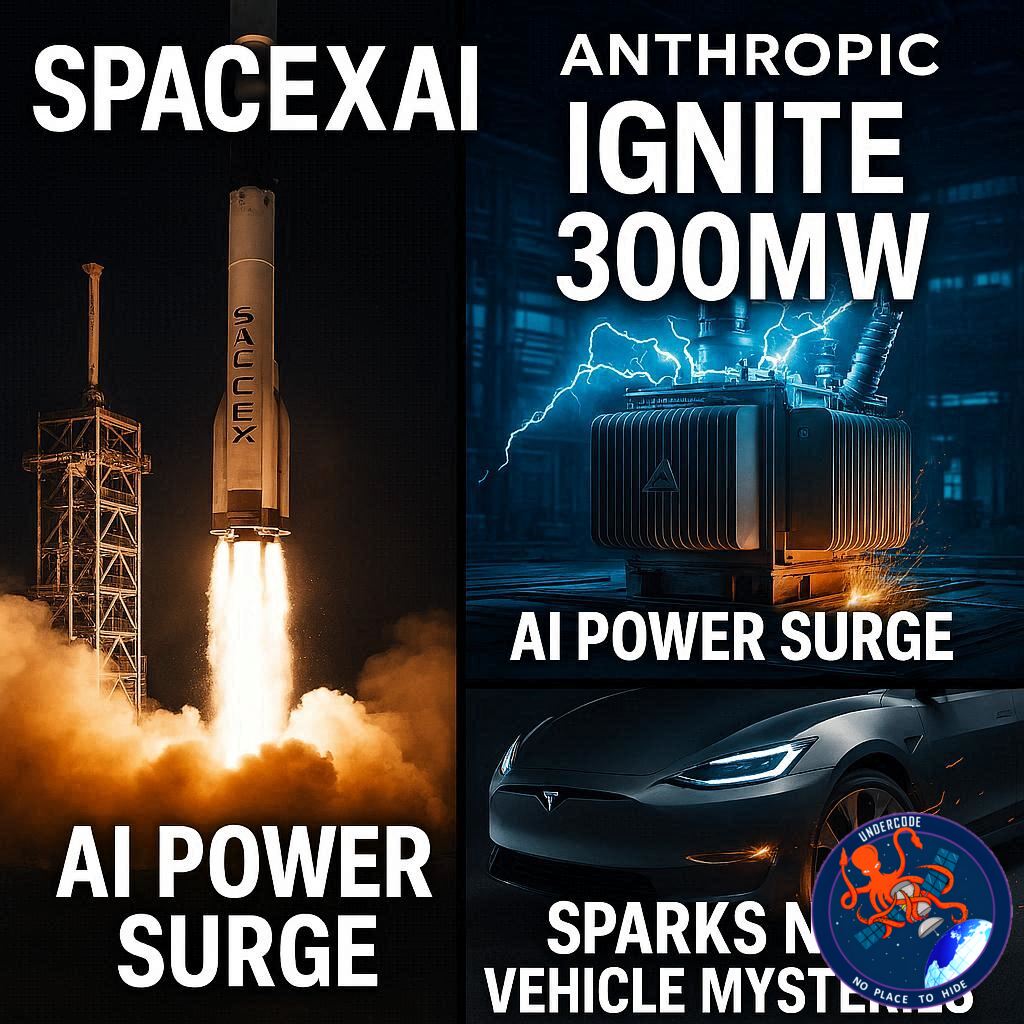
SpaceXAI has signed a landmark agreement with Anthropic, giving the AI company full access to the Colossus 1 data center in Memphis, Tennessee.
The facility delivers over 300 megawatts of power and more than 220,000 NVIDIA GPUs.
Anthropic confirmed the partnership, stating it will significantly expand compute capacity for Claude AI services.
As a result, usage limits for Claude Code and API services are being increased.
Pro and Max users will see doubled rate limits and reduced restrictions during peak hours.
API access for Opus models is also being significantly expanded.
SpaceX described itself as uniquely capable of scaling orbital compute infrastructure in the future.
Elon Musk commented on discussions with Anthropic, referencing internal evaluations during meetings.
The deal reinforces SpaceXAI’s positioning as both a space and AI infrastructure player.
Anthropic continues aggressively scaling compute through multiple major partnerships.
These include multi-gigawatt agreements with Amazon, Google, and Microsoft.
The company is also investing heavily in U.S. infrastructure expansion.
Colossus 1 provides immediate relief in GPU shortages and computational bottlenecks.
This enables faster Claude performance and broader API availability.
Long-term plans include expansion into orbital compute systems by 2026 and beyond.
Meanwhile, Tesla-related developments add further momentum to the technology sector narrative.
A covered prototype spotted at Giga Texas suggests a possible Model Y L variant for the U.S. market.
The vehicle appears larger than the standard Model Y but smaller than the Cybertruck.
It may offer extended seating and cargo space for family use.
Tesla has not confirmed details, but production rumors point to late-stage development.
Another update came from Tesla’s Roadster program via a new trademark filing.
The branding includes a futuristic emblem and aerodynamic design cues.
Despite excitement, fans are frustrated by repeated delays since its 2017 unveiling.
The Roadster promises extreme performance, including sub-two-second acceleration.
Optional SpaceX-style propulsion features remain part of long-term speculation.
Finally, Tesla secured a major Semi truck order from WattEV.
The deal includes 370 electric trucks valued at roughly $100 million.
Deliveries will begin in 2026 with full deployment expected by 2027.
The Semi will support zero-emission freight operations across California.
Charging infrastructure is being built alongside fleet deployment.
These developments reinforce Tesla’s expansion into energy and logistics infrastructure.
What Undercode Say:
AI Compute Becomes the New Oil of the Digital Era
The SpaceXAI–Anthropic deal highlights a reality the industry has been circling for years: AI is no longer limited by ideas, but by electricity and silicon. With 300MW-scale infrastructure and over 220,000 GPUs, this agreement places Anthropic in the upper tier of global AI compute access. This isn’t just expansion—it is industrialization of intelligence itself.
Strategic Convergence Between Space, AI, and Infrastructure Power
SpaceXAI positioning itself as both a launch provider and compute infrastructure operator signals a deeper shift. If orbital compute becomes viable, as hinted in their long-term vision, data centers may eventually move beyond Earth entirely. This turns space infrastructure into a potential extension of cloud computing rather than a separate industry.
Anthropic’s Aggressive Scaling Strategy Signals AI Arms Race
Anthropic’s simultaneous deals with Amazon, Google, Microsoft, and now SpaceXAI suggest an unprecedented attempt to eliminate compute bottlenecks. Each partnership adds redundancy, speed, and stability. The competitive pressure between AI firms is now less about model intelligence and more about who can physically sustain training and inference at scale.
Claude Expansion Reflects Real User Demand Pressure
The immediate increase in Claude Code limits and API throughput shows that demand is already outpacing infrastructure. This is not speculative growth—it is reactive scaling. Users and enterprise clients are pushing systems to their limits, forcing rapid backend expansion across multiple providers.
Tesla’s Giga Texas Prototype Fuels Market Speculation Cycles
The mysterious vehicle spotted between Model Y and Cybertruck reinforces Tesla’s strategy of controlled ambiguity. By allowing partial leaks without confirmation, Tesla keeps consumer anticipation high while avoiding official commitments. The likely Model Y L variant fits a clear market gap in the U.S. SUV segment.
Model Y L Could Replace the Aging Model X Segment
If the extended Model Y enters production, it may functionally replace the Model X lineup for mainstream buyers. This aligns with Tesla’s strategy of simplifying product lines while maximizing platform efficiency. A longer wheelbase Model Y would offer family utility without premium Model X pricing complexity.
Roadster Branding Suggests Preparation, Not Imminent Release
The new Roadster trademark is more about identity control than production readiness. Tesla is locking down intellectual property and design language, but historical delays suggest the vehicle remains far from mass production. Still, continued branding signals the project is not abandoned.
Tesla Semi Order Confirms Industrial Shift in Freight Electrification
The 370-unit Semi order demonstrates that electric freight is transitioning from pilot programs to commercial scale. With megawatt charging systems integrated into logistics hubs, Tesla is building not just vehicles but full transport ecosystems.
Infrastructure Integration Is the Hidden Battlefront
Across both AI and automotive sectors, the key constraint is infrastructure. Whether it is GPU clusters or electric charging depots, success depends on physical systems rather than software alone. Companies that control infrastructure will increasingly control market velocity.
Long-Term Convergence of AI and Energy Systems
Both SpaceXAI’s compute expansion and Tesla’s transportation electrification point toward the same macro trend: convergence of energy, computation, and mobility. In the coming years, these sectors may no longer operate independently but as interconnected layers of a single industrial ecosystem.
Fact Checker Results 🔍
Compute Capacity Claims Align With Industry-Scale Hyperscaler Builds
The reported 300MW facility size is consistent with known hyperscale AI data center developments, making the claim technically plausible.
Tesla Prototype Details Remain Unconfirmed by Official Sources
The Model Y L interpretation is based on visual analysis and prior market variants, but Tesla has not publicly confirmed any U.S. release.
Roadster Trademark Filing Is Verified but Production Timeline Remains Unclear
The trademark application is factual, but no production or release timeline has been officially updated by Tesla.
Prediction 📊
AI Infrastructure Will Become the Dominant Competitive Barrier
Future AI leadership will depend less on model design and more on who controls multi-gigawatt compute infrastructure and energy access.
Tesla May Quietly Expand Model Y Variants as Global Demand Diversifies
An extended Model Y could become a key global product replacing multiple niche SUV segments over the next two years.
Orbital and Distributed Compute Concepts May Shift From Theory to Pilot Projects
If SpaceXAI continues scaling infrastructure partnerships, early orbital compute experiments could emerge by 2026–2027.
🕵️📝Let’s dive deep and fact‑check.
References:
Reported By: www.teslarati.com
Extra Source Hub (Possible Sources for article):
https://www.reddit.com
Wikipedia
OpenAi & Undercode AI
Image Source:
Unsplash
Undercode AI DI v2
Bing
🔐JOIN OUR CYBER WORLD [ CVE News • HackMonitor • UndercodeNews ]
📢 Follow UndercodeNews & Stay Tuned:
𝕏 formerly Twitter 🐦 | @ Threads | 🔗 Linkedin | 🦋BlueSky | 🐘Mastodon


