
Listen to this Post
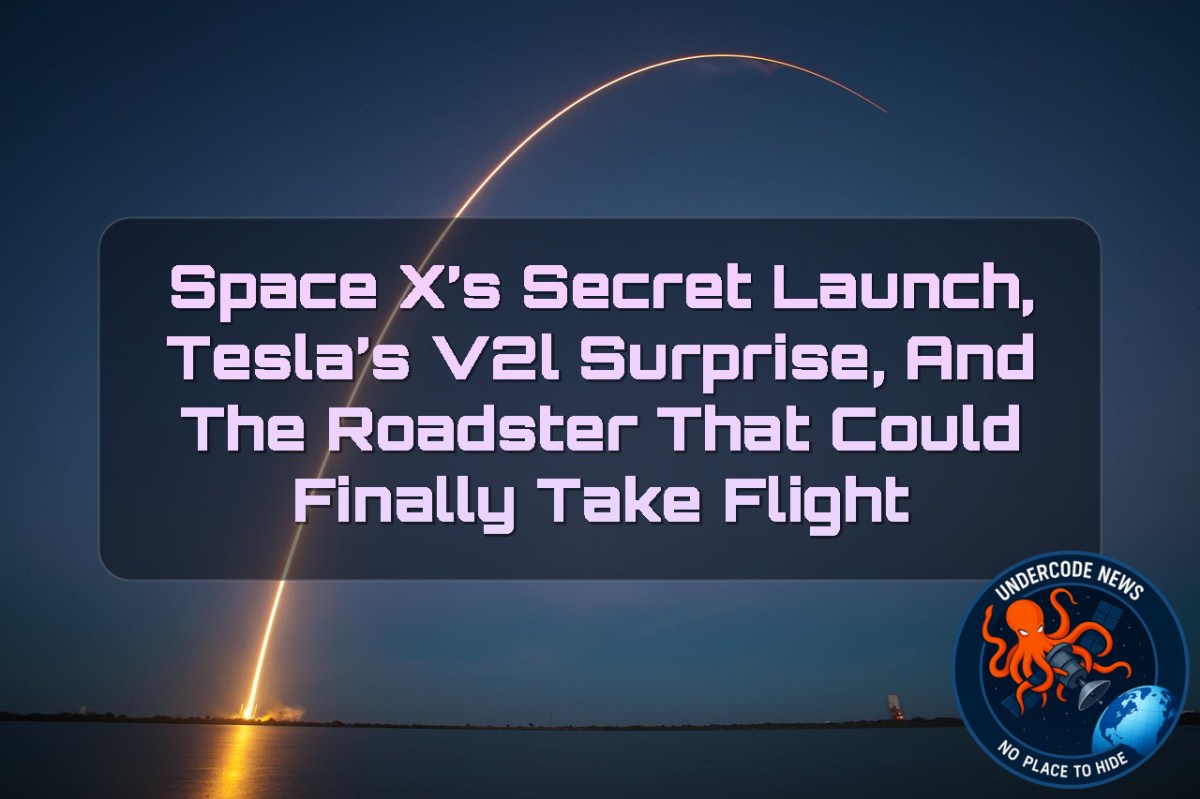 A Weekend That Connected Space, Cars, and a Very Different Kind of Future
There was something unusually revealing about this weekend in the world of Elon Musk. SpaceX sent a classified payload into orbit from California while Tesla quietly expanded the practical capabilities of its electric vehicles and, at the same time, renewed expectations that the long-delayed Roadster could finally receive its dramatic second unveiling.
Three stories might appear unrelated at first glance. One involves national security and a payload the public cannot identify. Another concerns an $80 accessory that can turn a compatible Model Y into a small mobile power source. The third revolves around a sports car that has spent nearly a decade trapped between prototype promises and production reality.
But together, they reveal a broader theme:
SpaceX Sends Another Classified Falcon 9 Into the Night
SpaceX launched the classified USSF-366 mission for the United States Space Force from Space Launch Complex 4E at Vandenberg Space Force Base in California on Saturday night, August 15. The launch occurred during a window that opened at 9:52 p.m. Eastern Time, with the mission carrying a payload officially identified only as classified.
The Payload Remains Behind a Wall of Secrecy
Unlike a normal Starlink launch, where SpaceX openly identifies the satellite group and usually provides extensive information about the mission, USSF-366 offers almost no public payload details. The secrecy is not an accident. Classified military spacecraft can be disclosed only at a very general level, leaving observers to reconstruct possibilities from launch trajectories, hardware patterns, and previous government missions.
Analysts Are Watching the Flight Profile
Independent analysts have suggested that the mission could involve Starshield hardware, SpaceX’s national-security satellite platform derived from the Starlink architecture. That possibility has attracted attention because Starshield is designed for government customers requiring communications, Earth observation, and other specialized capabilities.
Starshield Is Not Simply Another Starlink
Starlink is primarily associated with commercial broadband connectivity, while Starshield is designed around government and national-security requirements. The underlying philosophy is different. Instead of building every satellite system from scratch, government customers can take advantage of SpaceX’s rapidly produced satellite technology and launch infrastructure.
The Mystery Is Part of the Mission
The absence of public information is itself significant. SpaceX has transformed rocket launches into highly visible entertainment, routinely broadcasting missions around the world. USSF-366 represents the opposite model.
The rocket launches in public, but much of what happens after separation belongs to a classified world.
Vandenberg Has Become a Critical Security Launch Site
Vandenberg has increasingly become an important location for U.S. national-security launches because of its geographic position and ability to place spacecraft into demanding orbital inclinations. SpaceX’s reusable Falcon 9 has made these missions more frequent and economically practical.
Falcon 9 Reusability Changes the Equation
The booster used for USSF-366 returned near the launch area, producing the sonic booms that have become familiar to residents around Vandenberg. Reusability means SpaceX can potentially support national-security missions with a launch cadence that would have been difficult to imagine with traditional expendable rockets.
SpaceX Is Building a Government Launch Machine
The classified launch is also part of a much larger relationship between SpaceX and the U.S. government. SpaceX has secured major contracts supporting national-security and missile-warning infrastructure, strengthening its position as one of the country’s most important launch providers.
The Bigger Story Is the Launch Cadence
The most remarkable detail may not be what USSF-366 carried. It may be how routine a sophisticated classified launch has become.
SpaceX also launched another Falcon 9 from Florida on the same evening, only 38 minutes apart, establishing a new company record for the shortest interval between orbital launches.
A Classified Mission in an Era of Mass Production
That speed illustrates the fundamental shift taking place in spaceflight. Rockets, satellites, ground infrastructure, software, and launch operations are increasingly being treated as repeatable systems rather than individually handcrafted projects.
Tesla Quietly Turns the Model Y Into a Power Source
While SpaceX was sending a classified payload into orbit, Tesla was introducing a very different kind of technological capability. The company launched its $80 Outlet Adapter, allowing compatible vehicles to provide electricity to external devices through Vehicle-to-Load, or V2L, functionality.
The $80 Adapter Has Surprisingly Practical Uses
The concept is simple. A compatible Tesla can use energy stored in its battery to power electronics such as laptops, lights, small appliances, and other suitable devices.
For camping, outdoor events, emergencies, tailgating, or temporary power needs, this can turn an electric vehicle into a useful mobile battery.
Tesla Specifies 120 Volts and 20 Amps
According to
Compatibility Is the Real Problem
The biggest frustration for some Model Y owners is not the feature itself. It is determining whether their particular vehicle can actually use it.
Tesla lists the Outlet Adapter as compatible with Model Y Premium, Model Y Performance, and Cybertruck, but compatibility depends on the vehicle’s hardware configuration.
A Nearly New Tesla Can Still Be Incompatible
This creates an awkward situation for owners who purchased relatively recent Model Y vehicles and assumed that a newly introduced software or accessory feature would become available to them.
Some owners have reported seeing incompatibility warnings when attempting to order the adapter, even though their vehicles are relatively new. Community reports also point to differences between Power Conversion System configurations as an important factor.
Hardware Divides Tesla Owners
The episode highlights a growing reality in modern vehicles: two cars that look almost identical can have dramatically different capabilities because of changes beneath the body.
A software update cannot magically create hardware that was never installed.
The Upgrade Question Is More Complicated
Owners whose vehicles lack the necessary hardware may face an expensive upgrade path. At that point, a portable battery station can become a more financially attractive alternative, particularly for people who only need occasional backup power.
V2L Is More Than a Novelty
The feature may appear small, but V2L represents an important shift in how electric vehicles can interact with the energy system around them.
The vehicle is no longer simply something that consumes electricity.
It can also become a temporary source of electricity.
EV Batteries Are Becoming Mobile Energy Assets
An electric vehicle can contain tens of kilowatt-hours of stored energy. Using even a small portion of that energy to power external equipment creates possibilities that traditional gasoline vehicles simply do not offer without additional generators or specialized equipment.
The Feature Could Matter During Emergencies
A V2L-equipped vehicle could potentially provide limited electricity during a power outage for essential electronics, lighting, communications equipment, or other low-power loads.
It is not a replacement for a properly designed home backup system, but it can be extremely useful when portability matters.
Tesla Is Entering a Much Larger V2L Trend
Vehicle-to-load technology is already common across parts of the electric-vehicle market. Tesla’s expansion into the feature is therefore less about inventing V2L and more about bringing it into a much larger vehicle ecosystem.
The Roadster Story Is Getting Wild Again
Then there is the Tesla Roadster.
The vehicle first appeared as a dramatic prototype in 2017, promising extraordinary acceleration and performance. Nearly a decade later, the second-generation Roadster remains one of Tesla’s most delayed products.
Now, however, the story has become considerably more ambitious.
A New Roadster Reveal Could Come This Month
Reuters reported on August 14 that Tesla was preparing to unveil a redesigned Roadster as early as August, citing reporting from The Information. The proposed demonstration could include a limited-edition version equipped with SpaceX-developed cold-gas thrusters.
The SpaceX Version Could Briefly Lift Off
The reported cold-gas system is intended to provide an extraordinary performance boost and could allow the Roadster to briefly leave the ground during a demonstration.
That does not mean Tesla is preparing a conventional flying car for everyday roads. The reported demonstration is intended to showcase extreme technology rather than create a practical airborne transportation system.
This Is Where Tesla and SpaceX Become One Story
The Roadster proposal is fascinating because it represents a literal technological bridge between Tesla and SpaceX.
Electric motors provide the primary propulsion.
SpaceX contributes aerospace-inspired technology.
Tesla supplies the vehicle platform.
The result is a machine designed to demonstrate what happens when automotive engineering crosses into aerospace territory.
The Roadster Has Already Survived Multiple Deadlines
The second-generation Roadster was originally introduced with an expected production timeline around 2020. Years of delays followed.
The Information previously reported that Tesla had pushed the planned demonstration to August or later while engineers continued working on the cold-gas thruster system.
The Design May Also Have Changed
The latest reporting suggests Tesla considered different design directions during the long development period. That would make sense. Automotive technology, battery architecture, manufacturing methods, and Tesla’s broader product strategy have changed substantially since 2017.
A Seven-Year-Old Prototype Can Become a Different Vehicle
The Roadster shown in 2017 represented
Tesla Is Betting on Spectacle
The Roadster does not need to compete with ordinary performance cars on price or practicality to make an impact.
Its purpose may be to demonstrate what Tesla believes is possible when cost, complexity, and mass-market constraints are temporarily pushed aside.
The Risk Is That Spectacle Raises Expectations
That strategy comes with a serious problem.
The more extraordinary Tesla makes the promise, the harder it becomes to deliver something that feels equally extraordinary in reality.
A conventional supercar can impress people with speed.
A Roadster that is supposed to combine electric acceleration with aerospace-style propulsion has to deliver something much bigger.
SpaceX and Tesla Are Increasingly Sharing a Common Engineering Philosophy
The three stories from this weekend reveal an interesting pattern.
SpaceX is using reusable rockets and standardized infrastructure to make extremely complex missions routine.
Tesla is using a vehicle battery as a mobile energy platform.
The Roadster is attempting to merge electric propulsion with aerospace-inspired technology.
All three are based on the same broad philosophy: take a complex technology and make it increasingly repeatable, integrated, and scalable.
What Undercode Say:
The Secret Payload Matters Beyond the Satellite
USSF-366 is important because classified launches are becoming part of SpaceX’s normal operational rhythm.
Commercial Rockets Are Becoming National Infrastructure
The U.S. government increasingly depends on commercially operated launch systems for strategically important missions.
SpaceX’s Real Advantage Is Not Just the Falcon 9
The Falcon 9 is only one component of the advantage.
The Launch Infrastructure Is Equally Important
Ground systems, software, telemetry, recovery operations, logistics, and manufacturing all contribute to SpaceX’s ability to launch frequently.
Reusability Creates Operational Flexibility
A reusable booster can be prepared for another mission instead of being discarded after a single flight.
High Launch Frequency Changes Economics
The more frequently a launch provider operates, the more opportunities it has to distribute fixed infrastructure and operational costs across missions.
Classified Customers Benefit From That Infrastructure
National-security customers can potentially gain access to a mature commercial launch ecosystem while maintaining classified payload operations.
Starshield Expands
Starshield moves SpaceX beyond broadband connectivity and deeper into government space infrastructure.
Satellite Constellations Are Becoming Software-Like Systems
Modern satellite architectures increasingly rely on fleets rather than single irreplaceable spacecraft.
That Changes the Meaning of Failure
Losing one satellite does not necessarily destroy the entire system when a constellation contains many nodes.
Rapid Replacement Becomes Strategically Valuable
A company capable of manufacturing and launching replacement satellites quickly can provide resilience that older architectures struggle to match.
USSF-366 Represents That New Model
The classified launch is therefore more interesting as part of a system than as an isolated rocket flight.
Tesla’s V2L Move Is Strategically Significant
The Outlet Adapter is inexpensive compared with the vehicle itself, but it exposes a much larger concept.
The Battery Is Becoming Part of the
The car can potentially serve as transportation, storage, and temporary electrical infrastructure.
Hardware Compatibility Is Becoming a New Ownership Issue
Modern vehicles increasingly have software-defined features that depend on physical hardware revisions.
This Can Create Customer Friction
Owners naturally expect a recently purchased vehicle to remain technologically competitive with newer versions.
Tesla’s Manufacturing Changes Can Make That Difficult
Hardware revisions can appear quietly during production.
A Feature Announcement Does Not Guarantee Universal Compatibility
That distinction is becoming increasingly important in the modern EV market.
The V2L Feature Could Still Become Highly Valuable
For compatible owners, the ability to access up to 2.4 kW of portable power is genuinely useful for many everyday scenarios.
Tesla Could Eventually Expand Bidirectional Energy Features
V2L is only one step toward deeper vehicle-energy integration.
Home Backup Could Become the Larger Opportunity
If future Tesla systems support more sophisticated bidirectional power management, vehicles could become part of residential energy strategies.
That Would Change How Consumers Think About EV Batteries
Instead of viewing the battery solely as a means of extending driving range, owners could treat it as an energy reservoir.
The Roadster Is
The Model Y V2L feature emphasizes practicality.
The Roadster emphasizes spectacle.
Both Still Depend on Engineering Integration
The challenge is not simply inventing individual technologies.
The challenge is making all those technologies work together reliably.
The
Adding cold-gas propulsion to a high-performance electric vehicle introduces questions involving mass, packaging, control systems, safety, thermal behavior, aerodynamics, and regulatory constraints.
Demonstration Technology Is Not Automatically Production Technology
A system can work in a controlled test environment without being ready for mass production.
Tesla Has to Cross That Gap
If the Roadster eventually becomes a production vehicle, Tesla must transform an extraordinary engineering demonstration into something that can be manufactured, serviced, and operated safely.
That Is Much Harder Than Making a Prototype
The
Complexity Can Destroy Timelines
Every additional system introduces another dependency.
Aerospace Technology Raises the Bar Even Further
Cars operate close to people, buildings, roads, and other vehicles.
Rocket-inspired hardware demands an entirely different level of safety consideration.
The
The real test will be whether Tesla can make the technology reliable enough to move beyond a spectacular demonstration.
SpaceX Has Already Proven Its Ability to Operationalize Complexity
Falcon 9 is perhaps the strongest example.
What was once an extraordinary achievement has become routine launch infrastructure.
Tesla Wants the Same Transformation
The company has repeatedly attempted to take technologies that seem futuristic and turn them into consumer products.
The Roadster Could Become a Technology Showcase
If successful, it could demonstrate technologies that later influence Tesla’s broader engineering direction.
But The Roadster Could Also Become a Symbol of Overpromising
Years of delays have created enormous expectations.
The August Moment Is Therefore Important
Whether the unveiling occurs exactly as reported or moves again, Tesla has reached a point where the public is watching not just for a car, but for evidence that the project can finally move from concept to reality. Reuters says the reported reveal could happen as early as August, while Tesla itself has not publicly confirmed the reported schedule.
The Three Stories Are Connected by One Word
That word is infrastructure.
SpaceX is building infrastructure for national-security space operations.
Tesla is turning vehicles into infrastructure for portable electricity.
The Roadster is attempting to turn aerospace technology into automotive performance.
This Is the Larger Musk Strategy
Whether one admires or criticizes
Space Is Becoming Commercial
Government space activity increasingly depends on commercial launch capabilities.
Cars Are Becoming Energy Platforms
Electric vehicles increasingly have capabilities beyond transportation.
Vehicles Are Becoming Software Systems
Hardware, software, batteries, charging systems, and connected services increasingly operate as one integrated platform.
Aerospace Ideas Are Entering Automotive Engineering
The Roadster is an extreme example, but the broader trend is real.
The Future Will Be More Integrated
The next generation of transportation will likely involve energy management, software, connectivity, autonomous systems, and increasingly sophisticated hardware.
That Creates New Opportunities
The same integration that produces impressive capabilities can also create complicated ownership problems.
Hardware Fragmentation Could Become a Major Issue
If vehicle features depend on hardware revisions, consumers may need to understand technical differences that were once invisible to them.
Transparency Will Become More Important
Manufacturers will increasingly need to explain exactly which features work on which hardware configurations.
SpaceX Faces a Different Transparency Problem
For classified missions, secrecy is intentional and necessary.
Public Expectations Still Matter
Even when the payload cannot be disclosed, the growing importance of commercial companies to national security makes public understanding of their role increasingly relevant.
The Future Is Arriving in Pieces
A classified satellite launch may seem disconnected from an EV power adapter.
A flying Roadster may sound even more unrelated.
Yet all three represent different stages of the same technological transformation.
Deep Analysis
Check the SpaceX Mission Status
For public launch information, a Linux user can query a trusted API or endpoint with curl rather than relying on unverified social-media screenshots.
curl -I https://api.spacexdata.com/
Inspect Network Connectivity
Before retrieving public mission data, basic connectivity can be checked with:
ping -c 4 api.spacexdata.com
Verify DNS Resolution
A DNS lookup can confirm that the hostname resolves correctly:
dig api.spacexdata.com
Retrieve Public API Data
If a public endpoint provides mission information, command-line tools can make independent verification easier:
curl -s https://api.spacexdata.com/v4/launches/latest
Filter JSON Data
With jq, relevant fields can be extracted without manually scanning a large response:
curl -s https://api.spacexdata.com/v4/launches/latest | jq '{name, date_utc, success}'
Compare Public Sources
A more reliable research workflow is to compare official information with independent reporting rather than treating one source as definitive.
curl -I https://www.tesla.com/
Check HTTPS Certificates
Certificate information can be inspected using OpenSSL:
openssl s_client -connect www.tesla.com:443 -servername www.tesla.com </dev/null
Monitor Public Launch Information
For research systems, a scheduled task can periodically collect public launch data:
crontab -e
Store Research Results
A simple log can preserve the time at which public information was collected:
date -u >> launch-research.log
Hash Downloaded Research Files
If researchers save public documents locally, hashes can help determine whether a file has changed:
sha256sum report.pdf
Search Saved Records
Researchers can quickly locate mission identifiers in local archives:
grep -R "USSF-366" ./research/
Examine JSON Structure
When working with machine-readable launch information:
jq keys launch.json
Extract Mission Names
A researcher could isolate names with:
jq -r .name launch.json
Separate Facts From Interpretation
A good technical investigation should keep confirmed information separate from analyst speculation.
grep -E "confirmed|official|reported|unconfirmed" research-notes.txt
Preserve Source Timestamps
Time matters in fast-moving technology reporting:
stat research-notes.txt
Avoid Treating Social Posts as Primary Evidence
Social media can provide leads, but important claims should be checked against official documents, company statements, regulatory information, or reputable reporting.
Use Multiple Independent Sources
A simple research workflow can maintain separate source files:
mkdir -p sources/official sources/media sources/analysis
Record What Is Actually Known
A structured research note might contain:
printf "Confirmed: launch occurred
Speculation: payload identity
" > mission-status.txt
Protect Research Integrity
The objective is not to make every mystery disappear.
It is to clearly distinguish what is known, what is strongly supported, and what remains unknown.
Do Not Attempt to Circumvent Classified Information
Public analysis should remain within legally and ethically available information. The secrecy surrounding a national-security payload is not an invitation to bypass security controls.
The Same Principle Applies to Tesla
Vehicle compatibility should be verified through
Hardware Matters
A vehicle can have the same exterior appearance while containing different internal electrical components.
Software Cannot Replace Missing Hardware
That is the central lesson behind many modern vehicle compatibility problems.
Data Can Explain the Difference
Owners can document compatibility information, hardware revisions, and official specifications to determine whether a feature is supported.
The Bigger Technical Lesson
SpaceX, Tesla, and the Roadster demonstrate that engineering progress is rarely about a single breakthrough.
It is about integrating hundreds of systems until the entire machine works.
✅ USSF-366 Was a Real Classified Space Force Launch
SpaceX launched USSF-366 from Vandenberg on August 15, 2026, and public reporting confirms that the mission was classified. The exact payload remains undisclosed.
❌ Starshield Has Not Been Publicly Confirmed as the Payload
Starshield is a plausible interpretation based on reporting and mission analysis, but the government and SpaceX have not publicly confirmed that USSF-366 carried Starshield satellites. It should therefore be described as an analysis rather than an established fact.
✅ Tesla’s $80 Outlet Adapter Is Real
Tesla officially lists the Outlet Adapter at $80, with a 120V/20A rating and 2.4 kW maximum output. Tesla also specifies vehicle and Mobile Connector compatibility requirements.
Prediction
(+1) SpaceX Will Continue Expanding Classified Launch Operations
The growing launch cadence and expanding national-security relationship make it likely that SpaceX will continue handling increasingly important classified and semi-classified missions.
(+1) Vehicle-to-Load Will Become More Common
As EV batteries grow and bidirectional power technology matures, V2L is likely to become an increasingly normal feature rather than an exotic extra.
(+1) Tesla Will Push the Roadster as a Technology Demonstrator
If the Roadster reveal proceeds, Tesla is likely to emphasize its most spectacular capabilities rather than present it as an ordinary sports car.
(+1) SpaceX-Tesla Technology Crossover Will Remain a Major Story
The reported cold-gas thruster project demonstrates how technology developed across Musk’s companies can migrate between industries.
(-1) Roadster Production Could Still Take Much Longer Than the Reveal
Even if Tesla unveils the vehicle this month, a dramatic demonstration would not automatically mean immediate customer deliveries.
(-1) Older Model Y Owners May Face Continuing Feature Fragmentation
Hardware differences could prevent some existing vehicles from receiving newer energy-related capabilities, creating frustration among owners who expected broader compatibility.
The Final Picture
This weekend offered a remarkable snapshot of where Musk’s technology empire is heading.
Above California, SpaceX launched a classified payload that the public may never fully understand.
On the roads, Tesla began giving compatible vehicles the ability to export electrical power.
And somewhere between a car factory and a SpaceX test facility, the Roadster is reportedly being prepared for a demonstration that could push the definition of an electric performance car into unfamiliar territory.
The Secret Launch Is Only One Piece
USSF-366 matters because it shows how deeply SpaceX has entered the national-security launch ecosystem. The company is no longer simply competing for commercial satellite customers.
The Model Y Is Becoming More Than a Car
The V2L system demonstrates another transformation. A vehicle can become a portable energy resource, even if only for limited loads and compatible hardware.
The Roadster Represents the Most Extreme Vision
If Tesla really demonstrates a Roadster using SpaceX-derived cold-gas propulsion, it will be one of the strangest automotive technology demonstrations in recent memory. The Information’s reporting, cited by Reuters, indicates that such a demonstration is being prepared, but the final specifications and production plans remain subject to change.
Three Technologies, One Direction
Reusable rockets, mobile vehicle batteries, and aerospace-inspired electric performance may look like separate stories.
They are not.
They all point toward a future in which machines are increasingly connected to energy systems, software platforms, communications networks, and advanced infrastructure.
The Most Important Question Is What Comes Next
SpaceX has already demonstrated that spectacular technology can become routine when the infrastructure behind it is strong enough.
Tesla now faces the same challenge with its vehicles.
The real victory will not be launching a secret satellite, powering a laptop from a car, or making a Roadster briefly leave the ground.
The real victory will be turning those extraordinary capabilities into reliable systems that can operate repeatedly, safely, and at scale.
A New Era Is Taking Shape
The secret payload may remain secret.
The V2L adapter is already available.
And the
But together, these stories provide a striking glimpse of a technological landscape where the boundaries between rockets, cars, batteries, software, and national infrastructure are becoming increasingly difficult to separate.
▶️ Related Video (80% Match):
🕵️📝Let’s dive deep and fact‑check.
🎓 Live Courses & Certifications:
Join Undercode Academy for Verified Certifications
🚀 Request a Custom Project:
Secure, high-velocity infrastructure and disruptive technological engineering. Contact our engineering team for high-tier development and proprietary systems:
[email protected]
💎 Smart Architecture | 🛡️ Secure by Design | ⭐ Trusted by Thousands
References:
Reported By: www.teslarati.com
Extra Source Hub (Possible Sources for article):
https://www.discord.com
Wikipedia
OpenAi & Undercode AI
Image Source:
Unsplash
Undercode AI DI v2
🔐JOIN OUR CYBER WORLD [ CVE News • HackMonitor • UndercodeNews ]
📢 Follow UndercodeNews & Stay Tuned:
𝕏 formerly Twitter 🐦 | @ Threads | 🔗 Linkedin | 🦋BlueSky | 🐘Mastodon | 📺Youtube


