
Listen to this Post
Europe’s Climate Frontline Faces a Dangerous New Reality
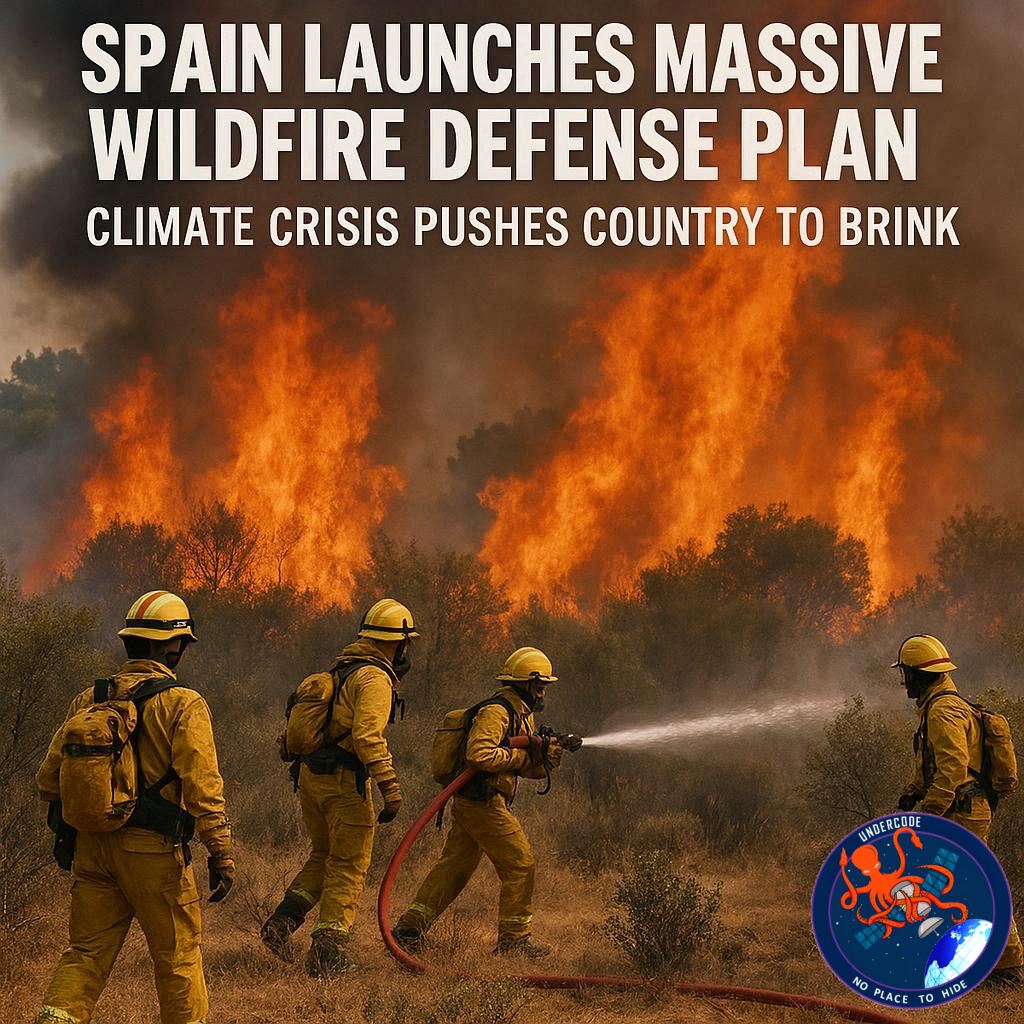
Spain is preparing for another brutal wildfire season after enduring one of the most destructive years in its modern history. With scorching temperatures, prolonged droughts, and increasingly aggressive forest fires becoming the new normal, the Spanish government has unveiled what officials describe as the country’s largest-ever anti-fire campaign. Prime Minister Pedro Sánchez announced the emergency measures at the Torrejón airbase near Madrid, warning that climate change is intensifying natural disasters across southern Europe at a frightening pace.
The announcement comes after Spain suffered its hottest summer ever recorded in 2025, a season that left entire landscapes blackened and communities traumatized. Nearly 4,000 square kilometers of land burned last year, making it the worst wildfire season registered by the European Forest Fire Information System. The disaster highlighted how vulnerable Mediterranean countries have become as global temperatures continue to rise.
Spain Mobilizes Its Largest Wildfire Response in History
The Spanish government is now preparing for what could become another catastrophic summer. Sánchez revealed an enormous national deployment involving advanced firefighting technology, expanded emergency coordination, and earlier seasonal readiness measures aimed at containing future disasters before they spiral out of control.
According to the Prime Minister, the government will use every available resource to combat the escalating threat. Spain’s emergency arsenal now includes new helicopters, specialized firefighting planes, amphibious aircraft capable of collecting water from lakes and coastlines, drones for aerial surveillance, thermal imaging systems, and upgraded monitoring infrastructure designed to detect fires faster and respond more efficiently.
Officials believe these tools are essential because wildfires are no longer behaving like traditional seasonal fires. Instead, they are becoming larger, faster, and more unpredictable due to extreme heat and dry environmental conditions. Sánchez acknowledged that fires are now striking “with greater force and greater virulence,” making them significantly harder to extinguish.
The Interior Ministry also confirmed that Spain’s official wildfire season will begin two weeks earlier than usual, starting on June 1 for the second consecutive year. Authorities say this adjustment reflects the growing reality that dangerous fire conditions are arriving much earlier in the calendar than they did in previous decades.
Climate Change Pushes Southern Europe Into Crisis Mode
Spain has increasingly become one of Europe’s most climate-exposed nations. Rising average temperatures are transforming the country’s ecosystems and weather patterns, fueling heatwaves, droughts, and widespread environmental stress. Forests that once acted as natural barriers are now turning into highly flammable landscapes during extended dry periods.
Scientists and environmental experts have repeatedly warned that southern Europe is warming faster than many other parts of the continent. In Spain, these shifts are already visible through shrinking water reserves, declining agricultural productivity, and increasingly destructive summer conditions.
The 2025 wildfire season became a symbol of this growing crisis. Thousands of hectares of forests, farmland, and natural habitats were destroyed, while smoke pollution affected air quality across multiple regions. Beyond environmental destruction, the economic consequences were enormous, impacting tourism, agriculture, infrastructure, and local communities dependent on rural industries.
The Spanish government is now trying to frame wildfire prevention as both a national security issue and a climate emergency. Sánchez emphasized that the state must adapt to a future where extreme environmental events are no longer rare exceptions but recurring realities.
Political Tensions Add Pressure to Emergency Response
Wildfires in Spain are not only environmental disasters — they are also deeply political events. Spain’s decentralized administrative system gives regional governments major responsibility over emergency management, often creating friction between local authorities and the central government during crises.
Several of the regions hardest hit by last summer’s fires, including Galicia, Castile and León, and Extremadura, are governed by conservative political leadership. This led to accusations and blame exchanges between regional officials and the Socialist-led central government over preparedness, funding, and response coordination.
Sánchez attempted to reduce those tensions during his announcement, insisting that wildfires should not become political weapons. He called for “institutional loyalty” and national unity, arguing that fires do not care which political party controls a region.
The Prime Minister also renewed calls for a nationwide climate emergency pact that would encourage long-term cooperation across all levels of government. His message was clear: climate-driven disasters are becoming too large and too dangerous for fragmented political responses.
The Technology Race Against Mega-Fires
One of the most important aspects of Spain’s new strategy is its heavy reliance on technology. Modern wildfire management increasingly depends on rapid detection systems, predictive monitoring, and aerial coordination that can identify high-risk areas before flames spread uncontrollably.
Thermal cameras and drones are expected to play a major role this year by scanning forests for abnormal heat signatures and monitoring fire behavior in real time. Advanced surveillance systems may also help emergency teams predict wind-driven fire movements more accurately, reducing delays in evacuation orders and deployment decisions.
Amphibious aircraft remain one of Spain’s most valuable firefighting tools because of the country’s geography. These planes can quickly refill from reservoirs or coastal waters and return to active fire zones within minutes. Combined with helicopters and ground teams, they form the backbone of Spain’s rapid-response strategy.
However, experts warn that technology alone cannot solve the deeper problem. As temperatures continue climbing, forests become drier and more combustible, meaning firefighting systems are being forced into a constant race against worsening climate conditions.
What Undercode Says:
Spain’s Wildfire Crisis Is a Warning for the Entire World
Spain’s response demonstrates how climate change is reshaping national security priorities across Europe. Wildfires are no longer viewed as isolated seasonal emergencies but as recurring disasters capable of overwhelming governments, economies, and infrastructure. The scale of Spain’s preparations reflects growing fear that future summers could become even more destructive.
The political messaging behind Sánchez’s announcement is equally significant. By framing wildfire prevention as a collective national mission rather than a regional issue, the government is attempting to centralize climate resilience as a long-term state priority. This may become increasingly common across Europe as environmental threats intensify.
Another important factor is timing. Launching the wildfire season earlier for a second year confirms that climate patterns are permanently shifting. Historically, southern Europe experienced predictable seasonal cycles, but recent years show that dangerous heat conditions are now arriving sooner and lasting longer.
The technological investment also reveals how governments are adapting to “mega-fire” conditions. Traditional firefighting methods were designed for smaller, localized events. Today’s fires behave more like rapidly expanding climate disasters, requiring surveillance systems, aviation coordination, and predictive analysis similar to military operations.
Spain’s situation also exposes the economic cost of climate instability. Wildfires destroy forests, agricultural land, tourism zones, and public infrastructure simultaneously. In regions dependent on summer tourism and farming, recurring fire disasters could permanently damage local economies.
There is also a social dimension often overlooked in wildfire discussions. Rural depopulation across Spain has left many forested regions with fewer residents maintaining landscapes and agricultural firebreaks. Abandoned land becomes overgrown and increasingly vulnerable during extreme heatwaves.
Politically, the tension between regional and national governments may continue to complicate emergency responses. Climate disasters often expose weaknesses in fragmented administrative systems, especially when funding responsibilities and crisis management authority are divided between competing political groups.
The European Union is likely watching Spain carefully because the country functions as a climate “preview” for other Mediterranean nations. Italy, Greece, Portugal, and southern France are facing similar environmental pressures, suggesting that Europe may need continent-wide wildfire coordination strategies in the future.
Another concern is public adaptation fatigue. As citizens experience repeated heatwaves, water shortages, and smoke emergencies, governments may struggle to maintain long-term public engagement with climate preparedness campaigns. Extreme weather risks can gradually become normalized, reducing urgency among populations despite escalating danger.
Spain’s aggressive deployment of aircraft and surveillance technology shows that governments are increasingly prioritizing rapid containment over prevention alone. Yet prevention remains critical. Forest management, controlled burns, water conservation, and urban planning will likely determine whether future wildfire seasons become manageable or catastrophic.
The wildfire crisis also intersects with energy policy. Heatwaves increase electricity demand through air conditioning usage while droughts can reduce hydroelectric generation capacity. Environmental disasters are therefore placing additional stress on national energy systems already transitioning toward renewable infrastructure.
Insurance industries are another hidden pressure point. As wildfire risks intensify, insurers may increase premiums or reduce coverage availability in high-risk regions. This could reshape housing markets and investment patterns in vulnerable rural and coastal areas.
Spain’s experience ultimately highlights a broader global reality: climate adaptation is no longer theoretical. Governments are now being forced to redesign emergency systems, infrastructure planning, and public policy around the assumption that extreme weather events will continue escalating.
The country’s massive anti-fire campaign may reduce damage in the short term, but it also serves as a visible acknowledgment that Europe has entered a new environmental era — one where summer itself is becoming a national emergency.
🔍 Fact Checker Results
✅ Spain experienced its hottest summer on record in 2025, according to the article’s claims.
✅ Nearly 4,000 square kilometers of land reportedly burned, matching figures attributed to the European Forest Fire Information System.
❌ There is still ongoing debate among experts regarding how quickly governments can fully adapt infrastructure to escalating climate-driven wildfire risks.
📊 Prediction
Spain will likely continue expanding its wildfire defense systems over the next decade, with larger investments in AI-powered surveillance, drone coordination, and climate adaptation infrastructure. Mediterranean countries may also begin creating shared European wildfire response networks as extreme heat and drought conditions intensify across southern Europe. If temperatures continue rising at current rates, future wildfire seasons could become longer, more destructive, and economically devastating for the entire region.
🕵️📝Let’s dive deep and fact‑check.
References:
Reported By: www.euronews.com
Extra Source Hub (Possible Sources for article):
https://www.github.com
Wikipedia
OpenAi & Undercode AI
Image Source:
Unsplash
Undercode AI DI v2
Bing
🔐JOIN OUR CYBER WORLD [ CVE News • HackMonitor • UndercodeNews ]
📢 Follow UndercodeNews & Stay Tuned:
𝕏 formerly Twitter 🐦 | @ Threads | 🔗 Linkedin | 🦋BlueSky | 🐘Mastodon | 📺Youtube


