
Listen to this Post
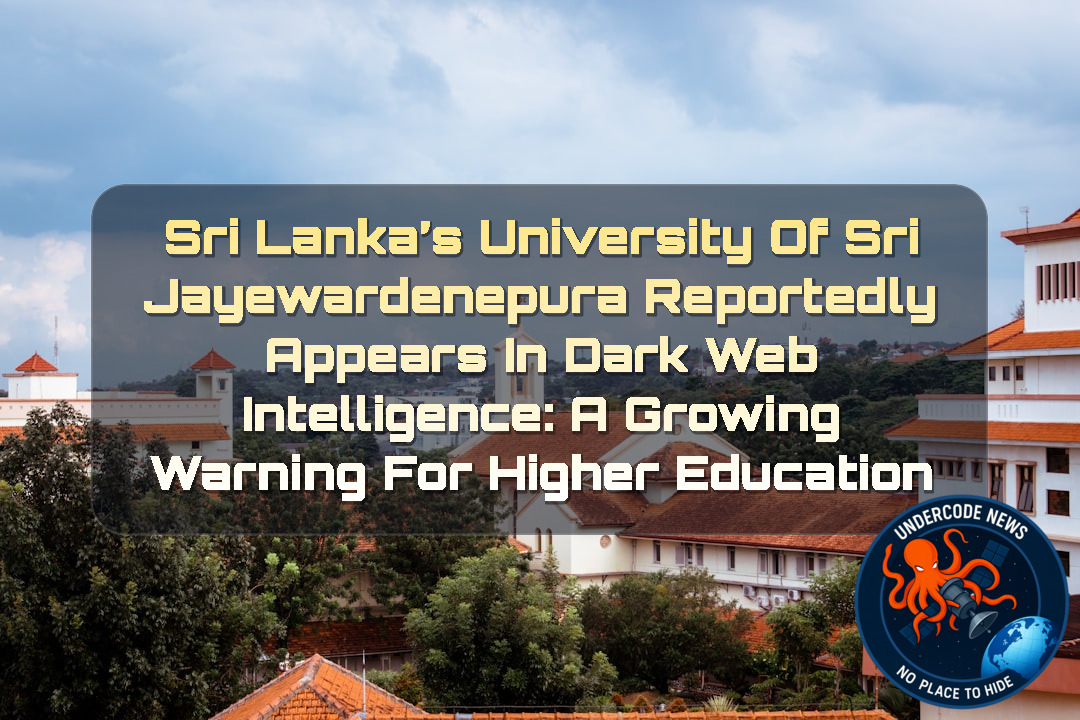 Introduction: When a University Becomes Part of the Cybersecurity Conversation
Universities are built to create knowledge, protect research, and prepare the next generation. But in the modern digital world, they have also become extremely attractive targets for cybercriminals.
On August 20, 2026, the Dark Web Intelligence account, known as DailyDarkWeb, published a post referencing the University of Sri Jayewardenepura in Sri Lanka. The short post provided very limited public information, but its appearance immediately raises important cybersecurity questions.
Was sensitive data exposed? Was a university system compromised? Was the institution listed by a threat actor? Or was the reference connected to another type of dark web activity?
The available post does not provide enough technical evidence to independently establish the exact nature or impact of the reported incident. However, the mention itself highlights a much larger problem facing universities worldwide. Higher education institutions hold enormous quantities of personal, academic, financial, administrative, and research data, while often operating large and complex networks with thousands of users.
That combination can create a dangerous attack surface.
Original Report Summary: A Brief Dark Web Intelligence Alert
The original information comes from a post published by Dark Web Intelligence (@DailyDarkWeb) on August 20, 2026.
The post referenced:
🇱🇰 Sri Lanka, University of Sri Jayewardenepura…
However, the visible content does not provide additional details about the alleged cyber event, the identity of a threat actor, the type of information involved, or the scale of any potential compromise.
Because of this limited information, the situation should be treated carefully. A dark web mention alone does not automatically prove the scope, authenticity, or severity of a cybersecurity incident.
Still, when a major educational institution appears in threat intelligence monitoring, it deserves attention.
Why Universities Are Valuable Targets
A university is not just a collection of classrooms and lecture halls.
Modern institutions operate massive digital ecosystems. These environments can include student portals, employee databases, research infrastructure, learning management systems, email platforms, financial services, cloud storage, identity systems, and internet-facing applications.
A successful intrusion into even one part of this ecosystem can potentially provide attackers with access to valuable information.
Student records can contain names, contact information, identification data, academic history, and financial details. Employee systems may contain payroll information and administrative documents. Research departments may store intellectual property, unpublished studies, scientific data, or international collaboration materials.
For cybercriminals, this makes universities attractive targets.
The Human Attack Surface: Thousands of Potential Entry Points
One of the biggest cybersecurity challenges for universities is scale.
A large university may have thousands of students, lecturers, researchers, contractors, administrators, and visitors accessing its infrastructure.
Every user account can become a potential target.
Phishing campaigns can target students who may not receive the same level of security training as professional employees. Compromised passwords can spread through reused credentials. Faculty members may rely on personal devices, external research tools, or third-party cloud platforms.
Attackers understand this environment.
Instead of attacking a heavily protected central system directly, they may search for the weakest point in the wider ecosystem.
A Dark Web Listing Does Not Automatically Explain the Incident
It is important to separate intelligence signals from confirmed technical evidence.
Threat actors and dark web forums may publish victim names, screenshots, samples, stolen credentials, databases, or claims related to organizations. But the appearance of an organization’s name does not automatically explain how the information was obtained.
The data could theoretically originate from a direct intrusion, a third-party compromise, credential theft, an exposed database, previously leaked information, or even inaccurate material posted for reputation-building purposes.
This is why incident response teams must verify evidence before making conclusions.
Cybersecurity intelligence is often the beginning of an investigation, not the end of one.
What the University Should Investigate
If the reference is connected to an actual security incident, investigators would need to establish several critical facts.
The first question would be whether the
The second would involve identifying which systems, accounts, applications, or databases may have been affected.
The third would be determining whether information was accessed, copied, altered, encrypted, or published.
Digital forensic analysis would also need to identify the possible entry point.
That could involve phishing, stolen credentials, an unpatched vulnerability, exposed remote access infrastructure, cloud misconfiguration, third-party compromise, or another attack vector.
Without these answers, the public cannot accurately determine the scope of the event.
The Data at Risk in Higher Education
Educational institutions often manage information that remains valuable for years.
Unlike a temporary password, personal identity information cannot simply be changed after exposure.
Potentially sensitive information within a university environment may include:
Student and employee identities.
Contact information.
Academic records.
Financial and payment data.
Authentication credentials.
Internal administrative documents.
Research information.
Network configuration data.
Intellectual property.
Communications between departments and international partners.
A compromise involving several categories of information could create long-term consequences.
Research Data Can Be More Valuable Than Personal Data
Not every cyberattack is motivated by identity theft.
Universities are major centers of scientific research, engineering, medicine, technology, economics, and national development.
Research projects can involve years of work and significant financial investment.
A threat actor interested in espionage, intellectual property, or competitive advantage may value research data far more than a typical customer database.
This makes cybersecurity in higher education an issue that extends beyond privacy.
It can also affect innovation.
Why Credential Theft Remains a Serious Threat
Stolen usernames and passwords continue to create major risks.
If a student or employee reuses the same password across multiple platforms, credentials exposed through an unrelated breach may later be tested against university systems.
This technique is commonly associated with credential stuffing.
Attackers do not always need sophisticated exploits.
Sometimes an old password is enough.
Multi-factor authentication can significantly reduce the danger of stolen passwords, especially when combined with strong identity monitoring and suspicious login detection.
Cloud Services Have Expanded the Attack Surface
Modern universities increasingly rely on cloud-based systems.
Email, collaboration platforms, storage services, learning environments, research applications, and administrative systems may all operate across different providers.
This improves flexibility, but it also creates complexity.
Security teams must understand where sensitive information is stored, who can access it, and whether permissions are correctly configured.
A single exposed cloud storage location can create consequences far beyond the original technical mistake.
Third Parties Can Become the Hidden Weak Point
Universities rarely operate alone.
They work with software providers, research organizations, payment processors, cloud companies, educational platforms, contractors, and government agencies.
Each connection can create another security dependency.
An organization may have strong internal security controls while a third-party provider introduces an unexpected risk.
Supply chain security is therefore becoming increasingly important.
Cybersecurity is no longer limited to protecting a single network perimeter.
The ecosystem itself must be protected.
What Undercode Say:
Intelligence Signals Must Be Investigated Before Conclusions Are Made
The DailyDarkWeb post is a cybersecurity signal, but the publicly visible information is too limited to establish the exact nature of the situation.
That distinction matters.
Security professionals should never confuse a threat intelligence mention with a complete forensic conclusion.
However, ignoring such signals can also be dangerous.
The correct response is investigation.
Universities Often Have Complex Security Architectures
Higher education networks are fundamentally different from many corporate environments.
Students need broad access.
Researchers need flexibility.
Academic departments may operate independent infrastructure.
Legacy systems may coexist with modern cloud services.
This diversity creates operational challenges.
It also creates security gaps.
Identity Security Should Be a Priority
The identity layer has become one of the most important parts of modern cybersecurity.
Attackers frequently target accounts instead of infrastructure.
A compromised account can sometimes bypass traditional perimeter defenses.
Universities should therefore monitor impossible travel events, unusual login patterns, privilege escalation, and authentication anomalies.
Multi-factor authentication should be deployed wherever possible.
Asset Discovery Cannot Be Ignored
Security teams cannot protect systems they do not know exist.
Internet-facing applications should be continuously identified and monitored.
Old development servers should not remain publicly accessible.
Forgotten subdomains can become entry points.
Shadow IT can quietly expand the attack surface.
Continuous asset discovery should therefore be part of a mature security strategy.
Patch Management Must Focus on Risk
Not every vulnerability creates the same danger.
Security teams should prioritize vulnerabilities based on exploitability, exposure, privilege requirements, and the sensitivity of the affected environment.
An internet-facing authentication server with a critical vulnerability deserves more immediate attention than an isolated internal test system.
Risk-based patching is more effective than blindly treating every vulnerability equally.
Logs Are the Memory of a Security Incident
When an organization discovers suspicious activity, logs become essential.
Authentication logs can reveal compromised accounts.
Web server logs can reveal exploitation attempts.
Endpoint telemetry can reveal malicious processes.
Network records can help reconstruct attacker movement.
Without sufficient logging, investigators may struggle to determine what happened.
Backups Must Be Protected Like Production Systems
A backup is only useful if attackers cannot destroy it.
Universities should maintain isolated and regularly tested backups.
Restoration procedures should be practiced.
Recovery should not begin for the first time during a real crisis.
Cyber resilience depends on preparation.
Threat Intelligence Should Feed Into Defensive Operations
Dark web monitoring should not become a collection of screenshots and alarming headlines.
Intelligence must become actionable.
Indicators should be reviewed.
Potential credentials should be checked safely.
Relevant domains and infrastructure should be monitored.
Incident response teams should know how to escalate credible evidence.
Intelligence without action creates awareness, but not necessarily protection.
Communication Is Also Part of Incident Response
Organizations sometimes focus entirely on technical containment.
But communication matters too.
Students, employees, researchers, regulators, and partners may all require accurate information.
Premature speculation can create panic.
Silence can create distrust.
The strongest approach is transparent communication based on verified facts.
The Real Question Is Not Only Whether a Breach Happened
The deeper question is whether the institution can detect, contain, investigate, and recover from a serious intrusion.
Modern cybersecurity assumes that prevention may eventually fail.
Detection speed matters.
Containment speed matters.
Recovery speed matters.
Preparation determines how damaging an incident becomes.
Deep Analysis
A Practical Defensive Investigation Workflow
Security teams investigating a possible compromise should begin by identifying unusual authentication activity.
For Linux-based infrastructure, administrators can review recent login activity:
last -a | head -50
Failed authentication attempts can also be reviewed:
sudo grep "Failed password" /var/log/auth.log | tail -100
Administrators can inspect listening services to identify unexpected exposure:
sudo ss -tulpn
Running processes can be reviewed for suspicious activity:
ps aux --sort=-%cpu | head -20
Network connections may reveal unusual external communication:
sudo ss -tpn
Recently modified files can also provide useful forensic clues:
sudo find / -type f -mtime -2 2>/dev/null | head -100
For web infrastructure, administrators should examine access logs for unusual requests:
sudo tail -500 /var/log/nginx/access.log
Security teams should also calculate hashes for suspicious files before further analysis:
sha256sum suspicious_file
A basic investigation should preserve evidence before deleting files or restarting affected systems.
Containment should be balanced with forensic preservation.
Destroying evidence too early can make it impossible to understand the full attack path.
Detection Should Become Continuous
The most effective cybersecurity strategy is not waiting for a dark web post to reveal a possible problem.
Organizations should continuously monitor authentication events, exposed assets, vulnerability intelligence, endpoint behavior, cloud permissions, and unusual network activity.
The goal is to discover the attacker before the attacker discovers everything else.
Zero Trust Is Especially Relevant to Universities
University networks traditionally require openness.
But openness does not mean unlimited trust.
Zero Trust principles can help institutions verify users and devices continuously.
Access should be based on identity and need.
Administrative privileges should be limited.
Sensitive systems should be segmented.
A compromised student account should not automatically become a path toward research infrastructure.
Incident Response Must Be Practiced
A written response plan is not enough.
Teams should practice realistic scenarios.
What happens if student credentials appear online?
Who investigates?
Who contacts leadership?
Who isolates systems?
Who communicates with affected individuals?
These decisions should not be invented during a crisis.
Preparation creates speed.
Speed can reduce damage.
Evidence Status: Limited Public Information
❌ The available DailyDarkWeb post does not publicly provide enough information to independently confirm the exact attack method, affected systems, stolen data, or scale of any potential compromise involving the University of Sri Jayewardenepura.
✅ The University of Sri Jayewardenepura was explicitly referenced in the supplied DailyDarkWeb post dated August 20, 2026, making it a legitimate cybersecurity intelligence signal that may warrant investigation.
❌ Based solely on the supplied post, it would be inaccurate to claim that a specific database, ransomware attack, data theft operation, or technical intrusion has been fully confirmed.
Prediction
(+1) Higher Education Will Face Stronger Pressure to Modernize Cybersecurity
Universities will increasingly adopt stronger identity protection, multi-factor authentication, continuous monitoring, and automated threat detection.
Dark web intelligence monitoring will become more integrated with institutional incident response teams as organizations attempt to identify exposed data and compromised credentials earlier.
Research institutions that improve asset visibility, network segmentation, backup resilience, and incident response readiness will be better positioned to limit the impact of future attacks.
Universities that continue to rely on fragmented legacy infrastructure and inconsistent security practices may remain attractive targets for financially motivated criminals and other threat actors.
Conclusion: The Dark Web Is Often Where Questions Begin
The reference to Sri Lanka’s University of Sri Jayewardenepura may contain only limited public information, but cybersecurity intelligence often begins with incomplete signals.
The important question is what happens next.
A responsible investigation should verify the evidence, identify whether any systems or information were affected, determine the attack path if unauthorized access occurred, and take action based on confirmed technical findings.
For universities, the lesson extends far beyond a single institution.
Every student account, research server, cloud platform, forgotten application, third-party connection, and administrative system can become part of the attack surface.
Cybersecurity is no longer only about building stronger walls.
It is about visibility, identity, resilience, and the ability to respond before a small warning becomes a much larger crisis.
▶️ Related Video (72% Match):
🕵️📝Let’s dive deep and fact‑check.
🎓 Live Courses & Certifications:
Join Undercode Academy for Verified Certifications
🚀 Request a Custom Project:
Secure, high-velocity infrastructure and disruptive technological engineering. Contact our engineering team for high-tier development and proprietary systems:
[email protected]
💎 Smart Architecture | 🛡️ Secure by Design | ⭐ Trusted by Thousands
References:
Reported By: x.com
Extra Source Hub (Possible Sources for article):
https://www.quora.com/topic/Technology
Wikipedia
OpenAi & Undercode AI
Image Source:
Unsplash
Undercode AI DI v2
🔐JOIN OUR CYBER WORLD [ CVE News • HackMonitor • UndercodeNews ]
📢 Follow UndercodeNews & Stay Tuned:
𝕏 formerly Twitter 🐦 | @ Threads | 🔗 Linkedin | 🦋BlueSky | 🐘Mastodon | 📺Youtube


