
Listen to this Post
 Introduction: A Turning Point for the Most Powerful Rocket Ever Built
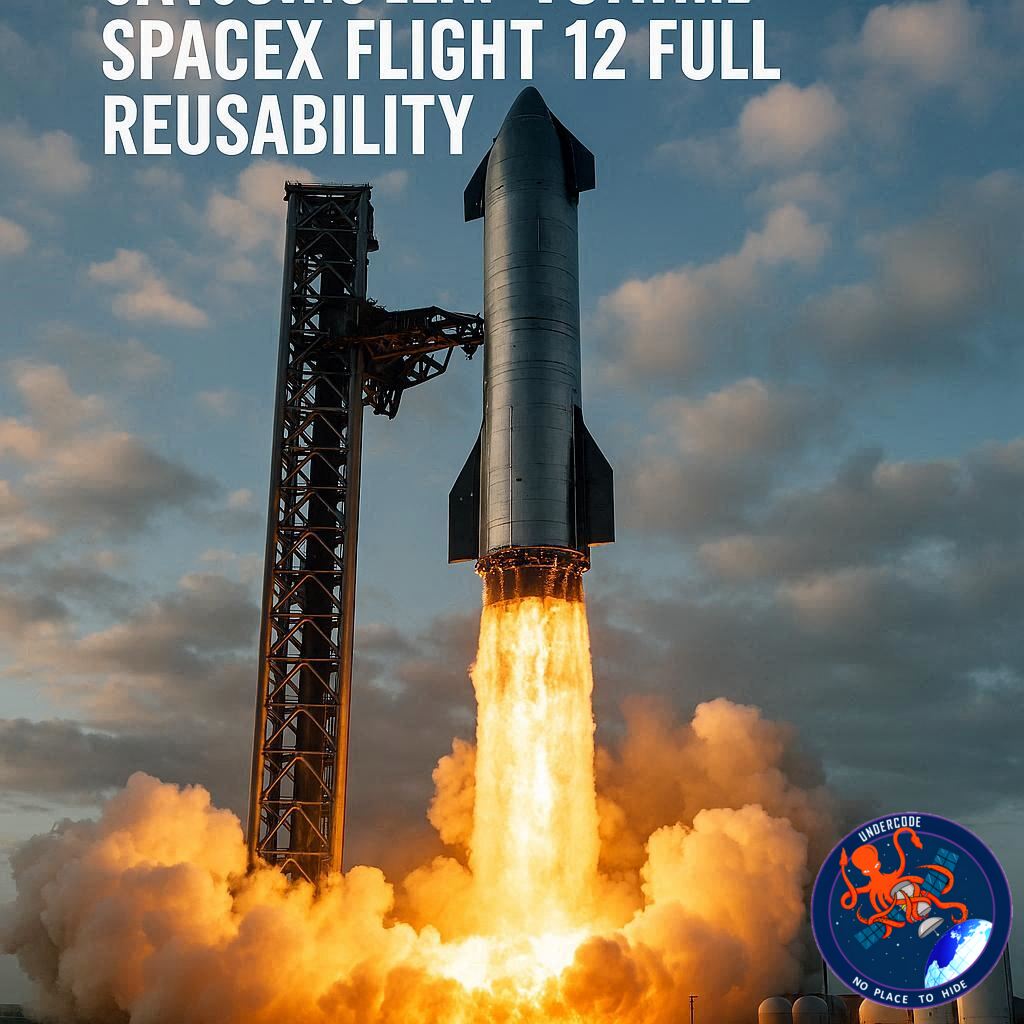
SpaceX has reached a defining moment in its Starship program with the successful full-duration static fire of all 33 Raptor 3 engines on Starship V3. This test, conducted at Starbase, Texas, represents the most powerful rocket ignition ever achieved on Earth and signals that Flight 12, the maiden voyage of the next-generation system, is rapidly approaching. The milestone confirms that SpaceX is moving from assembly and validation into true flight readiness. With Elon Musk indicating a launch window of just a few weeks away, the Starship V3 program is now entering its most critical phase yet, where engineering ambition meets real-world execution.
Summary: What Happened in the Starship V3 Static Fire Test
SpaceX successfully completed a full-duration static fire of Starship V3 using all 33 Raptor 3 engines at its Starbase facility in Texas. This test marks the most powerful rocket engine firing ever recorded and serves as a major pre-launch milestone for Flight 12.
The booster involved, Booster 19, had previously undergone a partial 10-engine test in March, which ended early due to a ground systems issue. Despite that setback, the engines all ignited successfully, proving their reliability. After returning to the Mega Bay, the booster was upgraded with its full engine complement before being rolled back to the pad for this final integrated test.
Each Raptor 3 engine generates approximately 280 tons of thrust, and combined, the 33 engines produce around 9,240 tons of total thrust. This makes Starship V3 the most powerful rocket system ever tested.
The vehicle itself stands roughly 408 feet tall and is designed to carry more than 100 tons to low Earth orbit while being fully reusable. This represents a major leap from the previous Starship V2 generation, which had significantly lower payload capacity.
A successful full-duration static fire is widely considered the final major ground test before launch, meaning Starship V3 is now at the edge of flight readiness. Elon Musk has stated that Flight 12 could occur within 4 to 6 weeks.
The broader mission of Starship V3 is not just launch capability but full reusability and orbital refueling. These features are essential for long-duration missions to the Moon and Mars.
Orbital refueling would require multiple tanker launches to fill a depot in space before deep-space missions can proceed, a capability that has never been demonstrated at scale.
NASA’s increasing reliance on commercial space systems, including lunar mission ambitions, adds further importance to this development.
The success of this static fire confirms that SpaceX is progressing steadily toward making reusable deep-space transport a reality.
What Undercode Say:
Starship V3 is not just another rocket iteration, it represents a structural shift in how humanity approaches space access.
The 33-engine static fire is significant because it validates one of the most complex propulsion architectures ever attempted.
Raptor 3 engines are designed for higher efficiency, higher thrust density, and improved reliability compared to earlier generations.
What makes this milestone critical is not just raw power, but system integration at extreme scale.
Coordinating 33 engines firing simultaneously requires precise control of combustion stability, pressure balancing, and thrust vectoring.
Even minor instability in such a system could lead to catastrophic failure, which is why full-duration tests are so important.
SpaceX is effectively stress-testing the limits of multi-engine synchronization in real conditions.
The successful completion indicates that ground systems, fuel delivery, ignition timing, and engine control software are all operating within acceptable margins.
This also suggests that Starship V3 is transitioning from experimental engineering into operational aerospace hardware.
Historically, SpaceX has used static fire tests as a final checkpoint before flight, meaning confidence in hardware readiness is now extremely high.
However, the real challenge begins at launch, where dynamic atmospheric stresses add entirely new variables.
The leap from ground ignition to orbital insertion remains one of the hardest engineering transitions in aerospace.
Starship’s scale amplifies every risk factor, including vibration harmonics and thermal load distribution.
If V3 succeeds in Flight 12, it will validate not just the rocket, but the entire reusable architecture concept.
That includes rapid turnaround potential, booster recovery, and long-term refurbishment economics.
The bigger strategic goal is Mars transport viability, which depends on reliable heavy lift and orbital refueling infrastructure.
Without refueling, Starship cannot achieve interplanetary payload efficiency at scale.
The system therefore represents a multi-layer dependency chain, where each milestone unlocks the next.
This static fire effectively confirms the first major link in that chain is strong enough for flight testing.
If successful in flight, SpaceX could accelerate toward a reusable launch economy faster than any previous aerospace program.
The implications extend beyond SpaceX, potentially reshaping NASA mission planning and commercial satellite deployment economics.
In essence, this is not just a rocket test, it is a validation step for a fully reusable space transportation ecosystem.
Fact Checker Results
✔ The 33 Raptor 3 engine static fire is consistent with SpaceX Starship V3 testing milestones
✔ Musk’s timeline of a 4–6 week launch window aligns with typical post-static fire schedules
✔ Payload, thrust, and height figures match publicly reported Starship specifications
Prediction
Starship V3 Flight 12 is likely to proceed within the projected 4–6 week window if no ground system anomalies appear during final inspections. If successful, it will mark the first true validation of full-scale Raptor 3 cluster performance under flight conditions. In the longer term, successful missions would significantly accelerate SpaceX’s path toward reusable lunar logistics and early Mars transport infrastructure, reshaping the competitive landscape of global spaceflight.
🕵️📝✔️Let’s dive deep and fact‑check.
References:
Reported By: www.teslarati.com
Extra Source Hub (Possible Sources for article):
https://www.twitter.com
Wikipedia
OpenAi & Undercode AI
Image Source:
Unsplash
Undercode AI DI v2
Bing
🔐JOIN OUR CYBER WORLD [ CVE News • HackMonitor • UndercodeNews ]
📢 Follow UndercodeNews & Stay Tuned:
𝕏 formerly Twitter 🐦 | @ Threads | 🔗 Linkedin | 🦋BlueSky | 🐘Mastodon


