
Listen to this Post
Introduction
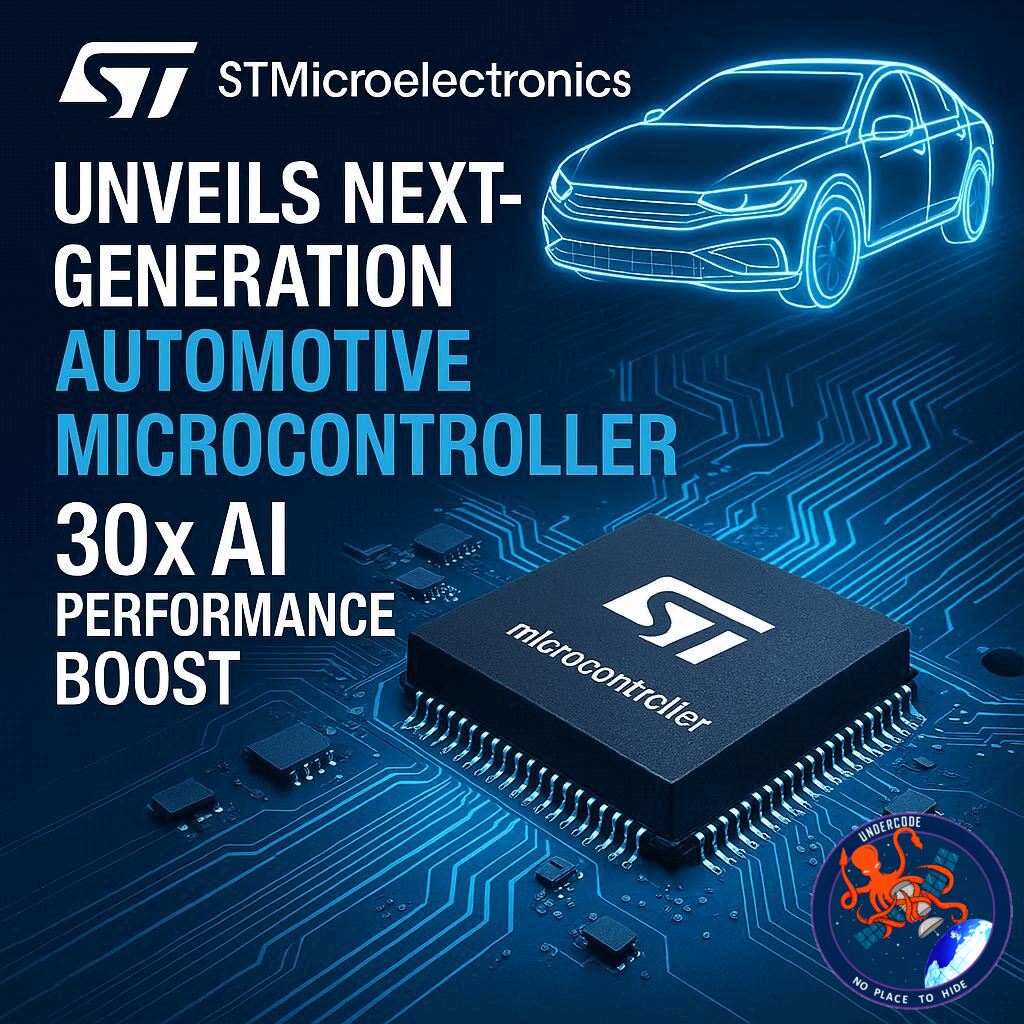
Swiss semiconductor giant STMicroelectronics has taken a major leap in automotive technology with the launch of a next-generation microcontroller designed for the vehicles of tomorrow. The breakthrough focuses on artificial intelligence (AI) processing directly on the vehicle, promising faster decision-making, smarter obstacle detection, and streamlined electronic control—all while easing the engineering burden on automakers. This innovation marks a pivotal step toward fully autonomous and electrified vehicles.
Next-Generation Microcontroller Development
STMicroelectronics announced the creation of its “Stellar P3E” microcontroller, engineered specifically for next-generation automotive applications. This microcontroller is capable of performing AI computations directly on the vehicle, increasing processing efficiency by approximately 30 times compared to conventional CPUs. The system can detect obstacles on the road or even instances such as a hand caught in a window in real time, offering unprecedented safety and responsiveness. Mass production is scheduled for the latter half of 2026, with key clients already receiving sample units for testing and integration.
Advanced AI Processing with NPU
The Stellar P3E microcontroller features a dedicated Neural Processing Unit (NPU) optimized for AI workloads, along with large-scale memory to support complex calculations. The AI inference time—the duration required for the system to generate a decision—has been reduced to just 1/30th of what standard CPUs require, and for specific applications like obstacle detection, it can shrink to 1/69th. This dramatic speed improvement allows vehicles to respond more effectively to dynamic driving conditions, significantly enhancing passenger safety.
Integration and Simplification of Vehicle Electronics
With the rise of electric and autonomous vehicles, the number of in-car features and electronic control units (ECUs) is increasing rapidly. STMicroelectronics’ new microcontroller can handle multiple functions on a single chip, reducing the need for complex wiring and multiple ECUs. This integration simplifies vehicle design, cuts down on manufacturing costs, and reduces the workload for automakers during development.
Implications for Automotive Industry
The Stellar P3E positions STMicroelectronics as a leading innovator in automotive semiconductors. By providing powerful on-board AI capabilities, the company is enabling smarter vehicles that can process real-world inputs in real time. As automakers push for higher levels of automation and electrification, such high-performance microcontrollers will become critical for scaling autonomous systems while maintaining safety standards.
What Undercode Say:
STMicroelectronics’ Stellar P3E microcontroller is more than just a hardware upgrade; it represents a strategic pivot in automotive AI integration. By embedding a Neural Processing Unit and ample memory, the company addresses the longstanding bottleneck of real-time AI processing in vehicles. Historically, AI tasks such as object recognition, collision avoidance, and adaptive automation were limited by CPU speed, forcing reliance on cloud computation or distributed ECU networks. Stellar P3E shifts that paradigm by executing these tasks directly on the chip, reducing latency dramatically and mitigating potential network delays or failures.
The implications extend beyond safety. With one chip capable of consolidating multiple ECUs, automakers can reduce the complexity of vehicle electronic architectures. This simplification leads to lighter wiring harnesses, lower production costs, and fewer points of failure—a major advantage as vehicles become increasingly electric and autonomous. The AI acceleration, particularly the 30x improvement in inference speed, allows the microcontroller to support advanced driver-assistance systems (ADAS) and autonomous features that were previously unfeasible in mass-market vehicles.
From a market perspective, the early release of sample units to key clients suggests STMicroelectronics is securing its foothold among premium automakers, who are racing to deploy AI-driven features ahead of competitors. If successful, this microcontroller could become a standard in next-generation vehicles, creating a ripple effect across the automotive semiconductor market. Moreover, the ability to detect critical safety events, like a hand trapped in a window, highlights ST’s focus on human-centric design—merging AI capability with real-world safety applications.
Technologically, the Stellar P3E also signals a shift in AI hardware design philosophy for vehicles. Moving from a multi-chip distributed architecture to a single-chip, AI-accelerated platform could reshape vehicle electronics for the next decade. It reduces energy consumption, as fewer chips perform the same amount of work, and streamlines software development, since developers now need to optimize for one integrated AI system rather than multiple independent ECUs.
Strategically, STMicroelectronics is positioning itself at the intersection of AI, electrification, and automation—a sweet spot that promises sustained relevance as the automotive industry evolves. Competitors may scramble to match the performance benchmarks set by Stellar P3E, but ST’s early mover advantage in combining AI processing with integrated microcontroller design may prove difficult to surpass.
In short, the Stellar P3E is not just a microcontroller; it is an enabler of smarter, safer, and more efficient vehicles, laying the groundwork for widespread adoption of autonomous systems and fully electrified car platforms. As the automotive landscape continues to transform, STMicroelectronics’ innovations will likely set new performance and safety standards, redefining how AI interacts with real-world driving environments.
Fact Checker Results
✅ STMicroelectronics announced Stellar P3E, a next-gen automotive microcontroller.
✅ AI processing efficiency is reported to be 30 times faster than standard CPUs.
❌ No public confirmation yet of full-scale mass production before late 2026.
Prediction 📊
The Stellar P3E microcontroller could become a foundational technology for 2027–2030 autonomous and electric vehicles. Its AI acceleration may drive adoption of higher-level ADAS features across mid-to-high-end vehicles. Automakers leveraging this chip could see reduced production complexity and faster rollout of safety innovations, potentially establishing STMicroelectronics as the dominant automotive AI semiconductor provider.
▶️ Related Video (88% Match):
🕵️📝✔️Let’s dive deep and fact‑check.
References:
Reported By: xtechnikkeicom_9defa24e7e8de1816d441b59
Extra Source Hub (Possible Sources for article):
https://www.quora.com/topic/Technology
Wikipedia
OpenAi & Undercode AI
Image Source:
Unsplash
Undercode AI DI v2
Bing
🔐JOIN OUR CYBER WORLD [ CVE News • HackMonitor • UndercodeNews ]
📢 Follow UndercodeNews & Stay Tuned:
𝕏 formerly Twitter 🐦 | @ Threads | 🔗 Linkedin | 🦋BlueSky | 🐘Mastodon


