
Listen to this Post
 A Nation Takes Its Climate Concerns to the Streets
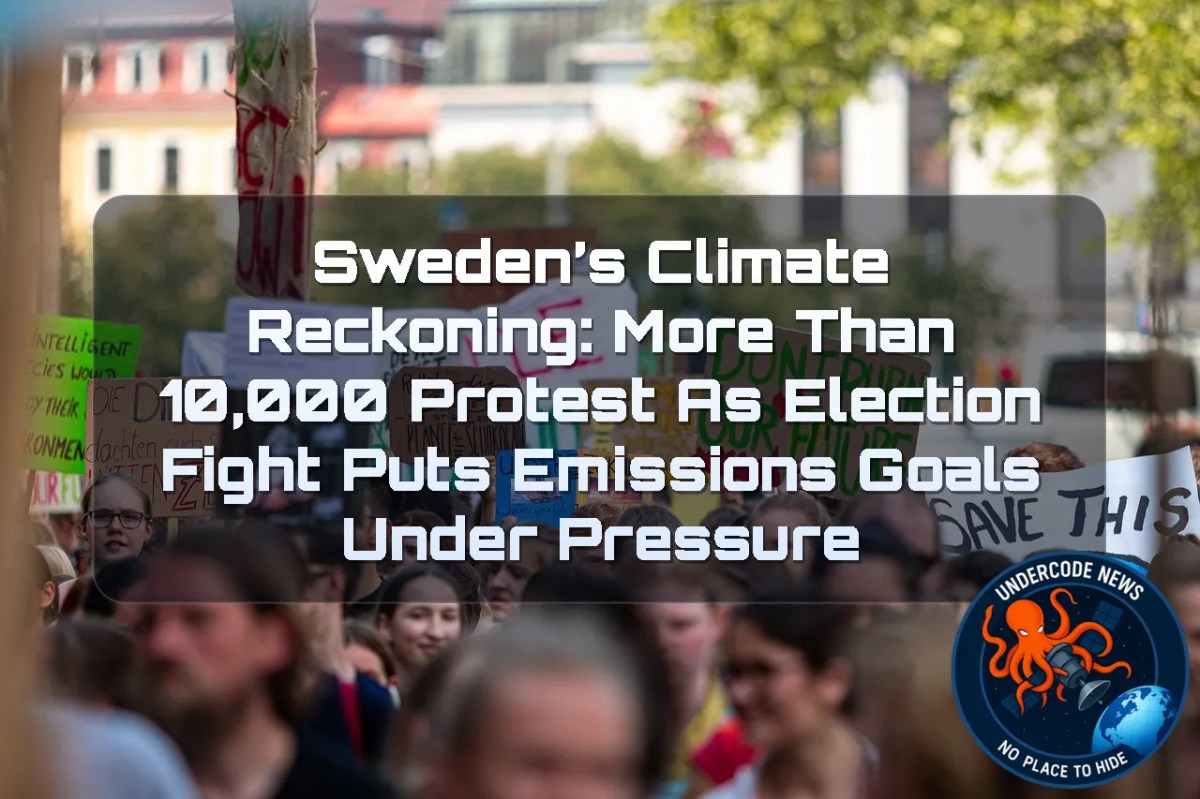
More than 10,000 people gathered in Stockholm on Sunday to protest human-caused climate change, sending a powerful political message only weeks before Sweden heads to the polls. With climate change ranking among the most important concerns for voters, the demonstration highlighted a growing divide between the government’s gradual approach to cutting fossil-fuel use and activists demanding immediate and deeper action.
A Protest That Reached Beyond Climate Activism
The demonstration was not limited to traditional environmental campaigners. Youth organizations, trade unions, sporting groups, rural associations and rights organizations joined forces for the rally, creating a broad coalition around the demand for stronger climate policies.
Among those taking part was Greta Thunberg,
Greta Thunberg Warns of a Dangerous Direction
Thunberg delivered a blunt assessment of Sweden’s political landscape, arguing that none of the country’s major political parties is proposing policies that come close to what climate science requires.
She warned that continuing on the current path could lead to increasingly severe consequences, arguing that signs of environmental and societal disruption are already visible.
Her message reflects a central argument made by climate activists around the world: the challenge is no longer simply acknowledging that climate change exists, but determining how quickly governments are willing to act.
Sweden’s Climate Targets Are at the Center of the Dispute
Sweden has established ambitious climate objectives. One of the country’s major goals is to reduce carbon dioxide emissions from transport by 70 percent from 2010 levels by 2030, while the country is also committed to reaching net-zero greenhouse gas emissions by 2045.
Those targets have helped Sweden build a reputation as one of Europe’s more ambitious countries on climate policy. But meeting them requires sustained reductions in fossil-fuel consumption, particularly in transportation, where petrol and diesel remain important sources of emissions.
The political argument now centers on whether Sweden is moving quickly enough to meet those commitments.
The Government’s Different Approach
Since Prime Minister Ulf Kristersson’s right-wing government took power in 2022, it has pursued policies that critics say have weakened the country’s climate ambitions.
Among the most controversial measures have been reductions in petrol taxes and changes to requirements concerning low-carbon alternatives in fuel supplies.
The government has defended its approach by arguing that climate policies must account for economic competitiveness, household costs and the ability of Swedish businesses to compete internationally.
That argument has created a fundamental political tension: how aggressively should a government pursue emissions reductions if those measures could increase costs for consumers and companies?
The 2030 Target Creates a Political Deadline
The 2030 transport target is particularly important because it leaves a relatively short period for Sweden to dramatically reduce emissions.
Achieving a 70 percent reduction compared with 2010 levels requires more than encouraging individual consumers to make greener choices. It involves changes to transportation systems, vehicle fleets, fuel markets, infrastructure and economic incentives.
The closer the deadline becomes, the more difficult it may be to rely on gradual reforms.
Critics Say the Government Rejected Stronger Measures
The government has rejected recommendations from a commission that examined potential ways to reach Sweden’s 2030 climate target.
Among the proposals were measures that would increase the cost of fossil fuels through higher petrol and diesel taxes, encouraging consumers and businesses to move toward lower-emission alternatives.
Opponents argue that rejecting stronger measures risks creating a future situation in which Sweden has to make much more dramatic changes in a shorter period of time.
Supporters of a Gradual Transition See Another Risk
The
Officials argue that an overly rapid phase-out of fossil fuels could hurt household finances, weaken industrial competitiveness and place Swedish companies at a disadvantage compared with businesses operating in countries with less aggressive climate policies.
From this perspective, climate policy must be designed around a transition that is economically sustainable rather than simply politically ambitious.
The disagreement therefore goes deeper than the question of whether climate change is real. It concerns the speed, cost and distribution of the transition.
Climate Change Becomes an Election Issue
The timing of the demonstration is particularly significant because Sweden’s general election is approaching.
According to the poll cited in the original report, climate change was identified as the election’s top priority by 37 percent of respondents. That figure demonstrates that environmental policy is not a niche political issue.
For voters who consider climate change a decisive concern, the government’s record could influence how they vote.
For others, the cost of fuel, inflation, employment and economic competitiveness may carry greater weight.
The Opposition Gains Momentum
The political backdrop makes the climate debate even more consequential.
A Verian opinion poll published by
If that political balance continues, climate policy could become one of several areas in which voters demand a change of direction.
However, elections are rarely decided by a single issue. Climate policy may influence the political debate without necessarily determining the final result.
The Emotional Power of the Demonstration
Beyond the statistics and political arguments, the Stockholm protest demonstrated something more difficult to measure: public anxiety.
Young people in particular have grown up with increasingly frequent warnings about rising temperatures, extreme weather, ecosystem damage and the long-term consequences of greenhouse-gas emissions.
For many protesters, climate policy is not an abstract economic debate. It is a question about the kind of society they will inherit.
A Young Protester Describes Relief
Kliff Lindberg, a 21-year-old student who attended the demonstration, said he felt relieved to see such a large turnout.
His reaction illustrates an important psychological dimension of climate protests. People who are worried about climate change can sometimes feel isolated, particularly when political action appears slower than scientific warnings.
Seeing thousands of others expressing the same concerns can transform that anxiety into collective political pressure.
Europe’s Extreme Heat Adds Urgency
The demonstration also took place against the backdrop of severe heat affecting parts of Europe.
Beatrice Rindevall, head of the Swedish Society for Nature Conservation, argued that the climate crisis is already happening rather than being a distant threat.
Her argument reflects a broader shift in climate communication. Extreme heat, drought, flooding and wildfires are increasingly discussed not as hypothetical future events but as risks that governments must manage in the present.
The Transport Problem Is Especially Difficult
Sweden’s transport sector represents one of the biggest challenges to achieving its climate targets.
Cars, trucks and other forms of road transportation depend heavily on energy systems that are difficult to transform overnight.
Electric vehicles can reduce emissions from driving, but widespread electrification also requires charging infrastructure, electricity generation, affordable vehicles and reliable supply chains.
Public transportation, rail investment and urban planning are equally important because reducing emissions is not simply about changing the fuel inside a vehicle.
Rural Sweden Faces a Different Reality
Climate policies also affect urban and rural communities differently.
In Stockholm and other major cities, residents may have access to public transportation, cycling infrastructure and shorter commuting distances.
In rural communities, however, cars and trucks can be essential for employment, education, healthcare, agriculture and everyday life.
That difference helps explain why fuel taxation can become politically sensitive. A policy that appears manageable in a major city can have a much larger impact on households that have few alternatives to driving.
The Economic Argument Cannot Be Ignored
The
Sweden has a highly industrialized economy with companies that compete in global markets. Higher energy and transportation costs can affect manufacturing, logistics and consumers.
The challenge is therefore not simply to choose between climate protection and economic growth.
The more difficult question is how to redesign the economy so that lower emissions and economic competitiveness reinforce each other rather than becoming opposing goals.
Green Investment Could Change the Debate
One possible path is to focus less on punishment and more on investment.
Instead of relying primarily on higher fossil-fuel prices, governments can accelerate investment in renewable energy, electricity grids, railways, charging networks, public transportation and clean industrial technology.
If cleaner alternatives become cheaper and more convenient, consumers may adopt them without needing extreme levels of government intervention.
This approach does not eliminate the need for regulation, but it can make the transition politically easier.
The Political Cost of Delay
There is another side to the economic argument: delaying climate action also carries costs.
Extreme weather can damage infrastructure, disrupt agriculture, increase insurance losses and place pressure on public services.
Businesses can also face increasing costs as governments introduce stricter environmental regulations and international markets demand lower-carbon products.
A policy that appears economically cautious in the short term can therefore create larger costs over the longer term.
Sweden’s Reputation Is Also at Stake
Sweden has long presented itself as a climate leader.
That reputation creates expectations both domestically and internationally.
If Sweden succeeds in combining economic strength with rapid emissions reductions, it could provide a model for other countries.
If it falls substantially behind its own targets, critics could argue that ambitious climate commitments mean little without policies capable of delivering them.
The Climate Debate Is Becoming More Practical
The global climate conversation is changing.
Earlier debates often focused on whether climate change was occurring and whether governments should respond.
Today, the debate increasingly revolves around implementation.
How quickly should fossil fuels be phased out? Who pays for the transition? How can electricity systems expand? How should rural communities be protected? How can industries remain competitive? What happens to workers in carbon-intensive sectors?
These are much harder questions than simply declaring support for climate action.
The Swedish Election Could Become a Test
The upcoming election represents an important test of how much political weight climate policy actually carries.
If climate-conscious voters turn their concerns into votes, parties may face pressure to strengthen their environmental platforms.
If economic concerns dominate instead, politicians could interpret the result as evidence that voters prefer a slower transition.
Either outcome could shape
Climate Policy Needs Public Trust
A successful transition cannot depend solely on government orders.
People need to believe that climate policies are fair.
If citizens feel that environmental policies punish ordinary households while wealthy people and large corporations avoid comparable sacrifices, political resistance can grow.
Fairness, affordability and transparency are therefore likely to become just as important as emissions targets.
The Technology Question
Technology will play a major role in determining whether Sweden can achieve its climate goals.
Electric vehicles, battery storage, renewable electricity, smart grids, industrial electrification and low-carbon fuels could all contribute to reducing emissions.
But technology should not be treated as an automatic solution.
Deploying new technologies at national scale requires investment, infrastructure, skilled workers and political stability.
Why the 2030 Deadline Matters
The 2030 target is close enough to create urgency but far enough away that significant policy changes remain possible.
That window will not remain open forever.
Every year of delayed emissions reductions can increase the amount of work required later.
This is one reason climate activists are pushing governments to act immediately rather than relying on promises of future technological breakthroughs.
The Demonstration Sends a Clear Message
The Stockholm protest ultimately represents more than opposition to a particular government’s policies.
It reflects a broader argument over what Sweden wants its economic and environmental future to look like.
Thousands of people gathered because they believe current policies are insufficient.
The government, meanwhile, argues that the transition must be gradual enough to protect economic strength.
The next stage of the debate will be decided not only in the streets, but also through ballots, budgets, legislation and investment decisions.
Deep Analysis
What the Protest Really Represents
The most important development is not simply the number of people who attended the protest. It is the political coalition behind it.
When environmental organizations, young people, unions, rural groups and rights organizations appear together, the climate issue becomes harder to dismiss as the concern of a narrow activist community.
The Real Battle Is About Speed
Both sides broadly acknowledge that emissions need to fall. The fundamental disagreement is about how quickly that should happen.
Activists see delay as dangerous because climate targets become increasingly difficult to achieve as deadlines approach.
The government sees excessive speed as economically risky because households and companies may not have enough time to adapt.
Sweden Has Created a Difficult Contradiction
Sweden’s climate ambitions are exceptionally demanding.
That creates a contradiction when policies simultaneously reduce the economic pressure to abandon fossil fuels.
If fossil-fuel consumption remains relatively attractive while clean alternatives are still developing, emissions reductions can become harder to achieve.
Petrol Taxes Are Politically Powerful
Fuel taxation is one of the clearest examples of the conflict between climate policy and political reality.
Higher petrol and diesel prices can encourage behavioral change and reduce fossil-fuel demand.
But they can also generate immediate anger among drivers, businesses and rural communities.
Politicians therefore face a difficult calculation between measurable climate benefits and immediate political costs.
Climate Policy Cannot Ignore Rural Communities
A successful national strategy must recognize that Sweden is not one uniform transportation environment.
People living in remote areas often depend heavily on private vehicles.
If governments want to reduce fossil-fuel dependence, they must provide realistic alternatives rather than simply increasing costs.
Electric Vehicles Are Part of the Solution
Electrification could substantially change transportation emissions over time.
However, affordability matters.
If electric vehicles remain too expensive for ordinary households, the transition can become socially unequal.
Government policy therefore needs to address not only technological availability but also accessibility.
Public Transportation Has a Strategic Role
Rail and public transportation can reduce the number of individual journeys made by fossil-fuel vehicles.
But infrastructure takes time to build.
This is another reason why climate policy requires long-term planning rather than short political cycles.
Industry Must Be Part of the Transition
Sweden’s industrial economy creates both a challenge and an opportunity.
Industrial companies consume significant amounts of energy, but they can also become leaders in clean manufacturing.
If Swedish companies develop competitive low-carbon technologies, climate policy could become an economic advantage rather than a burden.
Climate Action Can Become Industrial Policy
The most successful climate strategies may increasingly combine environmental policy with economic development.
Investments in batteries, clean steel, renewable electricity, grid infrastructure and low-carbon manufacturing can create jobs while reducing emissions.
That changes the political narrative from “climate costs” to “climate investment.”
The Cost of Inaction Is Often Invisible
One weakness in political debates about climate policy is that the cost of doing nothing can be difficult to see.
A tax increase appears immediately on a fuel receipt.
The economic consequences of worsening climate risks may appear gradually through damaged infrastructure, disrupted supply chains, heat-related health impacts and agricultural losses.
Politics naturally favors visible short-term costs over uncertain long-term risks.
Climate Anxiety Is Becoming Political Energy
The Stockholm demonstration shows how climate anxiety can evolve into political participation.
Young protesters are not simply expressing fear.
They are demanding policy changes, organizing demonstrations and attempting to influence elections.
That transformation can have long-term consequences for political parties.
Greta Thunberg Still Has Symbolic Influence
Regardless of political opinions about Thunberg, her presence remains symbolically important.
She helped turn climate activism into a major international youth movement and continues to represent the argument that governments should follow scientific evidence more aggressively.
Her participation also ensures that
But Protest Alone Cannot Deliver Emissions Cuts
Demonstrations can influence political priorities, but they cannot directly reduce emissions.
The harder work happens afterward through legislation, infrastructure investment, industrial transformation and changes in consumer behavior.
That means the success of the movement will ultimately depend on whether political pressure produces measurable policy changes.
The 2045 Net-Zero Goal Is the Bigger Test
The 2030 transport target is an immediate milestone, but Sweden’s 2045 net-zero objective represents the much larger transformation.
Reaching net zero will require changes across electricity generation, transportation, buildings, industry, agriculture and consumption.
It cannot be achieved through one policy.
The Next Government Will Face Difficult Choices
Any government taking office after the election will inherit the same fundamental challenge.
It will need to reconcile climate targets with economic competitiveness, energy security and household affordability.
Simply reversing existing policies may not be enough.
A new government would need a coherent strategy capable of surviving political pressure.
Sweden’s Experience Could Influence Europe
Sweden’s debate is important beyond its borders.
European countries are facing similar questions about fossil-fuel prices, transportation emissions, industrial competitiveness and public resistance.
How Sweden balances these pressures could provide lessons for other governments.
The Most Important Question Is Trust
Climate policy succeeds when citizens trust that the transition is necessary, fair and achievable.
If people believe policies are unrealistic or economically punitive, resistance can grow.
If people see affordable alternatives and believe the burden is distributed fairly, support for climate action can become much stronger.
The Transition Needs a Social Contract
The most effective climate strategy may therefore be a social contract.
Governments commit to infrastructure and investment.
Companies commit to cleaner production.
Consumers receive practical alternatives.
Workers receive support during industrial transitions.
And policymakers maintain transparent, measurable targets.
Sweden Is Approaching a Defining Moment
The Stockholm demonstration reflects a country confronting the gap between climate ambition and political implementation.
The question is no longer whether Sweden has ambitious targets.
The question is whether its policies can deliver them.
That distinction may define the
What Undercode Says:
The Bigger Story Behind the Protest
Sweden’s climate debate demonstrates one of the hardest problems facing modern democracies: governments can agree on long-term environmental goals while disagreeing dramatically about how to reach them.
Targets Mean Little Without Execution
A 2030 or 2045 target is ultimately a measurement of future performance. The real test is what governments do today to move toward those targets.
The Political Clock Is Moving Faster
Climate deadlines are fixed, but political governments change. A strategy that depends on several administrations maintaining the same direction must be strong enough to survive elections.
Economic Competitiveness Matters
Climate policy that ignores the economy will struggle to maintain public support. Sweden needs to demonstrate that reducing emissions can coexist with industrial strength.
But Competitiveness Cannot Become an Excuse for Permanent Delay
Economic concerns are legitimate, but they can also become a justification for postponing difficult decisions indefinitely. That is where climate activists’ criticism becomes particularly powerful.
The Transition Must Be Designed Around People
Policies should recognize differences between urban residents, rural families, commuters, truck operators, businesses and industrial workers.
Affordability Could Decide Public Support
If cleaner alternatives remain expensive while fossil fuels become more expensive, the transition could produce social backlash.
Infrastructure Is the Missing Link
Charging networks, railways, electricity grids and renewable generation can determine whether climate ambitions become practical reality.
Sweden Has an Opportunity
Because Sweden already has a strong technological and industrial base, it has the potential to turn climate investment into an economic advantage.
The Election Could Change the Direction
A shift in government could bring different priorities, but the underlying challenges would remain regardless of which political coalition wins.
Protesters Are Demanding Urgency
The
The Government Is Betting on Gradualism
The
Both Positions Contain Real Risks
Rapid climate action can create economic and political disruption. Slow climate action can increase environmental and future economic risks.
The Best Policy May Be Acceleration Through Investment
Rather than relying exclusively on higher taxes, Sweden could accelerate the transition by making clean alternatives increasingly attractive and accessible.
Technology Could Bridge the Divide
Innovation can reduce the political cost of climate action if cleaner technologies become cheaper, more convenient and more reliable.
The 2030 Goal Is a Reality Check
Sweden will eventually have to demonstrate whether its current policy mix is capable of producing the emissions reductions it has promised.
Public Pressure Will Continue
The size of the Stockholm demonstration suggests that climate policy will remain politically relevant even after the election.
Climate Politics Is No Longer Only About Activism
It is now connected to energy security, transportation, industrial strategy, household budgets and national competitiveness.
The Next Decade Will Be Decisive
Policies adopted today will influence whether Sweden approaches its 2030 and 2045 goals with confidence or faces increasingly difficult catch-up measures.
Undercode’s Assessment
The strongest lesson from Sweden is that climate ambition needs implementation. Setting ambitious targets earns headlines, but building the systems capable of achieving them determines whether those targets become reality.
✅ The article’s core claim is consistent with the supplied report: more than 10,000 people demonstrated in Stockholm over climate policy, with Greta Thunberg among those participating.
✅ Sweden has established major climate objectives, including a 70 percent reduction in transport emissions from 2010 levels by 2030 and a net-zero emissions goal for 2045.
⚠️ The political polling figures and election-specific details are time-sensitive and should be checked against the latest polling and official election information before publication as a current-affairs article.
Prediction
(-1) If Sweden’s transport emissions do not decline rapidly enough, pressure will increase on whichever government takes office to introduce stronger measures before the 2030 deadline becomes even harder to reach.
(+1) If Sweden combines climate investment with affordable electric transportation, expanded public transit, cleaner industry and stronger energy infrastructure, the country could demonstrate that emissions reductions and economic competitiveness do not have to be opposing objectives.
(+1) Climate policy is likely to remain a major electoral issue as extreme weather events and the economic consequences of the energy transition continue to shape public opinion.
(-1) If climate policies are perceived as disproportionately expensive for rural households and lower-income families, political resistance could grow and make ambitious emissions policies harder to sustain.
(+1) The strongest long-term outcome would be a Swedish climate strategy that moves beyond the simple argument of faster versus slower action and instead focuses on making the clean transition faster, cheaper and more practical for ordinary people.
▶️ Related Video (78% Match):
🕵️📝Let’s dive deep and fact‑check.
🎓 Live Courses & Certifications:
Join Undercode Academy for Verified Certifications
🚀 Request a Custom Project:
Secure, high-velocity infrastructure and disruptive technological engineering. Contact our engineering team for high-tier development and proprietary systems:
[email protected]
💎 Smart Architecture | 🛡️ Secure by Design | ⭐ Trusted by Thousands
References:
Reported By: www.euronews.com
Extra Source Hub (Possible Sources for article):
https://www.stackexchange.com
Wikipedia
OpenAi & Undercode AI
Image Source:
Unsplash
Undercode AI DI v2
🔐JOIN OUR CYBER WORLD [ CVE News • HackMonitor • UndercodeNews ]
📢 Follow UndercodeNews & Stay Tuned:
𝕏 formerly Twitter 🐦 | @ Threads | 🔗 Linkedin | 🦋BlueSky | 🐘Mastodon | 📺Youtube


