
Listen to this Post
Introduction: A Silent Autonomy Breakthrough Behind Factory Walls
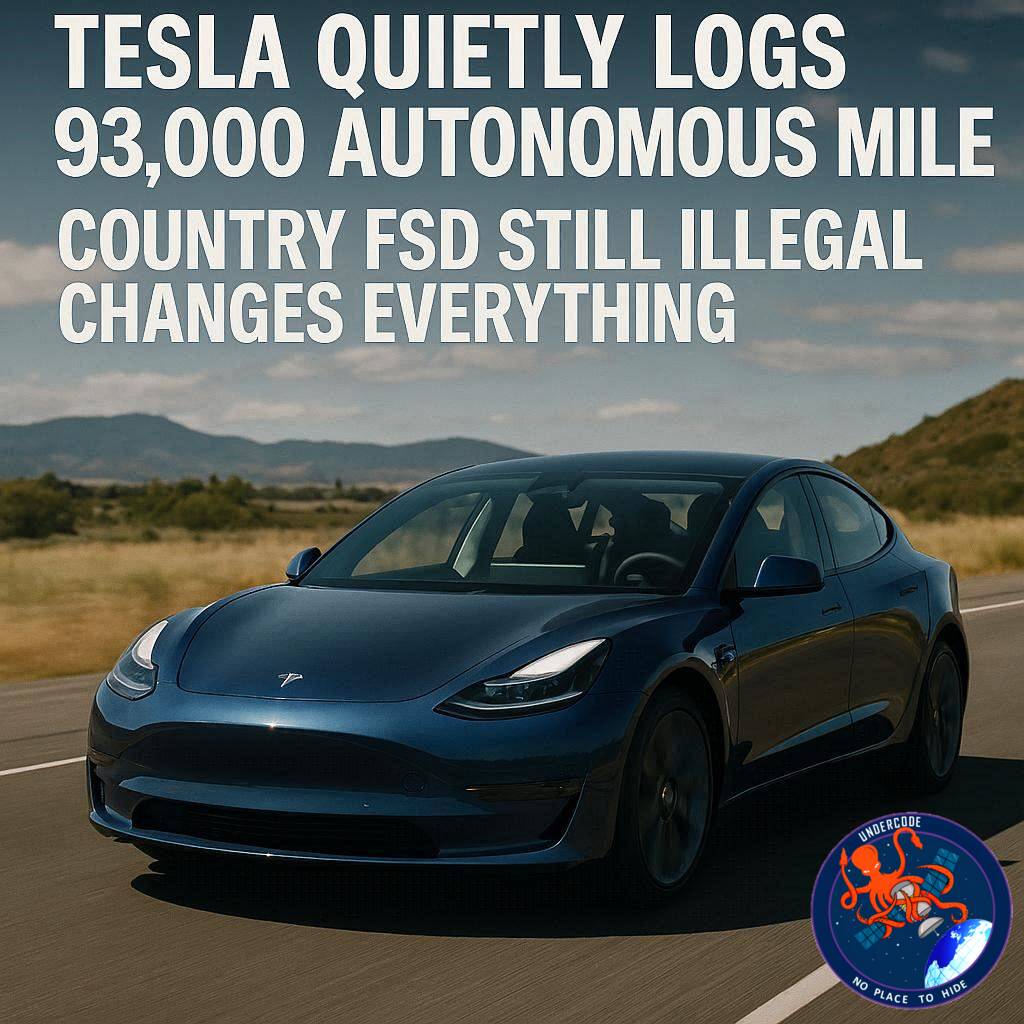
Tesla has achieved a surprising milestone that did not happen on public roads, highways, or testing zones open to consumers. Instead, the company quietly accumulated 93,000 miles of Full Self-Driving (FSD) mileage inside its Giga Berlin factory in Germany, a country where the system is still not approved for public use. This development reveals a different side of autonomy—one that thrives not in chaotic traffic, but in controlled industrial environments.
While regulators in Europe continue to maintain strict limitations on autonomous driving, Tesla has effectively created its own private proving ground. Every newly built Model Y now drives itself from the production line to the outbound logistics area without human intervention. What looks like a simple factory process is, in reality, a large-scale experiment in real-world AI navigation.
This milestone not only highlights Tesla’s internal efficiency but also raises broader questions about the future of autonomous systems, regulatory delays, and how companies can advance technology even when public approval lags behind.
Original Summary: Tesla’s Factory-Based Self-Driving Revolution
Tesla has reportedly accumulated around 93,000 miles (approximately 150,000 km) of Full Self-Driving operations within its Giga Berlin facility. This occurs entirely on private property, where regulatory restrictions for public roads do not apply. The system is used to move freshly manufactured Model Y vehicles from the end of the assembly line to the outbound storage and shipping zones.
At Giga Berlin, each car that completes production does not require a human driver for internal logistics. Instead, FSD is activated and the vehicle autonomously navigates through predefined internal routes. These routes are designed with wide lanes, predictable layouts, and minimal unpredictable obstacles, making them ideal for controlled autonomy testing.
The factory environment is essentially a closed loop system. There is no public traffic, no pedestrians crossing unpredictably, and no external driving complexity. This makes it one of the safest and most stable environments for testing autonomous driving systems at scale.
Tesla showcased this process in a factory video featuring a general assembly team member explaining how the system works. The video highlighted how autonomous driving has become embedded into production logistics, reducing the need for manual vehicle movement.
This system provides significant operational advantages. It reduces labor costs, saves time, and increases efficiency in managing high production volumes. At a factory producing hundreds of thousands of vehicles, even small time savings per unit compound into major logistical improvements.
Beyond efficiency, Tesla also benefits from continuous data collection. Every autonomous movement provides feedback to refine the FSD neural network. Unlike public road testing, this environment ensures repeatability, allowing engineers to isolate and improve specific performance behaviors.
Critically, the deployment also demonstrates Tesla’s confidence in its vision-based autonomous system. If FSD can reliably handle thousands of vehicles in a real factory environment, it strengthens the argument for broader scalability in more complex conditions.
In Europe, where regulations remain cautious, Tesla has effectively turned limitations into opportunity. While consumers cannot yet use FSD on public roads, the system is already functioning in a meaningful operational capacity behind closed doors.
As Giga Berlin continues scaling production, the autonomous driving loop is expected to expand further, reinforcing Tesla’s long-term strategy of integrating AI deeply into manufacturing and logistics.
What Undercode Say: Tesla’s Real Strategy Is Not Roads — It’s Controlled Reality
Tesla’s 93,000-mile achievement inside Giga Berlin is more than a technical curiosity; it reveals a strategic shift in how autonomy is being developed and validated. Instead of relying solely on unpredictable public roads, Tesla is increasingly leveraging controlled environments where variables can be managed, measured, and repeated.
Factory-floor autonomy is often underestimated, but it represents one of the purest stress tests for machine intelligence. While it lacks the chaos of urban driving, it offers something equally important: scale under constraint. Moving thousands of vehicles daily without human input is not just a demonstration—it is a production-grade deployment of AI decision-making.
This approach also highlights a quiet regulatory workaround. In regions like Europe, where public-road autonomy is heavily restricted, private industrial zones become innovation buffers. Tesla is effectively building a parallel testing ecosystem that operates outside traditional approval pathways, allowing continuous refinement without waiting for legislative alignment.
From a systems engineering perspective, this is a powerful feedback loop. Every factory-driven mile contributes structured data, which is far cleaner than public-road data. That structured environment improves model training efficiency and reduces edge-case noise, allowing faster iteration cycles for neural network improvements.
However, this controlled success also introduces a potential blind spot. Systems optimized for predictable environments may not fully translate to chaotic urban conditions. The challenge Tesla faces is ensuring that gains in factory autonomy do not create overconfidence in real-world readiness.
Economically, the implications are equally significant. Automation of internal logistics reduces dependency on human labor for repetitive transport tasks, allowing factories to reallocate workforce resources toward higher-value roles. Over time, this could redefine how automotive plants are structured, potentially reducing operational bottlenecks.
Strategically, Tesla is also sending a message to regulators without directly challenging them. By proving autonomy works at scale in a safe environment, the company builds indirect pressure for broader approval. It is a form of demonstration diplomacy—showing capability without breaking legal boundaries.
Another critical dimension is branding and perception. Each factory mile reinforces Tesla’s identity as an AI-first manufacturer rather than just an automaker. This distinction matters as competition in electric vehicles intensifies and software becomes the primary differentiator.
Ultimately, the Giga Berlin deployment is not just about moving cars. It is about building confidence in autonomy under real operational conditions, while carefully navigating regulatory constraints. Tesla is not waiting for permission to evolve autonomy—it is redefining where and how that evolution happens.
🔍 Fact Checker Results: What Holds Up Under Scrutiny
The reported 93,000 miles figure aligns with publicly shared internal factory logistics practices and Tesla’s known use of FSD in controlled environments.
The claim that vehicles drive autonomously within Giga Berlin is consistent with previously documented Tesla factory operations.
Regulatory restrictions preventing public-road FSD use in Germany are accurate and well established.
📊 Prediction: Where Tesla’s Factory Autonomy Is Heading Next
Tesla is likely to expand factory-based FSD deployments across additional Gigafactories as production scales globally.
Future iterations may integrate more complex indoor-to-outdoor autonomous transitions, bridging factory logistics with semi-public infrastructure.
Over time, factory autonomy will evolve into a key validation layer for Tesla’s broader push toward unsupervised driving on public roads.
🕵️📝Let’s dive deep and fact‑check.
References:
Reported By: www.teslarati.com
Extra Source Hub (Possible Sources for article):
https://www.stackexchange.com
Wikipedia
OpenAi & Undercode AI
Image Source:
Unsplash
Undercode AI DI v2
Bing
🔐JOIN OUR CYBER WORLD [ CVE News • HackMonitor • UndercodeNews ]
📢 Follow UndercodeNews & Stay Tuned:
𝕏 formerly Twitter 🐦 | @ Threads | 🔗 Linkedin | 🦋BlueSky | 🐘Mastodon


