
Listen to this Post
Introduction: A Silent Shift Toward Fully Autonomous Logistics
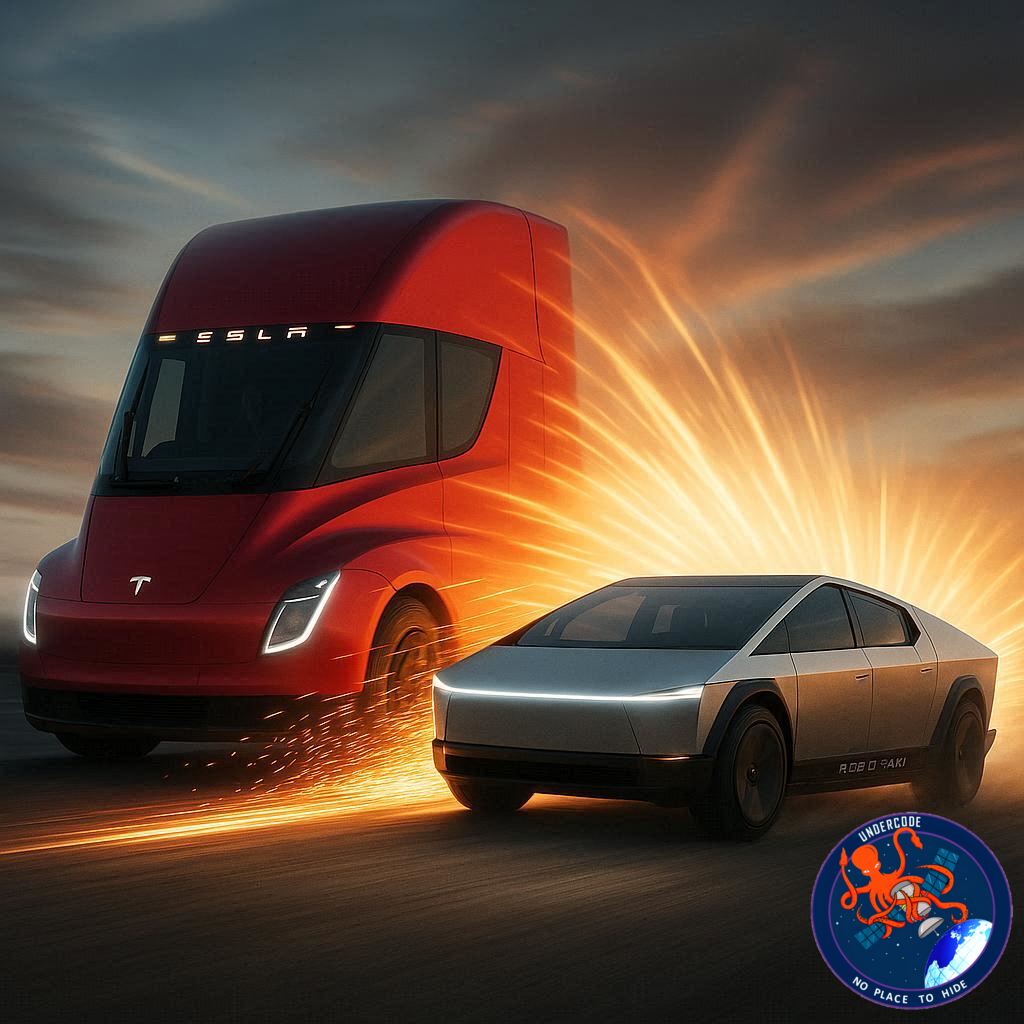
Tesla’s latest movements at Giga Texas are signaling something far bigger than routine vehicle logistics. A Tesla Semi recently hauling multiple Cybercab units has ignited speculation that the company’s robotaxi rollout is transitioning from controlled production into real-world deployment preparation. What was once a futuristic concept presented on stage is now visibly moving through supply chains, production yards, and public demonstrations. Combined with expanding robotaxi plans, regulatory shifts, and aggressive scaling targets, Tesla appears to be entering a decisive phase where autonomy is no longer experimental but operational.
Original From Factory Floors to Robotaxi Frontlines
A Tesla Semi was spotted transporting multiple Cybercab units from Gigafactory Texas, marking the first known instance of Tesla using its heavy-duty electric truck for Cybercab logistics. The sighting confirms that production of the autonomous two-seat vehicle is now active at Giga Texas, where early manufacturing began in February 2026. Prior drone footage had already shown around 60 Cybercabs staged in outbound lots, indicating pre-delivery readiness.
The Semi has previously been used for internal Tesla logistics, including transporting Tesla vehicles and cargo during prototype phases. The Cybercab itself was unveiled in October 2024 during Tesla’s “We, Robot” event, where early units demonstrated short autonomous rides. Production officially began in February 2026 with Musk confirming the milestone publicly.
Tesla aims to scale Cybercab production toward millions of units annually while targeting a sub-$30,000 price point and extremely low per-mile operating costs. The robotaxi network is expected to expand across multiple U.S. cities including Miami, Dallas, and Las Vegas in 2026. Meanwhile, Tesla continues strengthening brand loyalty, Supercharger dominance, and software-based vehicle retention advantages.
Alongside production developments, Tesla has been actively showcasing autonomy through public events, including Cybercab displays at high-profile venues like Miami’s F1 Grand Prix and prior promotional events in Boston and Miami Design District. These demonstrations are strategically aligned with upcoming robotaxi deployments.
On the regulatory side, California has introduced new rules allowing law enforcement to issue penalties directly to autonomous vehicle operators, closing legal gaps that previously exempted driverless systems from traffic violations. This adds new compliance pressure as Tesla scales its autonomous fleet operations across the U.S.
What Undercode Say:
The Semi as a Symbol of Internal Autonomy Logistics Transformation
The use of Tesla Semi trucks to transport Cybercabs is more than a logistical detail. It signals Tesla building a vertically integrated autonomy pipeline where production, transport, and deployment are all handled within its own ecosystem. This reduces dependency on third-party carriers and allows Tesla to tightly control delivery timing and fleet staging.
Cybercab Production Signals Transition From Prototype to Industrial Output
The shift from staged prototypes to visible outbound shipping activity indicates that Cybercab manufacturing is no longer experimental. Instead, it is entering structured production flow, where scaling efficiency and assembly optimization become more important than design iteration. This is typically the phase where industrial bottlenecks determine long-term viability.
Robotaxi Expansion Strategy Reflects Aggressive Market Saturation Goals
Tesla’s planned rollout across multiple U.S. cities suggests a strategy focused on rapid geographic saturation rather than gradual adoption. By targeting diverse urban environments simultaneously, Tesla appears to be testing system adaptability under varying regulatory, traffic, and infrastructure conditions.
Pricing and Cost Structure Suggest Disruption of Urban Transport Economics
The proposed sub-$30,000 price point combined with extremely low operating costs could redefine urban mobility economics. If achieved, the model would directly compete with traditional ride-hailing platforms by eliminating driver labor costs and significantly reducing per-mile transportation expenses.
Supercharger Network as a Hidden Backbone of Robotaxi Scaling
Tesla’s charging infrastructure remains a foundational advantage. With over 65,000 Superchargers globally, the system provides the logistical backbone required for large-scale autonomous fleets. Without such infrastructure, competitor robotaxi networks face significantly higher operational friction.
Software Evolution Reinforces Long-Term Ecosystem Lock-In
Over-the-air updates and Full Self-Driving improvements create a compounding value model where Tesla vehicles improve over time. This shifts ownership perception from static asset to evolving software platform, increasing customer retention and reducing brand switching behavior.
Public Demonstrations Function as Strategic Behavioral Conditioning
Events like Cybercab displays at Miami F1 or Boston marathons are not purely marketing. They function as psychological normalization tools, gradually conditioning the public to accept autonomous vehicles as part of everyday environments before full deployment.
Regulatory Pressure Introduces New Operational Constraints
California’s new enforcement framework introduces legal accountability directly to autonomous vehicle operators. This shifts risk from drivers to companies, increasing compliance complexity and potentially slowing deployment if violation rates are high.
Tesla Loyalty Trends Reinforce Ecosystem Stickiness
High brand loyalty and conquest rates suggest that Tesla is not only retaining customers but actively pulling them from competitors. This strengthens its ability to scale robotaxi adoption internally without relying heavily on external consumer conversion strategies.
Competitive Landscape Faces Structural Disadvantage
Traditional automakers and new EV entrants lack both integrated software autonomy systems and charging infrastructure depth. This creates a structural gap where Tesla’s advantage is not just technological but infrastructural and behavioral.
Fact Checker Results
🔍 Production Confirmation Reality Check
Cybercab production at Giga Texas has been publicly acknowledged, but scaling speed beyond pilot levels remains dependent on supply chain maturity and regulatory approvals.
🔍 Autonomous Deployment Timeline Uncertainty
Robotaxi expansion across multiple cities in 2026 is planned, but real-world deployment timelines often face delays due to local regulatory compliance and safety validation.
🔍 Cost Target Feasibility Question
The sub-$30,000 Cybercab price and ultra-low per-mile cost are long-term targets, but actual production economics may vary significantly depending on battery, sensor, and insurance costs.
Prediction
🚀 Acceleration Toward Regional Robotaxi Dominance
Tesla is likely to achieve concentrated robotaxi dominance in select U.S. cities first, particularly those with favorable regulations like Austin and Las Vegas.
⚙️ Gradual Scaling Bottlenecks in Production and Regulation
While production will continue increasing, regulatory friction and fleet safety validation will likely slow full nationwide rollout beyond initial target timelines.
🌐 Infrastructure Advantage Will Deepen Market Divide
Tesla’s integrated charging and software ecosystem is expected to widen the gap between itself and competitors, making it increasingly difficult for alternative robotaxi networks to match operational efficiency.
🕵️📝Let’s dive deep and fact‑check.
References:
Reported By: www.teslarati.com
Extra Source Hub (Possible Sources for article):
https://www.linkedin.com
Wikipedia
OpenAi & Undercode AI
Image Source:
Unsplash
Undercode AI DI v2
Bing
🔐JOIN OUR CYBER WORLD [ CVE News • HackMonitor • UndercodeNews ]
📢 Follow UndercodeNews & Stay Tuned:
𝕏 formerly Twitter 🐦 | @ Threads | 🔗 Linkedin | 🦋BlueSky | 🐘Mastodon


