
Listen to this Post
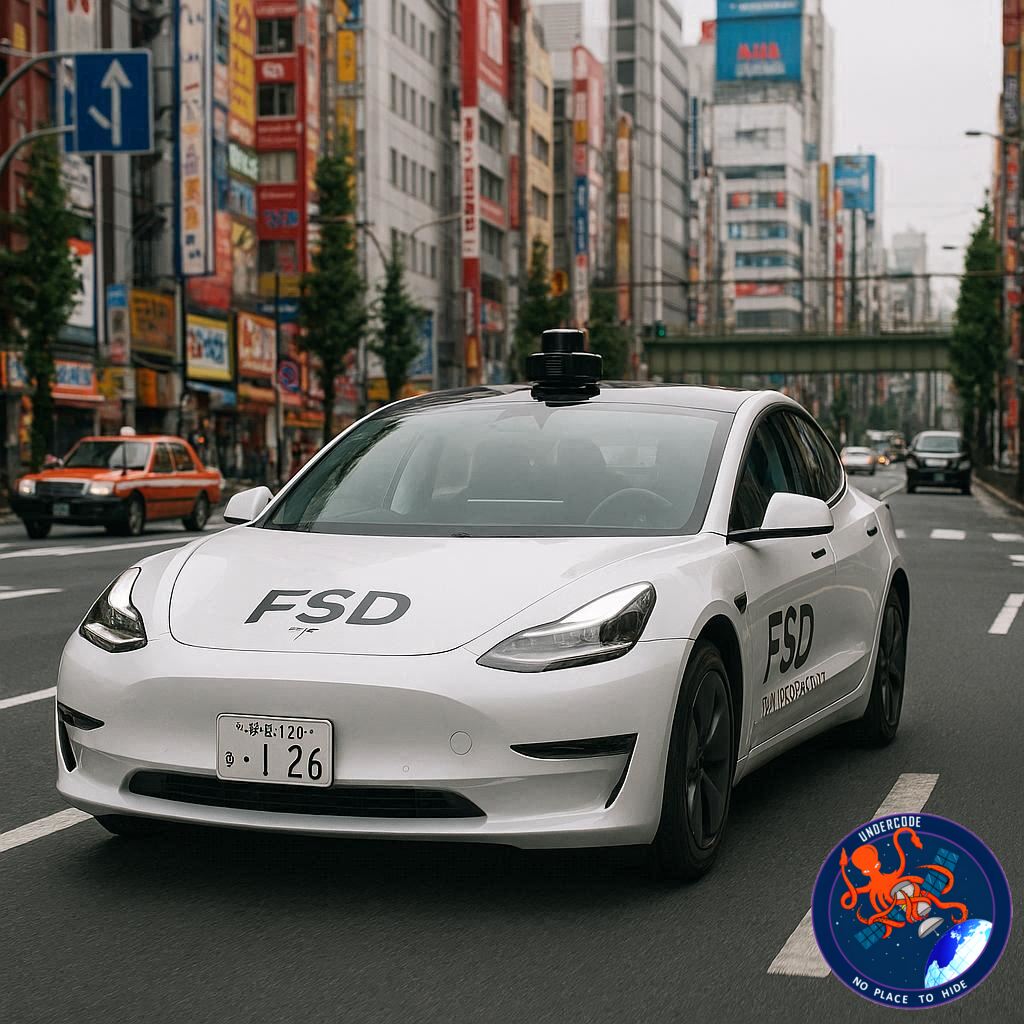
Introduction: A High-Stakes Experiment on Tokyo Streets
Autonomous driving has long been framed as the inevitable future of mobility, but translating that vision into reality requires navigating not just technology, but culture, infrastructure, and regulation. Tesla’s push to bring its Full Self-Driving (FSD) system into Japan represents one of the most ambitious attempts to localize artificial intelligence for one of the world’s most complex urban driving environments. A recent test ride through Tokyo’s dense and unpredictable streets offers a rare glimpse into how far this technology has come, and how far it still has to go.
Summary: Tesla’s FSD Test Drive in Tokyo and Its Global Context
NIKKEI Mobility presents an expert-driven analysis of mobility trends across industries, and this report features insights from Kenichiro Maeda, a professional with experience at Tesla’s U.S. operations and Porsche’s Japanese division. His perspective bridges both Western and Japanese automotive ecosystems, making his observations particularly valuable in understanding Tesla’s ambitions in Japan.
Tesla is currently aiming to implement its advanced driver assistance system, Full Self-Driving (FSD), within the Japanese market. Unlike traditional driver assistance technologies, FSD relies heavily on artificial intelligence and neural networks trained on vast amounts of real-world driving data. The company has already deployed and tested this system extensively in the United States, where road structures and driving behavior differ significantly from Japan.
During a recent visit to Tokyo’s Shinjuku district, Maeda had the opportunity to ride along in a Tesla vehicle equipped with FSD under testing conditions. The environment was far from controlled. Shinjuku is one of the busiest and most complex urban areas in the world, filled with narrow streets, unpredictable pedestrian movement, cyclists, taxis, delivery vehicles, and frequent signal changes. This made it an ideal testing ground for evaluating how Tesla’s AI performs outside the relatively structured American road systems.
The test revealed both promising advancements and critical challenges. Tesla’s FSD system demonstrated strong capabilities in recognizing lane markings, responding to traffic signals, and adapting to basic urban driving scenarios. However, Tokyo’s unique road conditions exposed limitations. The system occasionally struggled with ambiguous lane divisions, tight turns, and the nuanced behavior of local drivers who often rely on implicit communication rather than strict rule-following.
Compared to its performance in the United States, FSD in Japan appears to require additional refinement. American roads are generally wider and more standardized, while Japanese roads can be irregular, with less consistent signage and more complex intersections. This difference places a heavier burden on AI interpretation rather than rule-based navigation.
Another key issue lies in regulatory and cultural adaptation. Japan has stricter safety expectations and a cautious approach toward autonomous driving technologies. Even if Tesla’s system becomes technically capable, gaining approval and public trust will be equally critical. The test drive highlights how localization is not merely a technical challenge, but a systemic one involving legal frameworks, infrastructure compatibility, and societal acceptance.
Tesla’s approach, which relies primarily on vision-based AI rather than lidar or high-definition mapping, contrasts with many Japanese and European automakers. This philosophy allows for faster scalability but also introduces higher risk in complex environments. The Tokyo test serves as a real-world stress test for this strategy.
Ultimately, the trial underscores Tesla’s determination to expand FSD globally while revealing the depth of adaptation required for success in Japan. The company is not just exporting technology; it is attempting to retrain its AI to understand an entirely different driving culture.
What Undercode Say: Deep Analysis of Tesla’s Strategy and the Reality of AI Localization
Tesla’s attempt to deploy FSD in Japan is not just a technological milestone, it is a strategic gamble that exposes the limits of AI generalization. While Tesla has built its reputation on the idea that neural networks can learn universal driving behavior, Tokyo proves that driving is not universal. It is deeply cultural, situational, and sometimes irrational.
One of the most overlooked aspects of autonomous driving is the concept of “implicit negotiation.” In Japan, drivers often communicate through subtle cues, eye contact, hesitation, and timing rather than explicit signals. AI systems trained primarily on American datasets may fail to interpret these micro-interactions correctly. This is where Tesla’s vision-only approach faces its toughest challenge. Without lidar or detailed mapping, the system must infer intent purely from visual data, which becomes exponentially harder in dense urban chaos.
Tesla’s advantage lies in scale. Its data collection pipeline is unmatched, allowing continuous improvement through real-world feedback. However, scale alone does not guarantee precision in edge cases, and Japan is essentially a collection of edge cases. Narrow alleyways, mixed-use roads, and unconventional intersections create scenarios that rarely appear in U.S. datasets. This forces Tesla to either significantly retrain its models or accept performance gaps.
Another critical factor is regulatory friction. Japan’s government is known for its cautious approach to safety technologies. Unlike the U.S., where beta testing can occur on public roads with relatively fewer restrictions, Japan demands a higher threshold of reliability before approval. This slows down deployment but also ensures that only highly refined systems reach consumers. Tesla’s aggressive rollout strategy may need to be recalibrated for this environment.
From a competitive standpoint, Tesla is entering a market where domestic automakers have taken a different path. Companies in Japan have focused on incremental automation, emphasizing reliability and safety over rapid innovation. This creates a philosophical clash. Tesla’s “move fast and iterate” mindset may struggle against Japan’s “perfect before release” culture.
There is also a psychological barrier. Japanese consumers tend to value predictability and trust, especially in transportation. Any high-profile failure could significantly damage public perception, not just for Tesla but for autonomous driving as a whole. This raises the stakes of every test and every deployment decision.
Despite these challenges, Tesla’s presence in Japan could act as a catalyst for the entire industry. By pushing the boundaries of what AI can handle, it forces competitors and regulators to evolve. Even if Tesla does not achieve immediate success, its efforts will likely accelerate the development of more robust autonomous systems tailored to complex environments.
The Tokyo test is less about proving that FSD works and more about revealing what “working” actually means. It is no longer enough for a system to handle highways or simple city grids. True autonomy must adapt to the unpredictable, the unstructured, and the culturally specific. Tesla’s journey in Japan is a reminder that the final frontier of AI is not just intelligence, but understanding.
🔍 Fact Checker Results
✅ Tesla is actively developing and testing Full Self-Driving technology in multiple global markets.
✅ Japan presents unique driving challenges due to dense urban layouts and cultural driving behaviors.
❌ Fully autonomous driving is not yet legally approved for unrestricted public use in Japan.
📊 Prediction
🚗 Tesla will continue limited testing in Japan while refining AI models specifically for local conditions.
📉 Initial adoption may be slow due to regulatory caution and public trust barriers.
📈 Long-term success could position Japan as a benchmark for global autonomous driving complexity.
▶️ Related Video (80% Match):
🕵️📝✔️Let’s dive deep and fact‑check.
References:
Reported By: xtechnikkeicom_48a70b09c35212368f3f6dfd
Extra Source Hub (Possible Sources for article):
https://stackoverflow.com
Wikipedia
OpenAi & Undercode AI
Image Source:
Unsplash
Undercode AI DI v2
Bing
🔐JOIN OUR CYBER WORLD [ CVE News • HackMonitor • UndercodeNews ]
📢 Follow UndercodeNews & Stay Tuned:
𝕏 formerly Twitter 🐦 | @ Threads | 🔗 Linkedin | 🦋BlueSky | 🐘Mastodon


