
Listen to this Post
Introduction: A Turning Point for Tesla’s Future Vision
Tesla is entering a phase that Elon Musk and his team describe as a “golden era,” but this time it is not just marketing language or futuristic hype. It represents a coordinated push across autonomous transportation, robotics, AI chips, and even lifestyle ecosystems. The company is no longer positioning itself purely as a car manufacturer. Instead, it is evolving into a platform for autonomy, artificial intelligence, and large-scale robotic systems. Recent updates surrounding the Cybercab rollout, Robotaxi expansion, Optimus humanoid robot patents, AI5 chip development, and Tesla’s lifestyle projects such as the Tesla Diner collectively signal a deeper transformation. The core idea is simple but disruptive: ownership, labor, and mobility may all be redefined by autonomous systems working continuously in the background of daily life.
the Original (Tesla’s Expanding Autonomous Ecosystem)
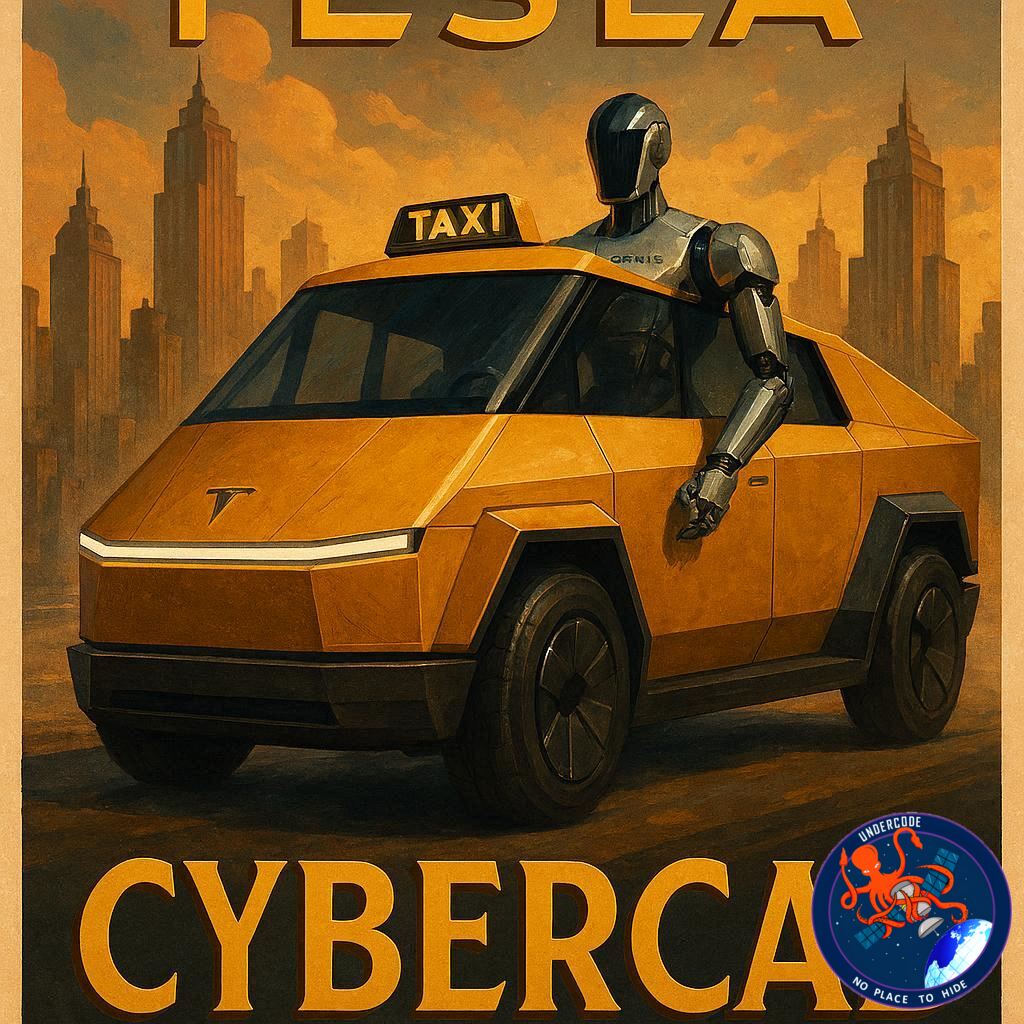
Tesla has released a teaser video showing a Cybercab parked outside a home, suggesting a future where autonomous vehicles arrive at users’ doors without human drivers. The video is part of Tesla’s broader messaging around its Robotaxi ecosystem and the shift toward fully driverless transportation.
The company has already begun rolling out its Robotaxi service in several US cities, with vehicles operating without human supervision in select areas. The Cybercab itself is a purpose-built autonomous vehicle, designed without a steering wheel, pedals, or side mirrors. It is engineered specifically for unsupervised AI driving rather than human control.
Production of the Cybercab began at Giga Texas, with the first unit rolling off the line in February 2026. Tesla is aiming for rapid scaling, with a manufacturing target that resembles consumer electronics production rather than traditional automotive assembly. Elon Musk has described the goal as producing a vehicle every ten seconds at full capacity.
Drone footage from Giga Texas has shown dozens of Cybercabs in production zones, reinforcing Tesla’s push toward volume manufacturing. The company also plans to price the vehicle under $30,000, making it relatively accessible compared to traditional autonomous mobility systems.
A key feature of Tesla’s strategy is integration with the Robotaxi network. Owners will be able to add their Cybercabs to the autonomous fleet when not in personal use, generating income and offsetting ownership costs. This creates a hybrid model where vehicles function both as personal transport and income-generating assets.
Tesla has also outlined an aggressive expansion plan for its Robotaxi service, targeting multiple US cities including Dallas, Houston, Phoenix, Miami, Orlando, Tampa, and Las Vegas. The system is already active in Austin without safety drivers, and testing is expanding across several states including California, Texas, New York, Illinois, and Massachusetts.
Alongside autonomy developments, Tesla is advancing its Optimus humanoid robot program. New patents reveal a tendon-driven hand and arm system designed to replicate human dexterity. The design shifts heavy actuators to the forearm and uses cable-driven mechanisms to achieve smoother, more precise motion.
The Optimus hand includes multiple degrees of freedom per finger, complex wrist routing systems, and tendon-based movement inspired by human anatomy. These innovations aim to solve one of robotics’ hardest engineering challenges: replicating the complexity of the human hand while maintaining durability and manufacturability.
Supporting patents also describe improved joint assemblies and structural designs that reduce friction and improve motion stability. Tesla executives have previously emphasized that the hand represents the most difficult component of the Optimus project, accounting for a significant portion of its engineering complexity.
Elon Musk has described the development of robotic hands as harder than many of Tesla’s previous engineering challenges, including vehicles and rockets. However, recent updates suggest that Tesla believes it has made major breakthroughs in both dexterity and production readiness.
The Optimus v3 hand is positioned as a production-ready system designed for scalability rather than just prototype demonstration. Its architecture reflects Tesla’s broader goal of combining robotics with mass manufacturing principles.
In parallel, Tesla has finalized its AI5 chip design, which has reached the tape-out stage. However, Musk clarified that AI5 will not be used to improve driving safety for Full Self-Driving, since AI4 hardware is already considered sufficient for that purpose.
Instead, AI5 will be dedicated to robotics and large-scale AI compute systems, including Optimus and training clusters. This marks a strategic shift in Tesla’s hardware roadmap, focusing less on vehicle upgrades and more on AI infrastructure.
Musk also emphasized that Tesla’s existing AI4 system already delivers performance that exceeds human-level driving safety in controlled metrics. However, full unsupervised autonomy still depends on regulatory approval rather than hardware capability alone.
Finally, Tesla is expanding its lifestyle ecosystem with plans for additional Tesla Diner locations. These venues combine Supercharger stations with retro-style dining experiences, blending transportation infrastructure with entertainment and community spaces.
The Los Angeles diner has already demonstrated strong engagement, and Tesla is now considering expansion into Silicon Valley, particularly Palo Alto, to integrate with its engineering and innovation ecosystem.
What Undercode Say: Tesla’s Shift From Car Maker to Autonomy Infrastructure Giant
Tesla’s current trajectory is less about vehicles and more about infrastructure for autonomy. The Cybercab is not simply a car; it is a node in a distributed mobility network.
The idea of ownership is being redefined into participation in a shared autonomous fleet.
If successful, the economic model of transportation shifts from purchase and maintenance to revenue-sharing systems.
This mirrors trends seen in cloud computing, where hardware becomes secondary to platform access.
The Robotaxi system essentially turns Tesla into a mobility-as-a-service provider.
This is structurally closer to Uber’s ambition but without human drivers at all.
The key difference is vertical integration: Tesla controls hardware, software, and network.
The Cybercab design eliminates human interface components entirely.
This is significant because it signals full confidence in autonomy maturity.
Removing steering wheels and pedals is not incremental innovation, it is final-state design commitment.
However, such a design also creates regulatory dependency risks.
No fallback mechanism means regulatory approval must fully align with technical readiness.
The production strategy is equally disruptive.
Treating cars like electronics implies shorter cycles, higher automation, and tighter supply chain control.
If Tesla achieves a 10-second production cycle, automotive manufacturing enters a new paradigm.
This would reduce marginal cost and dramatically expand fleet scale.
Optimus introduces a parallel labor disruption vector.
A tendon-driven robotic hand is one of the most complex mechanical systems ever attempted at scale.
If Tesla solves this, it unlocks general-purpose robotics rather than task-specific machines.
That means robots capable of operating in unpredictable environments.
This is critical for logistics, manufacturing, and eventually household applications.
Relocating actuators to the forearm is an engineering decision that mimics biological efficiency.
It reduces inertia in the hand and improves precision.
It also simplifies long-term maintenance and scaling.
These are clear signals that Tesla is designing for manufacturability, not just capability.
AI5’s positioning confirms a strategic bifurcation.
Vehicle autonomy is stable enough on AI4, according to Tesla’s internal metrics.
This frees next-gen silicon for robotics and training clusters.
That means Tesla is prioritizing general intelligence systems over incremental driving improvements.
The Robotaxi expansion strategy suggests aggressive geographic scaling.
But real-world autonomy deployment is still constrained by regulation and edge-case safety validation.
Even if the system is technically capable, legal frameworks may slow adoption.
Tesla Diner expansion may seem unrelated, but it strengthens ecosystem lock-in.
It connects charging infrastructure, brand experience, and consumer engagement.
This creates a lifestyle layer on top of mobility and robotics.
Overall, Tesla is building a multi-layered system: mobility, robotics, AI compute, and consumer experience.
The convergence of these systems is what defines the “golden era” narrative.
But execution risk remains extremely high given the complexity of autonomy at scale.
Still, if even part of this vision succeeds, it reshapes transportation and labor markets fundamentally.
Fact Checker Results
AI4 capability claims align with known Tesla hardware strategy but remain partially unverifiable at full scale ❌
Cybercab production and deployment timelines appear aggressive and depend on regulatory approval uncertainty ❌
Optimus tendon-driven design is consistent with robotics research principles but real-world performance is not yet independently validated ⚠️
Prediction
Tesla will likely accelerate Robotaxi expansion in limited US regions first, focusing on controlled regulatory environments.
Optimus will remain in early industrial deployment stages before reaching consumer-facing applications.
Cybercab adoption will grow gradually, but widespread replacement of personal car ownership will take significantly longer than projected timelines.
🕵️📝✔️Let’s dive deep and fact‑check.
References:
Reported By: www.teslarati.com
Extra Source Hub (Possible Sources for article):
https://www.digitaltrends.com
Wikipedia
OpenAi & Undercode AI
Image Source:
Unsplash
Undercode AI DI v2
Bing
🔐JOIN OUR CYBER WORLD [ CVE News • HackMonitor • UndercodeNews ]
📢 Follow UndercodeNews & Stay Tuned:
𝕏 formerly Twitter 🐦 | @ Threads | 🔗 Linkedin | 🦋BlueSky | 🐘Mastodon


