
Listen to this Post
🎯 Introduction
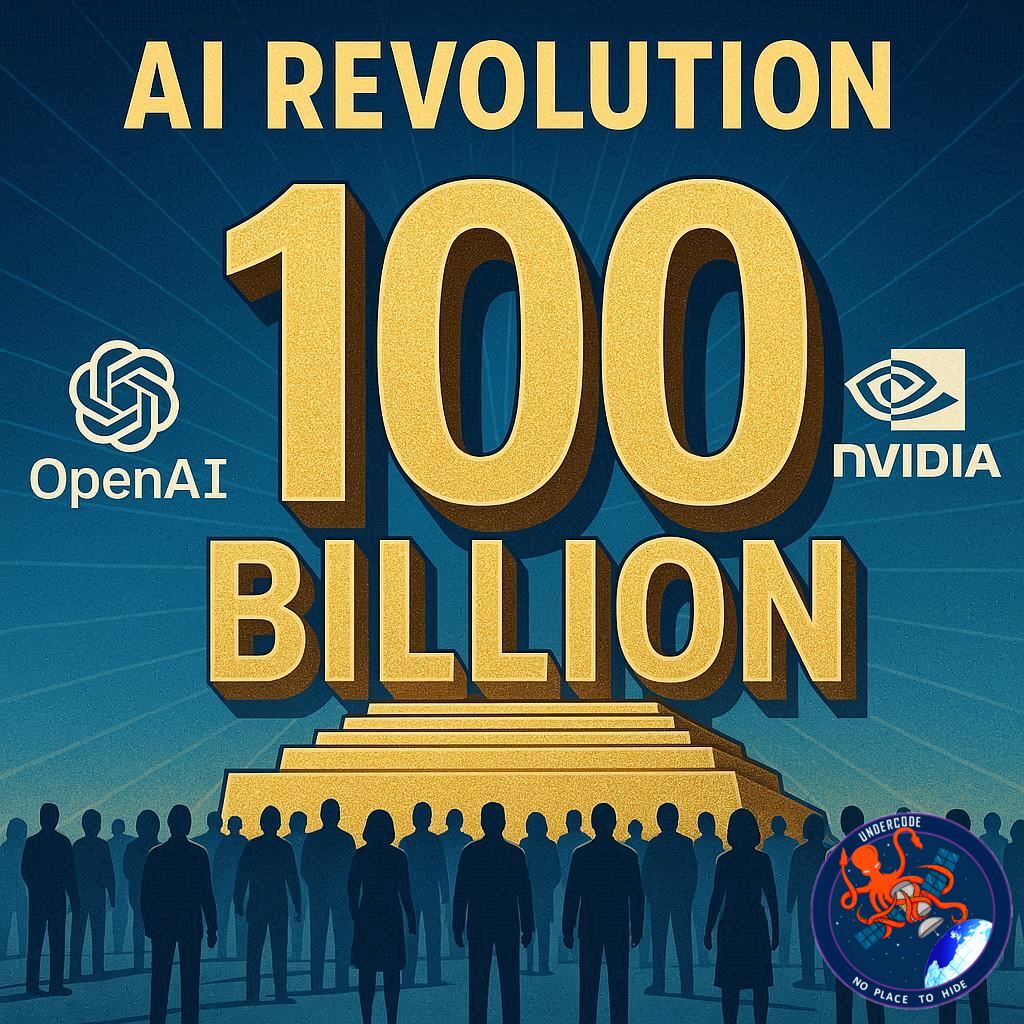
In an era where artificial intelligence is reshaping industries, creativity, and even governance, two of the world’s most influential tech forces—OpenAI and NVIDIA—have joined hands to redefine the future of computational power. Their newly announced multi-gigawatt AI infrastructure partnership isn’t just another corporate alliance; it’s a colossal leap toward the next generation of artificial intelligence. With NVIDIA committing up to $100 billion and OpenAI scaling to millions of GPUs, this collaboration stands as the largest AI infrastructure project in history. But beyond the staggering numbers lies a story about ambition, necessity, and the dawn of a world where AI becomes as pervasive as electricity once did.
Building the Largest AI Infrastructure in Human History
OpenAI and NVIDIA have officially confirmed a partnership that will scale OpenAI’s computing capabilities through multi-gigawatt data centers powered by millions of NVIDIA GPUs. The initiative aims to build the most powerful AI infrastructure ever created, capable of training and deploying the next generation of models that can think, reason, and act autonomously.
During an interview with CNBC’s Jon Fortt, Jensen Huang, CEO of NVIDIA, described the collaboration as “the biggest AI infrastructure project in history.” He emphasized that this isn’t merely about faster chips or bigger servers—it’s about enabling AI to transition from experimental labs into real-world deployment at planetary scale.
The partnership includes OpenAI deploying at least 10 gigawatts of NVIDIA systems built on the NVIDIA Vera Rubin platform, a next-generation architecture designed for efficiency and scale. In return, NVIDIA will progressively invest up to $100 billion in OpenAI as each gigawatt of capacity goes live.
Sam Altman, CEO of OpenAI, called NVIDIA the “only partner capable of scaling at this magnitude and speed.” Together, they intend to create massive AI factories capable of handling unprecedented levels of model training and inference—essentially fueling the evolution of frontier AI.
Powering the Future: Why AI Needs a Million-GPU Backbone
OpenAI’s trajectory has been nothing short of explosive. Since the 2022 launch of ChatGPT—then the fastest-growing application in history—the company now serves over 700 million weekly users and has expanded capabilities into multimodal reasoning, agentic AI, and long-context comprehension.
This massive growth has created an equally massive demand for compute power. To sustain future AI breakthroughs, OpenAI’s infrastructure must support not only the training of new models but also the inference—the real-time reasoning and interaction—of billions of users simultaneously.
Altman explained that the cost per unit of intelligence continues to drop as models become more efficient, but the frontier of maximum intelligence keeps rising. “That enables more and more use,” he said, “and a lot of it.”
Without enough compute, society would face painful tradeoffs: choosing between training AI for cancer research or providing free global education. “No one wants to make that choice,” Altman said. The only solution? More capacity—massive, scalable, distributed capacity—to meet humanity’s growing AI appetite.
The first gigawatt of systems will come online in late 2026, generating the first tokens of what might be the most advanced AI models ever built.
From a Single Server to a Global AI Supergrid
This partnership isn’t sudden. It traces back to 2016 when Jensen Huang personally hand-delivered OpenAI’s first NVIDIA DGX system. That humble server has now evolved into a plan for billion-fold computational growth.
Greg Brockman, OpenAI’s president, remarked that this infrastructure will unlock new frontiers: “We’re able to create new breakthroughs, new models… to empower every individual and business because we’ll be able to reach the next level of scale.”
Huang added a visionary note, predicting that this is “just the beginning.” In his words: “We’re literally going to connect intelligence to every application, to every use case, to every device—and we’re just at the start. This is the first 10 gigawatts, I assure you of that.”
The partnership signals not only a new era of AI hardware but also a global shift in how intelligence itself is produced and distributed.
🧩 What Undercode Say:
This collaboration is more than a business deal—it’s a strategic realignment of technological civilization. What’s unfolding here is a new kind of industrial revolution, one driven not by steam or electricity but by intelligence at scale.
From a technical standpoint, deploying 10 gigawatts of AI compute means OpenAI could train models of unimaginable complexity. Think of trillion-parameter architectures operating across multimodal domains: reasoning, language, vision, robotics, and even emotional modeling. The infrastructure becomes the nervous system of digital intelligence itself.
Economically, NVIDIA’s $100 billion pledge signals both confidence and control. The company isn’t just selling GPUs—it’s embedding itself as the core nervous tissue of the global AI economy. For OpenAI, the deal secures a stable compute backbone and ensures it can remain competitive in a landscape where Anthropic, Google DeepMind, and xAI are racing for frontier dominance.
There’s also a philosophical dimension. Altman’s comment about not wanting to choose between curing cancer and providing education exposes a deeper truth: AI’s progress is now limited not by algorithms, but by power and infrastructure. This partnership dissolves that bottleneck.
In essence, this deal plants the foundation for what could become the world’s first planetary AI grid—a globally distributed, continuously learning system that feeds on computation and data to evolve itself. By 2030, if projections hold, we may see AI systems that can reason across real-world data in real time, making decisions at speeds no human institution could match.
Yet, there are risks. Centralization of compute power in the hands of a few giants raises questions of governance, access, and equity. Will smaller labs ever compete? Will AI knowledge become monopolized by those who control the power grids of intelligence?
The scale is breathtaking, the ambition unstoppable—but the moral and regulatory framework must keep pace. Otherwise, this infrastructure might not just power intelligence; it might define who gets to use it.
🔍 Fact Checker Results
✅ OpenAI confirmed a 10-gigawatt infrastructure plan with NVIDIA.
✅ Jensen Huang and Sam Altman publicly discussed the deal on CNBC.
✅ NVIDIA pledged up to $100 billion in progressive investment as capacity scales.
📊 Prediction
By 2027, OpenAI’s next-gen models will likely surpass GPT-5 by several magnitudes in reasoning and adaptability. 🤖
NVIDIA will solidify its role as the “Intel of the AI Age”, controlling both hardware and ecosystem dominance. 💹
If unchecked, the compute divide could create a global power gap between nations that control AI infrastructure and those that merely consume it. 🌍
🕵️📝✔️Let’s dive deep and fact‑check.
References:
Reported By: blogs.nvidia.com
Extra Source Hub (Possible Sources for article):
https://www.quora.com
Wikipedia
OpenAi & Undercode AI
Image Source:
Unsplash
Undercode AI DI v2
Bing
🔐JOIN OUR CYBER WORLD [ CVE News • HackMonitor • UndercodeNews ]
📢 Follow UndercodeNews & Stay Tuned:
𝕏 formerly Twitter 🐦 | @ Threads | 🔗 Linkedin | 🦋BlueSky | 🐘Mastodon


