
Listen to this Post
Introduction: The Story Companies Can’t Quite Tell
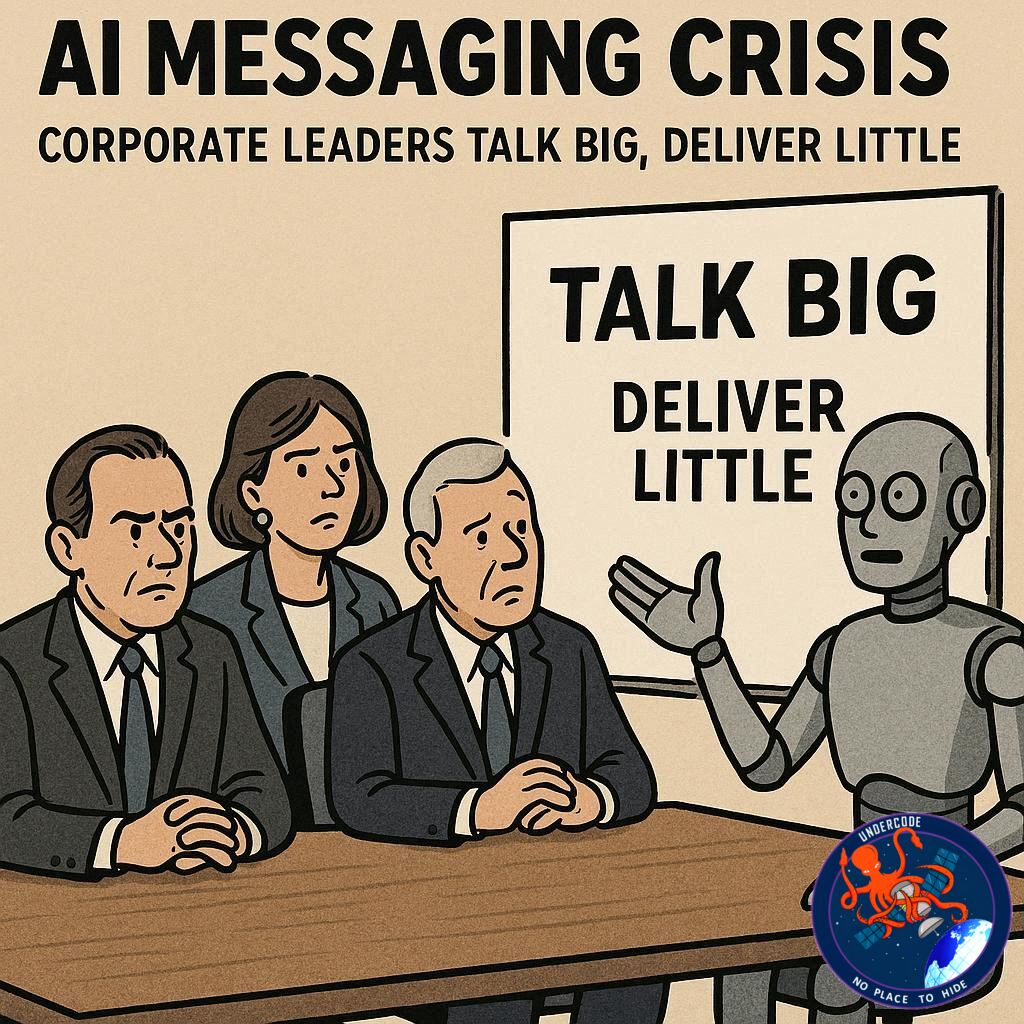
Artificial intelligence is no longer a futuristic promise—it is a boardroom priority, a budget line item, and a central pillar of corporate strategy. Yet despite billions poured into generative AI tools, most companies are failing to translate ambition into results. The problem is not a lack of technology, nor even a lack of intent. It is a failure of communication, trust, and internal alignment. As skepticism grows among employees, customers, and regulators, business leaders are discovering that selling the AI vision is just as hard as building it. And without a credible story, implementation collapses before it ever delivers value.
Summary of the Original Leadership Optimism Meets Workforce Reality
The article highlights a widening gap between executive enthusiasm for AI and the lived experience of employees. CEOs consistently promote AI as a productivity multiplier, yet adoption across organizations remains slow and fragmented. A striking MIT study shows that 95% of businesses investing in AI report zero return on investment, despite large-scale deployments of generative tools.
Communication Failures Inside Organizations
A core reason for this failure lies in how AI is communicated internally. Employees often lack clear guidance, training, and access to tools, leading to confusion and hesitation. Research from AI consultancy Section reveals that most workers still do not receive adequate enablement to use AI effectively, limiting any measurable efficiency gains.
Productivity Gains That Don’t Fully Stick
While some surveys paint a more optimistic picture, the reality remains mixed. A Workday study found that most AI users save between one and seven hours per week. However, more than a third of those gains are erased by the need to fix or redo AI-generated outputs, raising questions about quality, reliability, and real-world usefulness.
Job Loss Anxiety Fuels Resistance
AI adoption is further complicated by fears of job displacement. In the U.S. alone, over 55,000 layoffs were attributed to AI in a single year, according to Challenger, Gray & Christmas. High-profile companies such as Amazon, HP, UPS, and Workday have cited AI as a factor in workforce reductions, reinforcing employee anxiety across industries.
Investor Messaging vs. Employee Reality
Executives are increasingly framing AI in bold terms when speaking to investors. Mentions of “agentic AI,” “digital labor,” and “AI workforce” surged by more than 4,000% between late 2023 and late 2025. Earnings calls are now saturated with AI language, even as internal adoption struggles to gain traction.
Trust as the Missing Ingredient
This disconnect is taking a psychological toll. Studies show that 68% of individual contributors and nearly half of managers feel overwhelmed or anxious about AI. At industry gatherings, communication leaders increasingly link this anxiety to a lack of trust rather than a lack of technology. Employees are less concerned about algorithms and more concerned about how AI will redefine their roles and value.
Efforts to Close the Gap
Some organizations are responding by investing heavily in AI training and upskilling, dedicating entire learning budgets to workforce education. Others are creating AI operations roles to align technical capabilities with real business needs. Reputation research from Burson suggests these people-centered strategies outperform purely technical approaches by nearly 12%.
The Political Undercurrent
Beyond the workplace, AI skepticism is starting to surface as a political issue. Concerns about job losses, energy costs, and child safety are pushing voters—particularly conservative ones—to demand stronger AI regulation. As elections approach, leaders may find AI scrutiny extending far beyond corporate walls.
What Undercode Say: Why AI Fails as a Narrative Before It Fails as a Tool
The Illusion of Readiness
Most enterprises mistake access to AI tools for readiness. Deploying generative AI without redefining workflows is like installing new machinery without retraining operators. The result is predictable: confusion, inefficiency, and disappointment masked by optimistic dashboards.
Messaging Without Meaning
Executives often describe AI using abstract language—efficiency, empowerment, transformation—without grounding those terms in daily work. Employees do not resist AI because they dislike technology; they resist because they cannot see how it helps them succeed tomorrow morning.
Trust Is Operational, Not Emotional
Trust in AI is built through consistency, not reassurance. When investor decks promise cost-cutting while town halls promise empowerment, employees hear contradiction. This erodes credibility and turns AI into a symbol of hidden agendas rather than shared progress.
AI ROI Is a Human Equation
Return on investment in AI depends less on model accuracy and more on adoption depth. Tools unused or misused generate no value. Companies that ignore human factors—training, incentives, psychological safety—will continue to report zero ROI regardless of spending.
Middle Management as the Bottleneck
Managers sit at the intersection of strategy and execution, yet many lack clarity on how AI fits into team workflows. Without their buy-in, AI initiatives stall. Worse, managers often hesitate to document processes, fearing automation may expose redundancies.
Fear Outpaces Facts
Layoff headlines have done more to shape employee perception of AI than any internal memo. Even when AI is intended as an assistive tool, workers assume replacement. Until leaders directly address this fear with specificity, skepticism will dominate.
Skills Gaps Are Structural
AI literacy is uneven, creating silent hierarchies inside organizations. Early adopters surge ahead while others disengage. Without structured learning paths, AI becomes a source of inequality rather than empowerment.
Communication Teams as Change Agents
The article correctly reframes internal communications as modern change management. Messaging alone is insufficient; communication leaders must help design rollout strategies, feedback loops, and trust-building mechanisms tied to real outcomes.
People Strategy Beats Tech Strategy
The Burson study underscores a critical insight: companies that treat AI as a people strategy outperform those treating it as infrastructure. Culture, not code, determines whether AI becomes leverage or liability.
The Risk of Political Backlash
Ignoring public sentiment is dangerous. As AI becomes politicized, companies perceived as reckless or opaque may face regulatory and reputational consequences. Transparent workforce strategies are no longer optional—they are defensive measures.
Fact Checker Results
AI Implementation Failure Rates
The claim that 95% of businesses fail to achieve AI ROI aligns with multiple academic and consulting studies. ✅
Workforce Anxiety Statistics
Reported anxiety levels among employees and managers are consistent with recent surveys from AI consulting firms. ✅
AI-Driven Layoff Figures
Layoff numbers attributed to AI match publicly reported labor market analyses. ✅
Prediction
AI Narratives Will Shift from Hype to Accountability 🔮
Companies will be forced to explain not just what AI can do, but who benefits and how roles change.
Employee Trust Will Become a Measurable KPI 📊
Trust metrics will increasingly influence AI investment decisions and adoption strategies.
AI Skepticism Will Shape Regulation 🗳️
Public concern around jobs and safety will push governments toward stricter oversight, reshaping enterprise AI roadmaps.
🕵️📝✔️Let’s dive deep and fact‑check.
References:
Reported By: axioscom_1770315993
Extra Source Hub (Possible Sources for article):
https://www.pinterest.com
Wikipedia
OpenAi & Undercode AI
Image Source:
Unsplash
Undercode AI DI v2
Bing
🔐JOIN OUR CYBER WORLD [ CVE News • HackMonitor • UndercodeNews ]
📢 Follow UndercodeNews & Stay Tuned:
𝕏 formerly Twitter 🐦 | @ Threads | 🔗 Linkedin | 🦋BlueSky | 🐘Mastodon


