
Listen to this Post
Introduction
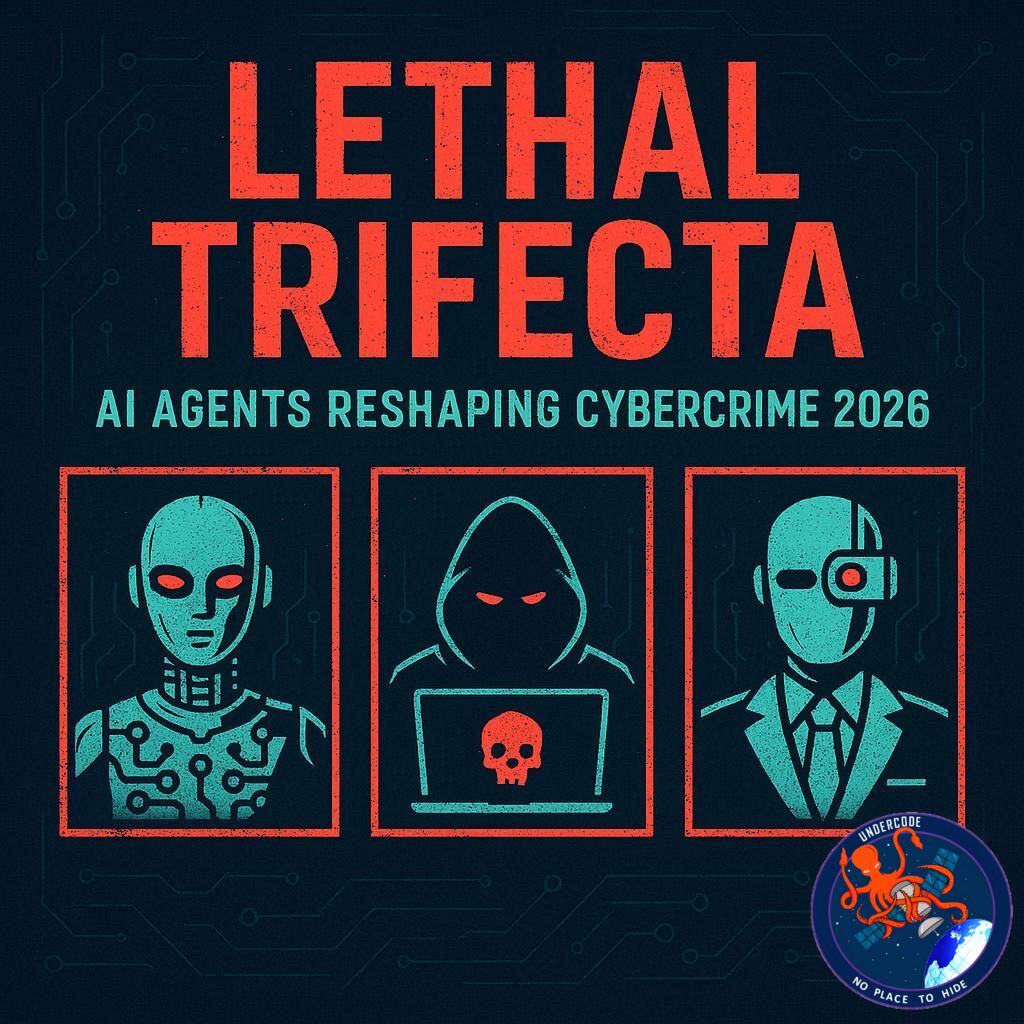
Cybercrime has entered a new phase where artificial intelligence is no longer just a supporting tool but the driving force behind fully autonomous attacks. A recent disclosure circulating in cybersecurity circles describes a so-called “Lethal Trifecta” of AI agents—OpenClaw, Moltbook, and Molt Road—working together to automate every stage of a modern cyberattack. From credential theft to lateral movement and ransomware deployment, this AI-powered ecosystem signals a turning point in how digital crime is executed, scaled, and monetized.
the Original Report
The original report highlights the emergence of three coordinated AI agents collectively referred to as a “Lethal Trifecta.” These agents—OpenClaw, Moltbook, and Molt Road—are designed to operate autonomously, reducing the need for continuous human oversight during cyberattacks. OpenClaw is described as the initial access specialist, focusing on harvesting credentials through automated reconnaissance, phishing optimization, and exploitation of exposed services. Moltbook handles post-compromise activity, enabling rapid lateral movement across infected networks by mapping internal systems, escalating privileges, and identifying high-value assets in real time. Molt Road acts as the final execution layer, responsible for deploying what is referred to as “Ransomware 5.0,” a new generation of ransomware optimized by AI decision-making rather than static scripts.
Together, these agents form a closed-loop attack chain that can adapt dynamically to defensive measures. If a security control blocks one technique, the AI agents reportedly switch tactics without waiting for operator input. The report also points to crypto-funded operations, allowing attackers to remain anonymous while efficiently laundering ransom payments. According to the claim, attacks linked to this AI-driven model have resulted in ransom demands totaling up to $22 million in the United States alone. The broader implication is that cybercrime is moving away from fragmented toolkits toward intelligent, self-optimizing systems capable of running large-scale campaigns with minimal human involvement.
What Undercode Say:
The idea of a “Lethal Trifecta” is less about three specific tools and more about a structural shift in cybercrime. What stands out is not the novelty of credential theft or ransomware—those are old problems—but the level of autonomy being described. When AI agents can independently scout, decide, and execute, the traditional timelines defenders rely on begin to collapse. Detection windows shrink, response teams lose precious minutes, and automated attacks start to resemble living organisms rather than static threats.
From an operational standpoint, AI-driven lateral movement is particularly dangerous. Human attackers make mistakes, get tired, or overlook systems. An AI agent does not. It can enumerate thousands of endpoints, analyze permissions, and select optimal attack paths faster than any human operator. This turns internal networks into high-speed battlegrounds where defense-in-depth strategies are tested to their limits.
The mention of “Ransomware 5.0” suggests a conceptual evolution rather than a specific version number. It implies ransomware that can negotiate, time its execution, and select victims based on predicted payout likelihood. AI can analyze company size, sector, insurance indicators, and even public financial data to decide how much to demand and when to strike. This transforms ransomware from blunt extortion into precision-targeted financial crime.
Another critical factor is the economic scaling of these attacks. Autonomous agents dramatically lower the cost of running campaigns. One operator could theoretically oversee dozens or hundreds of concurrent intrusions, each managed by AI. This scalability explains how ransom totals can reach tens of millions of dollars without a proportional increase in manpower.
For defenders, the psychological impact is just as significant as the technical one. Security teams are used to thinking in terms of threat actors, groups, or campaigns. AI agents blur those boundaries. An attack may not have a clear “signature” or consistent behavior because the system is designed to adapt. This undermines signature-based detection and forces a heavier reliance on behavioral analytics and zero-trust principles.
There is also a strategic implication for national cybersecurity. If such AI-driven toolchains become widely available on underground markets, the barrier to entry for sophisticated attacks drops sharply. Smaller criminal groups—or even non-technical actors with enough money—could deploy enterprise-grade cyberattacks with little understanding of how they work internally.
In this context, the “Lethal Trifecta” should be seen as a warning sign. Whether these exact tools exist in the form described matters less than the direction they represent. Cybercrime is aligning itself with the same automation and optimization trends seen in legitimate AI development, and the gap between attackers and defenders risks widening unless defensive AI adoption accelerates at the same pace.
Fact Checker Results
The existence of AI-assisted cybercrime tools is well documented, but specific names like OpenClaw, Moltbook, and Molt Road remain unverified in public technical disclosures. The $22 million ransom figure aligns with known ransomware impact ranges in the US. Claims of fully autonomous attack chains should be treated as plausible but not independently confirmed.
Prediction
AI-driven cybercrime will continue to evolve toward fully self-directing attack systems, forcing organizations to adopt AI-based defense as a baseline rather than an enhancement. In the near future, the defining cybersecurity battles will be fought between competing machine decision-makers, not human analysts alone.
🕵️📝✔️Let’s dive deep and fact‑check.
References:
Reported By: x.com
Extra Source Hub (Possible Sources for article):
https://www.facebook.com
Wikipedia
OpenAi & Undercode AI
Image Source:
Unsplash
Undercode AI DI v2
Bing
🔐JOIN OUR CYBER WORLD [ CVE News • HackMonitor • UndercodeNews ]
📢 Follow UndercodeNews & Stay Tuned:
𝕏 formerly Twitter 🐦 | @ Threads | 🔗 Linkedin | 🦋BlueSky | 🐘Mastodon


