
Listen to this Post
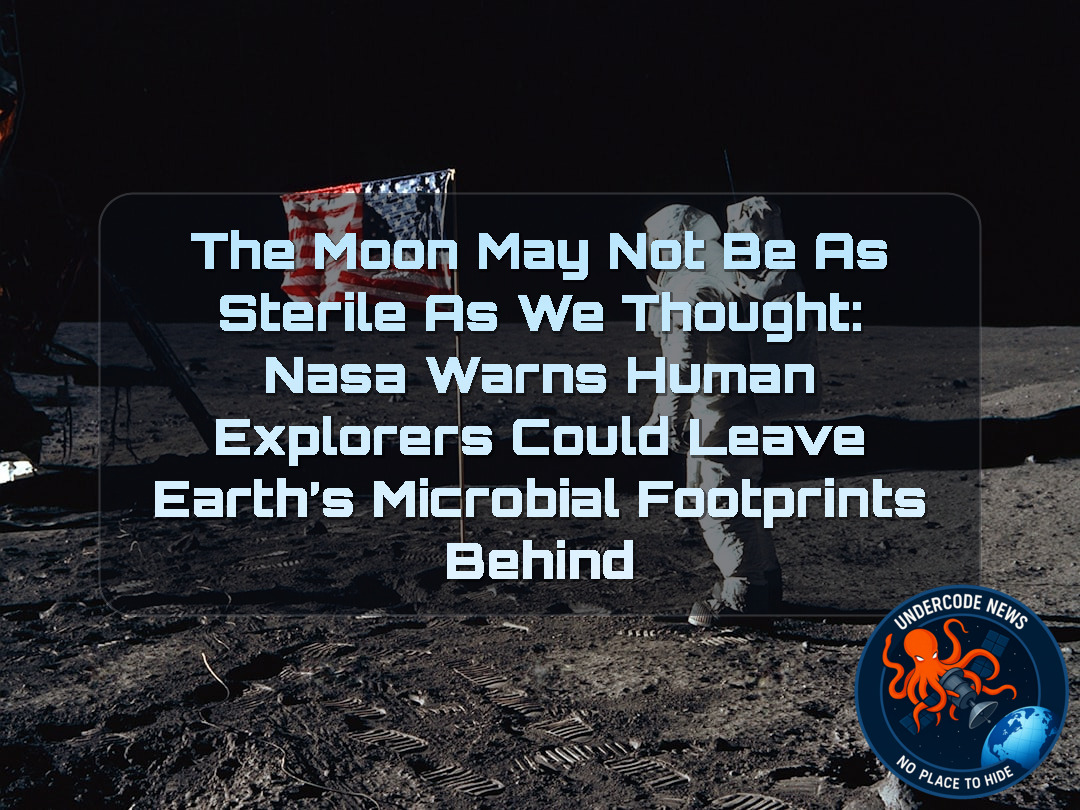 A New Lunar Contamination Problem Is Coming Into Focus
The Moon has long been treated as one of the cleanest natural laboratories available to science — a barren world with no atmosphere, no known indigenous biology, and geological records preserved for billions of years. But as humanity prepares to return in greater numbers, scientists are confronting an uncomfortable possibility: we may not arrive alone.
A new NASA-led study published August 19, 2026, in Science Advances suggests that some microorganisms carried unintentionally by astronauts could potentially remain alive for at least a day in protected environments around the Moon’s South Pole. The finding does not mean that microbes can establish thriving colonies on the Moon. Instead, it shows that certain Earth organisms may be tougher than previously assumed when sheltered from the most destructive lunar conditions.
That distinction matters enormously.
As Artemis-era exploration moves toward repeated lunar landings, surface operations, scientific stations, and eventually longer-term human activity, every astronaut, spacesuit, rover, habitat, and piece of equipment becomes a potential source of biological contamination. NASA scientists therefore face a paradox: the very humans who want to investigate pristine lunar environments could unintentionally change them before scientists have fully studied them.
The research was led by planetary scientist Prabal Saxena of NASA’s Goddard Space Flight Center, whose work includes identifying potentially survivable niches at the lunar poles. NASA’s research portfolio already recognizes the importance of understanding microbial survival beyond Earth, including investigations involving fungi such as Aspergillus niger.
Humans Are Biological Travelers
Astronauts do not simply carry tools, food, computers, and scientific instruments into space.
They carry ecosystems.
The human body is covered with microorganisms, many of which are harmless or beneficial. Skin, hair, respiratory systems, clothing, spacecraft interiors, and habitats all provide opportunities for microbes to travel alongside explorers.
Complete sterilization is also fundamentally different for a human mission than for an unmanned robotic spacecraft. NASA can subject robotic hardware to aggressive sterilization procedures, including high-temperature treatments designed to dramatically reduce biological contamination. A living astronaut obviously cannot be treated the same way.
That creates a difficult scientific problem.
Every future sample collected from the Moon could potentially contain traces of material brought from Earth. Some contamination may be obvious. Other contamination could be microscopic, dormant, chemically altered, or hidden inside tiny cracks and sheltered surface features.
And if scientists discover an unusual organic molecule decades from now, they will need to know whether it was genuinely lunar or whether humans accidentally delivered it.
The
The lunar South Pole is especially important because its geography creates extraordinary lighting and temperature conditions.
The
These shadows are normally viewed as hostile environments.
But from a microbial perspective, darkness can sometimes become protection.
Ultraviolet radiation is one of the most destructive hazards facing exposed microorganisms. Remove or reduce that radiation, and a microbe that would quickly die under direct sunlight might persist longer in a protected pocket.
That does not transform the Moon into a habitable world.
It simply means that the difference between instant destruction and temporary survival can be created by a few centimeters of terrain.
A Microbe Could Hide in a Space Smaller Than a Footprint
One of the most striking implications of the study is the scale of the potential survival zones.
The researchers modeled environmental conditions around several lunar South Pole regions, including Nobile Rim, Connecting Ridge, and De Gerlache Rim. Using elevation, temperature, and radiation information from NASA’s Lunar Reconnaissance Orbiter, they calculated where selected organisms might remain viable under different environmental conditions.
The resulting “survivable niches” ranged from large areas such as crater floors to incredibly small protected spaces.
In some circumstances, the relevant scale could be comparable to an astronaut’s boot print.
That creates a fascinating scientific irony.
A footprint normally represents nothing more than the physical presence of a human being on the Moon. But biologically, it could potentially become a tiny shelter containing Earth-derived material.
The important word is survival.
The study’s definition does not mean that an organism grows, reproduces, colonizes the Moon, or evolves into some lunar superorganism. It means that the microorganism could remain alive for at least the modeled survival period — approximately one Earth day under the study’s criteria.
Aspergillus niger Is One of the Main Characters
Among the organisms considered was Aspergillus niger, a common fungus known for its resilience.
It is not an exotic alien organism. It is found in ordinary environments on Earth and has also been studied in spaceflight research.
NASA has previously highlighted experiments investigating how A. niger and other fungi respond to the stresses of deep-space environments. Earlier research involving spaceflight and Mars-like conditions also found that A. niger spores could temporarily survive exposure to severe environmental stress.
That history makes the fungus particularly interesting.
The new modeling indicates that A. niger was especially resistant to ultraviolet radiation among the organisms considered, allowing it to potentially survive in some areas that receive limited sunlight.
This is not evidence that the fungus could grow across the Moon.
It is evidence that the lunar environment may contain small protective zones where an Earth microorganism can endure longer than a simplistic “vacuum equals instant death” model would suggest.
Spacecraft Sterilization Has Limits When Humans Are Involved
Robotic planetary protection has traditionally been easier to conceptualize.
Build the spacecraft.
Clean it.
Sterilize it.
Launch it.
The moment humans become the payload, the equation changes.
Astronauts continuously shed biological material. They breathe, perspire, shed skin cells, interact with equipment, and move through habitats. Spacesuits and life-support systems are engineered to keep humans alive, not to make them biologically invisible.
NASA’s broader biological research already demonstrates how seriously scientists take microbial behavior in spacecraft environments. Research involving Aspergillus niger, for example, examines fungal survival and adaptation under deep-space conditions.
The challenge therefore
That is effectively impossible.
The challenge is understanding which organisms are likely to survive, where they could survive, how long they could remain viable, and how scientists can distinguish them from genuinely extraterrestrial material.
The Real Threat Is Not a Lunar Microbial Invasion
The phrase “microbes surviving on the Moon” can easily create the wrong impression.
There is no evidence from this study that Earth microbes could establish a self-sustaining lunar ecosystem.
The Moon lacks the combination of stable liquid water, atmosphere, moderate temperatures, and accessible nutrients that terrestrial organisms generally require for active growth and reproduction.
A dormant organism surviving temporarily is therefore very different from a population multiplying.
The scientific concern is contamination, not a lunar biological takeover.
The Moon is effectively a geological archive. Its ancient surface preserves information about the history of the Earth-Moon system, the early Solar System, solar radiation, impacts, and volatile materials. Introducing terrestrial biological material complicates the interpretation of that archive. NASA researchers have emphasized that the Moon’s lack of atmosphere and plate tectonics makes it unusually valuable for preserving ancient records.
Why Mars Makes This Problem Even More Serious
The Moon may be the rehearsal.
Mars is the real planetary-protection nightmare.
If scientists eventually search Martian rocks, soil, ice, or subsurface environments for evidence of ancient or present-day life, contamination from Earth could become scientifically devastating.
Imagine discovering an organic signature inside a Martian sample.
Is it native to Mars?
Is it an ancient chemical residue?
Is it a biological molecule produced by an unknown Martian process?
Or did a terrestrial microorganism, transported millions of kilometers by human exploration, leave it behind?
Without a reliable contamination baseline, answering that question becomes much harder.
That is why
The Moon provides a relatively accessible opportunity to develop that knowledge before human exploration expands deeper into the Solar System.
The Moon Could Become an Unintentional Microbial Experiment
There is another way to interpret the study.
Instead of viewing contamination only as a problem, scientists could potentially use it as an experiment.
If researchers know precisely which microorganisms are carried by astronauts, they could monitor designated areas after human activity and measure how long different organisms remain viable.
Scientists could compare exposed surfaces with shadowed surfaces.
They could examine different temperatures.
They could track radiation exposure.
They could investigate how long spores remain dormant.
They could determine whether microscopic biological material becomes trapped in lunar regolith.
In other words, human contamination could become scientifically useful — provided it is carefully documented rather than ignored.
That is the opportunity highlighted by Saxena: an unavoidable consequence of human exploration could potentially be transformed into a controlled experiment.
What This Means for Artemis-Era Exploration
The findings arrive at an important moment.
NASA’s lunar science program increasingly focuses on the South Pole because of its scientific and resource value. Permanently shadowed regions are particularly important because they may contain ancient materials and water ice.
As robotic and crewed missions become more frequent, the number of opportunities for contamination will increase.
A single landing may have a limited impact.
Repeated landings create a much larger footprint.
Permanent habitats create an even larger one.
Mining, construction, rover traffic, waste systems, exhaust plumes, spacesuit operations, and human movement could collectively create a new layer of terrestrial influence on the lunar surface.
The scientific record of the Moon could therefore begin to contain two overlapping stories: the ancient history written before humanity arrived, and the modern biological and chemical signature humanity leaves behind.
Deep Analysis
Turning Lunar Maps Into Microbial Risk Maps
The
Scientists start with lunar topography, temperature estimates, illumination geometry, and radiation exposure. They then compare those environmental conditions with the known tolerance limits of selected microorganisms.
A simplified research workflow could look like this:
Create a clean research environment
python3 -m venv lunar_microbe_env
source lunar_microbe_env/bin/activate
Install common scientific-analysis packages
pip install numpy pandas scipy matplotlib rasterio
The basic conceptual model is straightforward:
survival = (
uv_exposure <= uv_tolerance
and temperature >= minimum_temperature
and temperature <= maximum_temperature
)
Real lunar modeling is substantially more complicated. Radiation varies with location and terrain geometry, temperatures change over time, and microorganisms respond differently depending on whether they are exposed individually, embedded in material, dormant, or protected by physical structures.
The important breakthrough is therefore not a single “microbe survives here” map.
It is the creation of a framework that connects lunar geography with biological vulnerability.
Terrain Becomes Part of Planetary Protection
Traditional maps tell astronauts where they can land.
Future planetary-protection maps may also tell them where they should avoid depositing biological material.
A ridge could block sunlight.
A crater could preserve a contaminant.
A shadow could extend microbial survival.
A small rock could become a protective shield.
That means lunar geography may eventually need to be interpreted through a biological lens.
The same terrain that protects ice from sunlight could protect microbial spores from ultraviolet radiation.
Contamination Could Become a Data-Integrity Problem
The most important issue may ultimately be scientific credibility.
Suppose researchers detect amino acids or other organic compounds near a future lunar base.
The discovery itself would not automatically reveal where the molecules came from.
Scientists would need a detailed contamination record covering spacecraft materials, astronaut microbiomes, life-support systems, landing sites, tools, spacesuits, and waste.
This is similar to maintaining a chain of custody in forensic science.
If scientists cannot reconstruct what humans brought to a site, they may struggle to determine what was already there.
The “Sterile Moon” Is Already a Changing Concept
It is tempting to imagine the Moon as perfectly untouched.
But spacecraft have already reached the lunar surface.
Hardware, exhaust products, mechanical disturbances, and human-made materials have been introduced during decades of exploration.
What changes with future human missions is the scale and biological complexity of that footprint.
A robot may introduce manufacturing residues.
A human mission introduces an entire living ecosystem.
That is a fundamentally different contamination challenge.
The South Pole Is Especially Sensitive
The lunar South Pole is scientifically valuable precisely because some of its environments have remained extraordinarily cold and dark for very long periods.
These regions may preserve volatile compounds and ancient information that would otherwise be destroyed or altered.
NASA’s lunar science work repeatedly emphasizes the importance of these cold, shadowed environments.
That makes them both scientifically precious and contamination-sensitive.
The closer exploration gets to these environments, the more important biological controls become.
Survival Does Not Equal Growth
This distinction deserves constant emphasis.
A dormant spore surviving for a day is not equivalent to microbial reproduction.
A viable cell is not automatically a colony.
A colony is not automatically an ecosystem.
And an ecosystem is certainly not evidence of indigenous lunar life.
The study is therefore not predicting “life on the Moon.”
It is warning that Earth life may be capable of persisting temporarily in places where we once assumed it would immediately perish.
Why UV Radiation Matters So Much
Ultraviolet radiation is an efficient biological destroyer.
DNA and other cellular components can suffer molecular damage when exposed to intense UV.
This is precisely why UV-based sterilization is used in some terrestrial applications.
The lunar surface receives no protective atmosphere comparable to Earth’s, so exposed microorganisms face an exceptionally harsh radiation environment.
But terrain changes everything.
A shadow can dramatically reduce direct UV exposure.
A crack can create shelter.
A thin layer of dust can alter exposure.
A rock can become a microscopic radiation shield.
The lunar surface is therefore not one environment.
It is millions of tiny environments.
The Boot-Print Problem
One of the most intriguing concepts is the possibility that a microbial survival niche could be extremely small.
Imagine an astronaut stepping onto the lunar surface.
The boot presses into the regolith.
The footprint creates a physical disturbance.
Biological material associated with the astronaut may be deposited nearby.
A tiny shadowed pocket could then provide slightly more favorable conditions than the surrounding terrain.
That does not make the footprint a habitat in the traditional sense.
But it demonstrates how planetary protection may have to operate at microscopic scales.
Microbes Could Become Tracers of Human Activity
There is also a scientific opportunity.
If researchers deliberately catalog the microorganisms associated with crewed missions, those organisms could eventually function as biological tracers.
A future scientist finding a particular terrestrial organism in a lunar sample could potentially identify it as evidence of human contamination.
That would be extraordinarily useful.
Instead of contamination being an invisible problem, it could become measurable evidence of where humans have interacted with the environment.
Better Baselines Are Essential
Before major human activity begins, scientists need reference measurements.
They need to know the chemical composition of untouched areas.
They need to understand naturally occurring organic compounds.
They need baseline measurements of volatile materials.
They need high-resolution geological maps.
They also need detailed biological contamination inventories.
The better the baseline, the easier it becomes to recognize change.
Planetary Protection Is Becoming More Than Sterilization
The old mental model was simple:
Keep spacecraft clean.
The future model must be broader:
Understand the environment, understand the contaminant, monitor the interaction, and preserve the scientific record.
That requires microbiology, geology, chemistry, engineering, robotics, environmental modeling, and mission operations to work together.
Human Exploration Changes the Rules
Robotic missions can be engineered around sterilization.
Human missions cannot.
That does not mean crewed exploration should be delayed indefinitely.
It means missions must be designed with biological reality in mind.
Airlocks, waste management, suit systems, habitat ventilation, landing zones, sampling procedures, and surface mobility can all influence contamination.
Every engineering decision potentially becomes a scientific decision.
The Moon Is the Training Ground for Mars
The greatest value of this research may ultimately be beyond the Moon.
Mars is farther away, harder to sample, and scientifically more complicated.
If humanity makes mistakes with contamination on the Moon, those mistakes can become lessons.
If we understand microbial persistence around the lunar South Pole, we can improve the protocols used for Mars.
If we fail to establish contamination baselines on the Moon, Mars missions may face even greater uncertainty.
Commands for Reproducible Research
For researchers working with publicly available lunar datasets, reproducibility should be part of the workflow.
A basic command-line structure might look like:
mkdir -p lunar_microbe_project/{data,models,results,logs}
Record the research environment
python3 --version
pip freeze > lunar_microbe_project/logs/environment.txt
Hash downloaded datasets for provenance
sha256sum lunar_microbe_project/data/ > lunar_microbe_project/logs/data_hashes.txt
The commands above do not perform planetary operations. They illustrate a reproducible scientific workflow for documenting datasets and computational environments.
The principle is important because future contamination research will depend heavily on comparing observations collected across different missions and years.
The Bigger Scientific Question
The most profound question raised by the research is not simply whether Earth microbes can survive on the Moon.
It is whether humanity can explore another world without unintentionally rewriting the evidence we went there to study.
That is a much larger challenge.
The Moon is not only a destination.
It is a historical archive.
And once humans establish a permanent presence, the archive will no longer be completely untouched.
What Undercode Say:
- The Moon Is Becoming a Scientific Crime Scene
The comparison may sound dramatic, but it captures the core issue.
Scientists are looking for evidence in an environment that has preserved ancient information for billions of years.
Human explorers could unintentionally leave fingerprints everywhere.
- Microbial Contamination Is More Subtle Than a Flag
A flag is easy to identify.
A microorganism is not.
A microscopic biological signature can become mixed with lunar dust, trapped inside equipment, or deposited in a shadowed region.
- The Most Dangerous Contaminant May Be the One Nobody Notices
A visible piece of equipment can be documented.
A dormant spore cannot be recognized with the naked eye.
That makes microbial contamination a fundamentally different problem.
- The South Pole Is Both Valuable and Vulnerable
Scientists want to explore the South Pole because of its ice and ancient materials.
Those same protected environments may also give terrestrial microbes a better chance of temporary survival.
5. Artemis Makes This More Urgent
As crewed lunar exploration becomes more ambitious, contamination will become increasingly difficult to avoid.
The solution is not to pretend humans can be sterile.
The solution is to measure what humans bring.
- Baseline Science Should Come Before Permanent Infrastructure
Before habitats and industrial activity expand, scientists should collect extensive environmental measurements.
Once a location becomes heavily used, recreating its original condition may be impossible.
- The Study Does Not Say the Moon Has Alien Life
This is perhaps the most important correction.
The research concerns the survival of Earth organisms.
It does not establish indigenous lunar biology.
8. Survival Is a Narrow Biological Definition
A microbe remaining viable for a limited period is not the same as reproducing.
The difference is enormous.
- Aspergillus niger Is a Warning From Earth
The fungus has repeatedly demonstrated an ability to tolerate unusually harsh conditions.
NASA has already studied its behavior in spaceflight and deep-space biological experiments.
- The Lunar Environment Is More Complex Than “Dead”
The Moon is biologically hostile, but hostility is not uniform.
Terrain creates gradients.
Shadows create protection.
Dust and rocks create microenvironments.
- A Crater Can Function Like a Natural Shield
The same geography that preserves water ice can reduce exposure to destructive sunlight.
That makes lunar topography a major part of contamination modeling.
- Human Exploration Will Create New Lunar Chemistry
Astronaut exhaust, materials, waste, and biological debris can alter the local environment.
The scientific question is how large that influence becomes.
13. Microbes Could Become Environmental Markers
If contamination is carefully characterized, terrestrial organisms could help scientists identify human influence.
That turns a problem into a potential measurement tool.
14. Planetary Protection Needs Better Data
Rules are only as good as the evidence behind them.
Knowing which organisms survive which conditions makes contamination-control policies more scientifically meaningful.
15. Robots and Humans Need Different Standards
A robotic spacecraft can tolerate aggressive sterilization.
An astronaut cannot.
Future planetary-protection systems must therefore be designed around human biology.
- The Moon Is the Best Place to Learn This Lesson
It is close enough to monitor and experiment with compared with Mars.
Mistakes made here can be corrected before humans travel farther.
17. Mars Raises the Stakes
If scientists eventually find potential biosignatures on Mars, contamination questions will be unavoidable.
Every lesson learned on the Moon could improve the credibility of Martian discoveries.
18. The Scientific Chain of Custody Matters
Researchers need to know what was present before humans arrived.
They also need to know exactly what humans introduced afterward.
- Future Lunar Missions May Need Biological Accounting
Mission planners could eventually maintain inventories of organisms associated with crews and equipment.
That information could become part of scientific sample documentation.
20. The Definition of Pristine Is Changing
The Moon has already experienced spacecraft visits.
But sustained human activity will introduce a much more complicated biological footprint.
- Contamination Could Become a Permanent Scientific Variable
Once a region is repeatedly visited, future experiments may have to account for human influence.
That is why early baseline measurements matter so much.
- The Tiny Scale Is the Most Fascinating Part
A survivable niche does not need to be a giant cave.
It could be a crack.
A depression.
A rock shadow.
A footprint.
- Lunar Biology May Be Mostly About Persistence
For now, the scientifically meaningful question is not “Can life thrive?”
It is “Can Earth life remain viable long enough to interfere with our measurements?”
24. Radiation Is the Great Filter
The lunar surface is constantly exposed to radiation that terrestrial organisms normally avoid.
Shelter therefore becomes disproportionately important.
25. Darkness Can Become Biological Protection
A place that looks completely hostile to humans may provide exactly the shielding a dormant microorganism needs.
That is an important conceptual shift.
- Human Exploration Is an Experiment Whether We Like It or Not
Every astronaut landing changes the environment.
The responsible approach is to measure those changes instead of pretending they do not exist.
- The Moon Could Teach Us How to Explore Responsibly
The next era of lunar exploration should not only ask how to land.
It should ask how to preserve what we find.
28. Science and Exploration Must Advance Together
Exploration without contamination control risks compromising science.
Contamination control without exploration limits discovery.
The answer lies between the two.
- The Best Planetary Protection Strategy Is Knowledge
We cannot eliminate every biological particle.
But we can identify, model, monitor, and document them.
- Lunar Exploration Is Entering a New Era
The first space age was about reaching another world.
The next one will be about learning how to live and work there without destroying its scientific value.
31. This Is Bigger Than NASA
International missions, commercial lunar landers, private spacecraft, and future lunar infrastructure will all contribute to the environment.
Planetary protection will therefore require broad cooperation.
32. Commercial Lunar Activity Will Add Complexity
More missions mean more hardware, more landing events, and more potential contamination pathways.
The scientific community should prepare for that reality now.
- A Future Lunar Laboratory Could Study Microbial Survival Directly
Instead of relying exclusively on simulations, scientists could eventually conduct carefully controlled experiments on the lunar surface.
Such experiments could reveal how predictions compare with reality.
34. The Moon May Become
Not because native life has been discovered there.
Because humans themselves are bringing biology to it.
35. Every Sample Will Need Context
A lunar sample is only as scientifically powerful as the information surrounding its collection.
Where was it taken?
When?
By whom?
With which equipment?
What contamination was possible?
- The Future of Lunar Science Will Be Multidisciplinary
Geologists, microbiologists, planetary-protection experts, engineers, chemists, and data scientists will increasingly have to work together.
The Moon is forcing traditionally separate disciplines into the same laboratory.
- The Most Important Discovery May Be a Better Question
Instead of asking whether microbes can survive the Moon, researchers should ask under what precise combinations of conditions survival becomes possible.
That produces better science.
38. Mars Will Demand Even Greater Precision
If humanity eventually searches Mars for life, contamination uncertainty could become one of the biggest obstacles to interpreting results.
The Moon gives us a chance to practice first.
39. Human Footprints Will Become Scientific Evidence
One day, scientists may study not only ancient lunar material but also the environmental signature left by humanity.
Our presence will become part of the
40. The Real Message Is About Responsibility
The Moon is not merely a place to plant flags or build bases.
It is a record of cosmic history.
If we are serious about understanding that history, we must learn how to explore without accidentally rewriting it.
✅ Fact: NASA Scientists Are Studying Potentially Survivable Microbial Niches at the Lunar Poles
NASA’s Prabal Saxena has documented research specifically focused on identifying potentially survivable niches for microbial life at the lunar poles. His NASA profile lists a 2026 NASA research award concerning survivable niches and biological-interest areas at the lunar poles.
The broader NASA science portfolio also explicitly discusses what types of microbes humans might bring to the Moon and why their survival matters.
✅ Fact: Aspergillus niger Has Demonstrated Strong Spaceflight Resilience
NASA has previously reported experiments in which Aspergillus niger spores survived Mars-like atmospheric and radiation conditions sufficiently to be recovered afterward.
NASA also continues to investigate the biology of A. niger in deep-space environments, including its response to radiation and other spaceflight stresses.
❌ Claim: The Study Proves Microbes Can Live and Reproduce on the Moon
This conclusion would go far beyond the evidence.
The
There is therefore no basis for describing the findings as evidence that Earth microbes can colonize the Moon.
❌ Claim: NASA Has Discovered Native Lunar Life
Nothing in the research establishes indigenous lunar biology.
The scientific concern is precisely the opposite: researchers want to distinguish Earth’s biological contamination from genuinely extraterrestrial evidence.
✅ Fact: Lunar South-Pole Shadows Can Preserve Extremely Cold Environments
NASA identifies permanently shadowed lunar polar regions as important targets for scientific investigation, including because they may preserve ancient materials and water ice.
Those environments are also relevant to microbial-survival modeling because terrain can reduce exposure to sunlight and radiation.
Prediction
(+1) Planetary Protection Will Become a Core Requirement of Human Lunar Infrastructure
As lunar missions become more frequent, contamination control is likely to move from a specialized planetary-protection concern into a standard part of mission design.
Future landing sites, habitats, rover routes, sample-collection zones, and scientific reserves could increasingly be planned around biological as well as geological considerations.
(+1) Lunar Missions Will Establish Detailed Microbial Baselines
Future crews will likely be accompanied by increasingly sophisticated biological inventories documenting which microorganisms are associated with astronauts, spacesuits, spacecraft interiors, and equipment.
Those records could eventually become as important to sample interpretation as geological coordinates and instrument calibration.
(+1) The Moon Will Become a Testbed for Human Planetary Biology
Rather than treating contamination exclusively as an unwanted consequence, researchers may deliberately study microbial persistence in carefully controlled lunar environments.
That could produce data impossible to obtain accurately on Earth.
(+1) Mars Missions Will Benefit From Lunar Lessons
The biggest long-term payoff may come when humans eventually travel to Mars.
Every contamination-control lesson learned near the lunar South Pole could help protect future Martian biosignature investigations.
(+1) Biological Mapping Could Become Part of Lunar Navigation
Today’s lunar maps emphasize terrain, illumination, temperature, slopes, and resources.
Tomorrow’s maps may also identify areas where terrestrial organisms are more likely to persist.
That would represent a major evolution in how humanity understands another world.
Final Perspective: We May Leave More Than Footprints
Humanity has dreamed of returning to the Moon for generations.
Now that the return is becoming a sustained scientific and technological project, the challenge is no longer simply getting there.
It is learning how to arrive responsibly.
The discovery that ordinary Earth microorganisms may survive temporarily inside protected lunar niches is not a horror story about an alien invasion. It is something more subtle — and scientifically more important.
The Moon may be hostile to life, but hostile does not always mean instantly sterile.
A crack in a rock, the shadow of a ridge, a pocket of regolith, or even the disturbed terrain beneath an astronaut’s boot could change the biological equation for a microscopic traveler from Earth.
That realization should not stop human exploration.
It should make exploration smarter.
The Moon is one of the oldest witnesses to the history of our Solar System. Its surface preserves clues that Earth has lost through erosion, weather, tectonic activity, oceans, and life itself.
As humans begin writing new chapters on that ancient surface, scientists face a responsibility that extends far beyond the next mission.
We must know what was there before us.
We must know what we bring with us.
And most importantly, we must make sure that when humanity finally finds something truly extraordinary on another world, we can prove that it did not come from home.
🕵️📝Let’s dive deep and fact‑check.
🎓 Live Courses & Certifications:
Join Undercode Academy for Verified Certifications
🚀 Request a Custom Project:
Secure, high-velocity infrastructure and disruptive technological engineering. Contact our engineering team for high-tier development and proprietary systems:
[email protected]
💎 Smart Architecture | 🛡️ Secure by Design | ⭐ Trusted by Thousands
References:
Reported By: science.nasa.gov
Extra Source Hub (Possible Sources for article):
https://www.github.com
Wikipedia
OpenAi & Undercode AI
Image Source:
Unsplash
Undercode AI DI v2
🔐JOIN OUR CYBER WORLD [ CVE News • HackMonitor • UndercodeNews ]
📢 Follow UndercodeNews & Stay Tuned:
𝕏 formerly Twitter 🐦 | @ Threads | 🔗 Linkedin | 🦋BlueSky | 🐘Mastodon | 📺Youtube


