
Listen to this Post
🎯 Introduction:
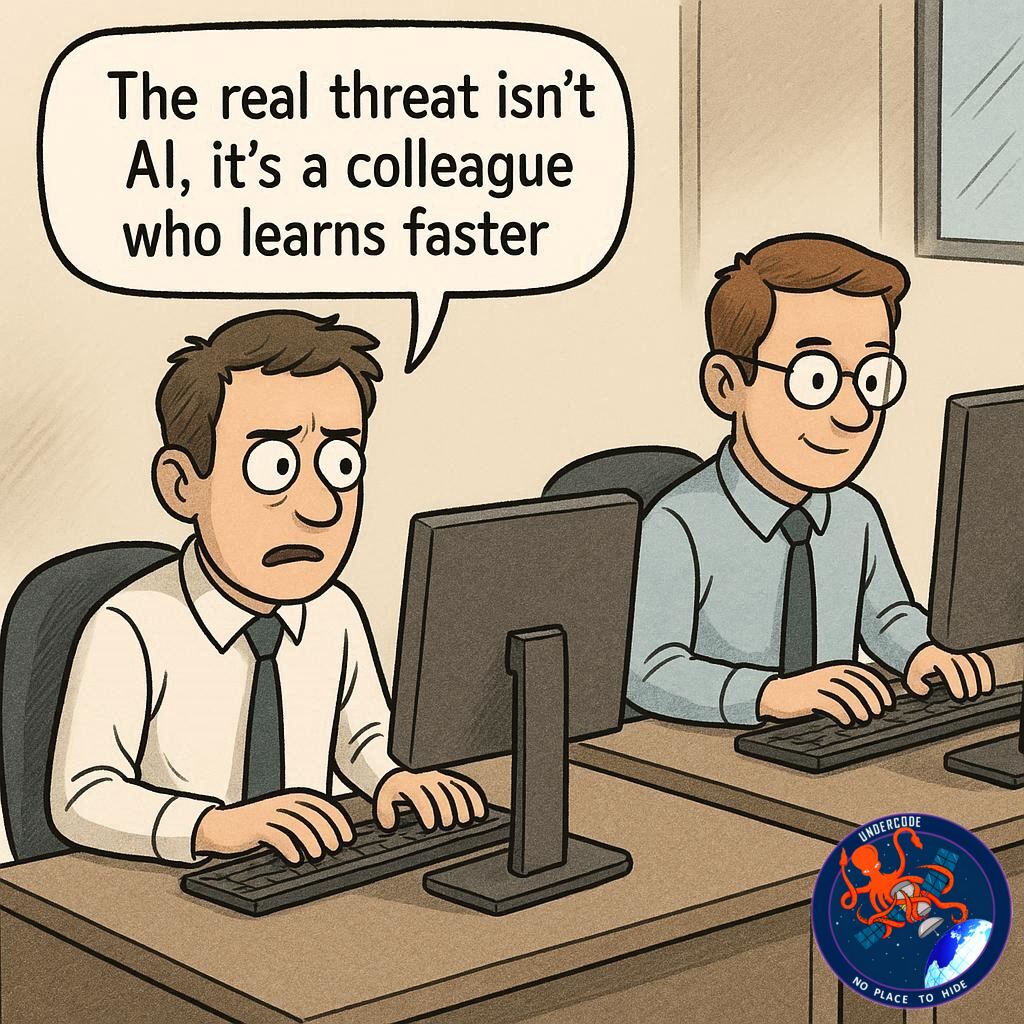
At the NDTV World Summit 2025, a single statement by Deloitte’s Global AI Leader, Nitin Mittal, sparked an electric conversation across industries: “Don’t fear AI, fear your colleague who learns to use it faster.” In one bold line, Mittal reframed the world’s biggest technological anxiety — that artificial intelligence is coming for our jobs. His point? AI itself isn’t the enemy. Complacency is. The future, he suggested, belongs not to those who resist automation, but to those who adapt and build alongside it.
The Race to Adapt in the AI Era
Nitin Mittal, co-author of the Wall Street Journal bestseller All-in on AI, offered a clear and urgent message: every worker, from software engineers to customer service agents, stands at a turning point. While AI may automate certain roles, he noted that no job has been directly taken by the machine alone. Instead, jobs are being reshaped — and sometimes replaced — by those who’ve mastered AI’s power faster than others.
He identified software engineering, coding, customer support, and call centers as the first sectors feeling the tremors of automation. Yet even in these spaces, Mittal emphasized a key nuance: AI doesn’t eliminate human roles, it redefines them. The true disruptor isn’t technology itself but the human who uses it better.
Curiosity Over Fear: The New Career Survival Code
Mittal warned that apathy is the greatest risk in the age of AI. Those who spend hours scrolling through fear-based headlines instead of upskilling will find themselves left behind. “Curiosity,” he stressed, “is the currency of survival.” Workers who learn, experiment, and engage with AI tools will thrive, while those who resist change will fade out of relevance.
He encouraged professionals to look beyond job losses and focus instead on the dawn of an AI-driven economy — one teeming with opportunities we’ve barely imagined. Just as the internet once gave birth to social media managers and app developers, AI will generate new classes of work: model trainers, AI ethicists, data infrastructure engineers, and creative strategists who know how to blend human emotion with machine precision.
Building the AI Economy: A New Industrial Revolution
Mittal painted an optimistic vision of what’s to come. The building of AI data centers, he explained, will spark growth in construction, manufacturing, and infrastructure development. Every server farm represents not only computing power but thousands of local jobs. “The AI economy,” he said, “isn’t just about algorithms. It’s about ecosystems.”
He also called for India to take a bold step toward sovereignty in AI innovation. Instead of importing foreign technology, Mittal urged India to design, build, and deploy its own models — ones that preserve the nation’s linguistic and cultural identity. “India must leverage its strengths,” he insisted, “the scale of its talent, entrepreneurship, and innovation.”
Local Innovation Over Imported Solutions
When asked about self-driving Waymo cabs and their feasibility on India’s unpredictable roads, Mittal smiled. Rather than asking whether Silicon Valley’s technology would work in India, he suggested a different question: why not build our own? His answer reflected a deeper message — that AI adoption shouldn’t mean dependency. It should mean empowerment.
“The conversation,” he said, “should be about what we can make, design, build, test, and deploy in India.” This spirit of local innovation, Mittal argued, will define the next generation of technological progress.
What Undercode Say:
Nitin Mittal’s insight slices through the surface-level panic that dominates discussions around artificial intelligence. His argument carries a profound truth: technology itself has never been the threat. It’s the human gap in adaptation that creates displacement. History echoes this pattern. When electricity replaced manual labor or when the internet transformed business, the ones who lost weren’t victims of machines — they were victims of stagnation.
In today’s AI revolution, speed of learning is the new currency. A coder who integrates ChatGPT into their workflow will outperform another who writes every line manually. A marketer who uses AI analytics will outpace one who still relies on spreadsheets. The hierarchy of value is shifting — not from human to machine, but from static human skills to adaptive intelligence.
Mittal’s comments also highlight a crucial socioeconomic layer. The new AI economy won’t just belong to software engineers; it will reach blue-collar sectors through AI data centers, robotics, and smart infrastructure. This mirrors the industrial revolutions of the past — where machines amplified productivity and created jobs that never existed before. The irony is that AI could become the greatest job creator of the century, but only for those willing to learn its language.
India’s opportunity lies in sovereignty. By developing indigenous AI systems, the country could prevent digital colonialism — where global tech giants dictate the flow of information, data, and profit. Sovereign AI would mean models trained in regional languages, embedded with cultural nuance, and aligned with local priorities. This could turn India into a global AI exporter rather than a consumer of prebuilt systems.
There’s also a psychological truth in Mittal’s words. Fear of AI often masks a deeper discomfort — fear of change itself. Yet, those who embrace learning are already turning that fear into fuel. Across industries, AI is evolving into a partner, not a predator. The challenge isn’t survival against machines but cooperation with them.
Ultimately, Mittal’s statement reframes the modern workplace as a competition of curiosity. The winners will be those who constantly evolve, who ask better questions, who experiment, and who never stop learning. The losers will not be replaced by AI, but by those who understand how to use it.
🔍 Fact Checker Results:
✅ Nitin Mittal is Deloitte’s Global AI Leader and co-author of All-in on AI.
✅ He made the remarks at the NDTV World Summit 2025.
✅ His statement about fearing “colleagues using AI faster” has been widely reported across credible news outlets.
📊 Prediction:
🚀 Within the next five years, AI literacy will become a mandatory skill across industries, much like computer literacy in the 1990s.
🤖 India is likely to emerge as a hub for sovereign AI models rooted in local culture and languages.
💼 The workforce divide will no longer be between humans and machines — but between those who adapt, and those who don’t.
🕵️📝✔️Let’s dive deep and fact‑check.
References:
Reported By: timesofindia.indiatimes.com
Extra Source Hub (Possible Sources for article):
https://www.github.com
Wikipedia
OpenAi & Undercode AI
Image Source:
Unsplash
Undercode AI DI v2
Bing
🔐JOIN OUR CYBER WORLD [ CVE News • HackMonitor • UndercodeNews ]
📢 Follow UndercodeNews & Stay Tuned:
𝕏 formerly Twitter 🐦 | @ Threads | 🔗 Linkedin | 🦋BlueSky | 🐘Mastodon


