
Listen to this Post
A Legacy Carved in Wood and Sound
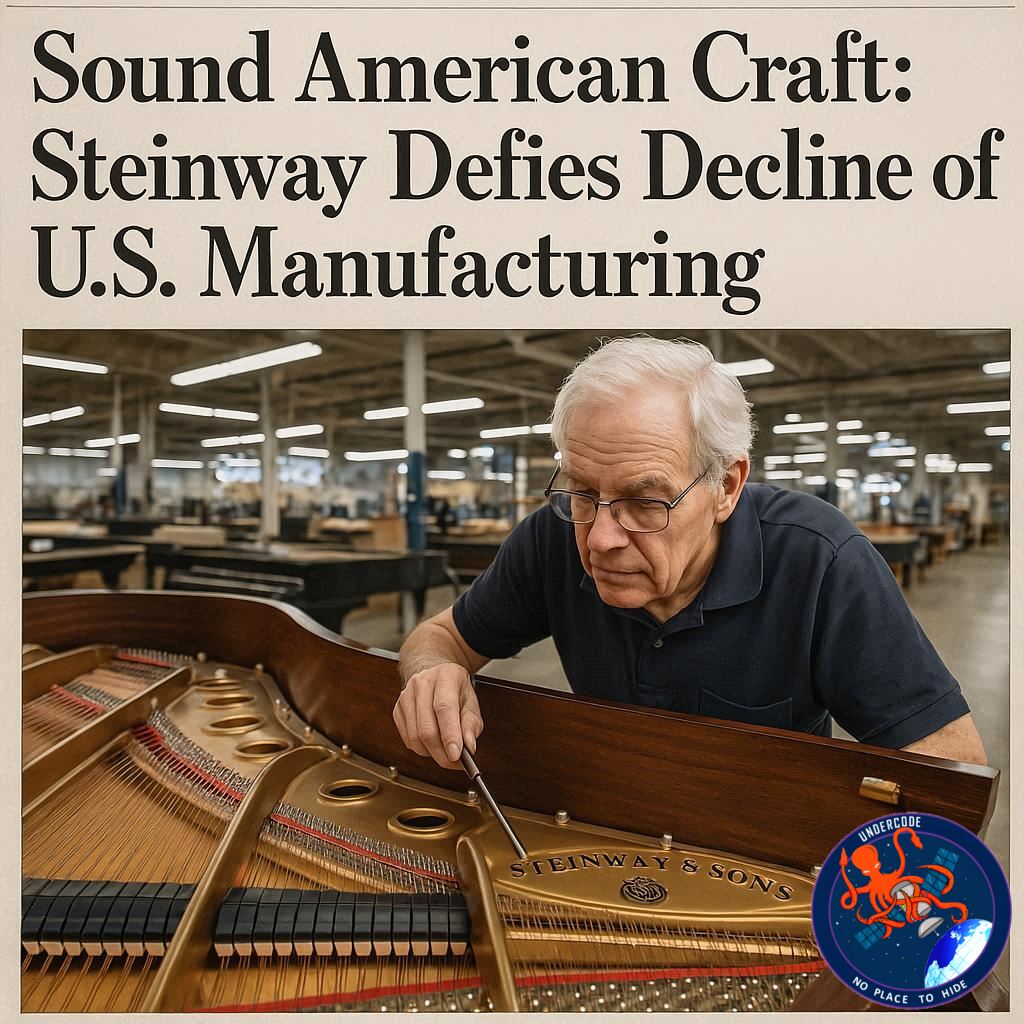
In a world dominated by automation and global supply chains, one company continues to prove that human craftsmanship still has a song to play. Inside a factory in Astoria, Queens, oversized crowbars bend wood to form the elegant rim of a piano, while skilled hands sand Sitka spruce soundboards until they gleam like glass. Hammers, chisels, and patience — these are the tools that have kept Steinway & Sons alive for more than 150 years.
For decades, this legendary piano maker has stood as a quiet symbol of what American manufacturing can still be — precise, personal, and profoundly artistic. While political leaders promise industrial renaissances and tariff battles rage, Steinway thrives not by cutting costs, but by elevating quality. Their grand pianos — priced from $90,000 to over $200,000 — aren’t built for mass markets. They’re built for concert halls, virtuosos, and dreamers who believe sound can have a soul.
A Handmade Symphony of Survival
At the heart of Steinway’s factory stands Bernard Craddock, one of 200 master craftsmen who have devoted their lives to the art of piano making. “Everybody has a specific job here,” he says, aligning a piano frame for precision hammer strikes. Each instrument takes nearly a year to complete, passing through dozens of skilled hands before it’s ready to sing. Only four or five pianos leave the factory each day — a pace that defies the modern obsession with mass production.
This dedication to quality is not a nostalgic indulgence; it’s the company’s survival strategy. As Steinway’s CEO Ben Steiner explains, “Unless you’re focused on quality and innovation, you’re not going to survive.” That philosophy has turned Steinway into a rare manufacturing success story in the U.S. — a business that doesn’t need to chase cheap labor or offshore production.
Economist Adam Hersh agrees. “They serve the highest market segments,” he notes. “They can charge a premium because what they make is irreplaceable.” Unlike steel or electronics producers squeezed by global price wars, Steinway has built its brand on emotion, heritage, and the irrefutable value of craftsmanship.
When Trade Wars Strike the Wrong Notes
Meanwhile, America’s broader manufacturing sector struggles to find harmony. President Donald Trump’s trade war — meant to revive U.S. industry — has instead left factories uncertain and cautious. The country lost 42,000 manufacturing jobs between April and August, as tariffs drove up the cost of raw materials like steel and aluminum.
“Businesses don’t like tariffs, but they can adjust,” says Hersh. “The problem is uncertainty.” That uncertainty freezes investments, halts hiring, and weakens confidence across industries that rely on predictable trade.
The White House insists its plan is a long-term play — to bring back every stage of production, from raw materials to finished goods. But the manufacturing landscape has changed. Robots now do much of the repetitive labor that once employed millions. Factories today require fewer workers but more expertise, a shift that mirrors Steinway’s own model: fewer people, greater skill, deeper pride.
Sustaining the Craft and the Craftsmen
Still, even a titan like Steinway faces its share of challenges. The company’s lifeblood — Sitka spruce, prized for its resonance — grows only in limited regions of Alaska. The slow-growing trees are becoming harder to find, threatening the consistency that gives Steinway pianos their unmistakable sound.
Yet, perhaps the greater challenge lies not in the wood, but in the hands that shape it. The factory’s survival depends on its artisans — many of whom have been perfecting their skills for decades. Training the next generation of craftsmen takes years, and that’s one reason Steinway has never left New York.
During the Great Depression and World War II, the company pivoted to building glider parts, just to keep its experts employed. “It not only kept the lights on,” recalls Steinway executive Anthony Gilroy, “it kept the valued craftspeople around.” Those “old timers,” as he affectionately calls them, trained the next wave of builders, ensuring that the company’s soul — its human touch — never faded.
As Steiner puts it, “You can’t replicate these skills. You can’t just open a factory somewhere else and expect the same result.” That loyalty to place and people makes Steinway a living museum of American artistry — not frozen in the past, but resonating into the future.
What Undercode Say:
Steinway & Sons represents a striking paradox in modern industry — proof that in the age of machines, human mastery still matters. The company doesn’t just sell pianos; it sells the legacy of craftsmanship itself. Each curve of wood and stroke of lacquer carries a story — not of efficiency, but of excellence.
From an economic standpoint, Steinway’s model defies typical business logic. In a world driven by scalability, it thrives on limitation. In a market obsessed with cost-cutting, it grows by refusing to compromise. Its success underscores a fundamental truth: luxury isn’t about scarcity of materials — it’s about scarcity of mastery.
This philosophy might not work for every sector, but it offers a lesson for American manufacturing: the future doesn’t belong to those who make the most; it belongs to those who make the best. The age of cheap goods and fragile supply chains has shown its cracks. What Steinway proves is that authenticity, quality, and purpose can still command both respect and profit.
Moreover, Steinway’s survival challenges the assumption that American manufacturing is doomed. It suggests a path forward where craftsmanship becomes a competitive advantage, where skill replaces scale as the core value. The company’s 11-month production cycle isn’t inefficiency — it’s devotion measured in time.
Yet, there’s a deeper cultural note here. The story of Steinway isn’t just about pianos; it’s about identity. It reflects a nation’s ability to still create, to value the art behind the object. In an era when algorithms compose symphonies and machines assemble instruments, Steinway reminds us that true sound — like true progress — still begins with human hands.
If policymakers looked closer, they might see that the future of manufacturing isn’t only in automation or tariffs, but in fostering craftsmanship, education, and pride. Steinway’s old factory in Queens may seem like an echo of the past, but it hums with a lesson about the future: quality endures, even when trends fade.
Fact Checker Results:
✅ Steinway & Sons has operated in Astoria, Queens since 1873.
✅ Each grand piano takes roughly 11 months to craft and costs between $90,000–$200,000.
❌ Trump’s tariffs did not notably impact Steinway due to its domestic sourcing.
Prediction 🎹
As automation continues to dominate global manufacturing, niche industries rooted in artistry — like Steinway’s — will gain prestige, not perish. Expect a growing appreciation (and market) for handcrafted goods as luxury consumers seek authenticity over mass production. In the next decade, “Made by Hand” may become the new “Made in America.”
🕵️📝✔️Let’s dive deep and fact‑check.
References:
Reported By: edition.cnn.com
Extra Source Hub (Possible Sources for article):
https://www.stackexchange.com
Wikipedia
OpenAi & Undercode AI
Image Source:
Unsplash
Undercode AI DI v2
Bing
🔐JOIN OUR CYBER WORLD [ CVE News • HackMonitor • UndercodeNews ]
📢 Follow UndercodeNews & Stay Tuned:
𝕏 formerly Twitter 🐦 | @ Threads | 🔗 Linkedin | 🦋BlueSky | 🐘Mastodon


