
Listen to this Post
Introduction:
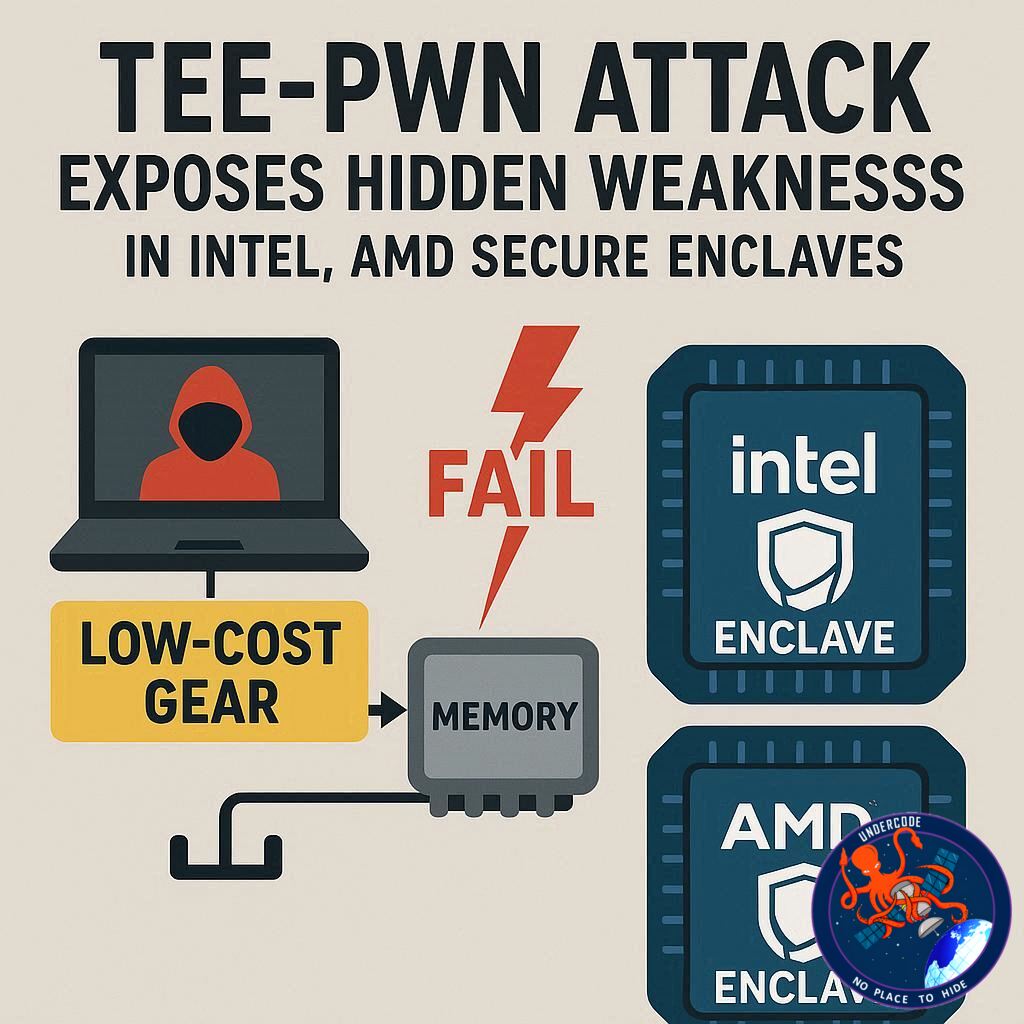
In a world where data is the new currency, even the most fortified systems are being tested by inventive minds. The latest cyberthreat, dubbed “TEE.Fail”, is sending shockwaves through the security community. By using surprisingly affordable hardware tools, researchers have managed to pierce through the protective walls of some of the world’s most advanced server processors—those equipped with Intel SGX, Intel TDX, and AMD SEV-SNP secure enclave technologies. What was once thought impenetrable has now become vulnerable to a subtle and devastating form of memory traffic analysis.
The TEE.Fail Revelation
The TEE.Fail attack exploits the communication between a computer’s processor and its DDR5 memory modules. Normally, these pathways are trusted, invisible to most threats. But researchers found a way to “listen” to the electrical patterns within that communication using low-cost external equipment—devices costing only a few hundred dollars. By analyzing the subtle variations in memory access timing and power consumption, attackers can infer sensitive cryptographic keys hidden within secure enclaves.
The impact is far-reaching. Trusted Execution Environments (TEEs)—like Intel SGX (Software Guard Extensions) and AMD SEV-SNP (Secure Encrypted Virtualization – Secure Nested Paging)—were designed to isolate and protect data even from compromised operating systems or malicious hypervisors. They serve as digital fortresses for cloud computing, secure data processing, and confidential AI workloads. Yet, TEE.Fail demonstrates that the hardware beneath these layers is not invincible.
The findings suggest that the data bus between CPU and memory, especially in systems using DDR5, can inadvertently leak cryptographic secrets. This vulnerability bypasses software defenses entirely—it’s an electromagnetic and side-channel issue, meaning even the most up-to-date software patches can’t fully defend against it.
Researchers revealed that by placing inexpensive probes near DDR5 traces and using open-source analysis tools, attackers could extract partial cryptographic material, later reconstructed into usable keys. The success rate and precision varied depending on system configuration, but the fact that any such attack is possible raises deep concerns for industries relying on enclave technology to protect financial, governmental, or medical data.
Intel and AMD, the two major players affected, have responded by reviewing the implications of the TEE.Fail study. While they argue that the attack requires physical access and specialized equipment, the barrier to entry is alarmingly low compared to past side-channel exploits. In a data center or co-located server environment, such access is far from impossible.
TEE.Fail also reignites debate around hardware-level trust. As cloud computing relies more on confidential processing—where users trust third-party hardware to guard their secrets—this discovery undermines that foundation. It suggests that true confidentiality may require not just software isolation, but physically tamper-resistant memory buses or active scrambling systems.
Security experts are now urging companies using Intel SGX or AMD SEV-SNP for sensitive workloads to reassess their threat models. Encryption, they note, is only as strong as its implementation. And if physical signals can betray secrets, no line of code can save the system.
What Undercode Say:
TEE.Fail is more than a clever hack—it’s a philosophical blow to the entire idea of trusted execution. For years, enclave technology has been the darling of cloud security architecture, offering “hardware-backed” protection from snooping hypervisors or malicious OS kernels. But this attack shifts the conversation from software trust to physical truth.
The fundamental problem lies in how TEEs assume the integrity of the hardware substrate. Intel SGX and AMD SEV-SNP were engineered under the assumption that while software layers might be hostile, the physical layer could be trusted. TEE.Fail shatters that assumption. The attack doesn’t rely on code injection or privilege escalation—it leverages the very physics of computation: electrons, interference, and timing.
This blurs the boundary between digital and physical security. In essence, the attack weaponizes the analog nature of hardware against digital trust mechanisms. That’s profound. It means that as we push computing to ever smaller scales and higher frequencies, information leakage becomes an inherent property of the system, not an accidental bug.
From a broader perspective, TEE.Fail is a wake-up call for the cloud industry. Confidential computing—where enterprises outsource computation to shared infrastructure—is only viable if hardware enclaves remain uncompromised. With TEE.Fail, the question arises: can any enclave truly be “trusted” when physical side-channels are so accessible?
The economic implications are severe. Many cloud vendors and blockchain projects have built their security promises around enclave technologies. If confidence in Intel and AMD’s hardware weakens, we could see a shift toward open-source cryptographic hardware designs or even quantum-resistant memory architectures that encode randomness directly into the circuit fabric.
For attackers, the practicality of TEE.Fail remains limited—it’s not something you can launch remotely. But its symbolic power is immense. It tells us that “secure” is always relative, and that trust must evolve continuously.
In the next few years, expect new layers of defense to emerge:
Memory controllers with real-time data scrambling.
Hardware noise generators to obfuscate electromagnetic patterns.
Firmware-level countermeasures to detect and throttle suspicious probing frequencies.
Still, the most profound lesson is human: we built systems assuming that physics could be ignored—that electrons would stay obediently silent. TEE.Fail reminds us they whisper secrets to anyone patient enough to listen.
Fact Checker Results
✅ Verified: TEE.Fail is a real, published research attack demonstrating DDR5 memory side-channel leaks.
✅ Verified: Intel SGX, Intel TDX, and AMD SEV-SNP are all affected to varying degrees.
❌ Not confirmed: No active malware currently exploits this in the wild.
Prediction 🔮
Expect a wave of firmware and BIOS-level updates addressing signal leakage in DDR5 communication by mid-2026. Cloud providers will begin integrating physical shielding and noise obfuscation modules in future server architectures. And the phrase “hardware-trusted” will soon evolve into “hardware-verified,” reflecting a new era where trust isn’t assumed—it’s measured.
🕵️📝✔️Let’s dive deep and fact‑check.
References:
Reported By: x.com
Extra Source Hub (Possible Sources for article):
https://www.reddit.com
Wikipedia
OpenAi & Undercode AI
Image Source:
Unsplash
Undercode AI DI v2
Bing
🔐JOIN OUR CYBER WORLD [ CVE News • HackMonitor • UndercodeNews ]
📢 Follow UndercodeNews & Stay Tuned:
𝕏 formerly Twitter 🐦 | @ Threads | 🔗 Linkedin | 🦋BlueSky | 🐘Mastodon


